

In the world of blockchain, 'privacy' has always been a contradictory demand. Traditional public chains like Bitcoin and Ethereum have all transactions publicly available—anyone can check your address, transfer amount, and transfer time. This is good for applications that require transparency, but it becomes a pain point for scenarios that need to protect sensitive information.
In the past, the solutions to this problem were 'fully private' coins like Monero and Zcash. Their technology is indeed powerful, able to completely hide transaction amounts, senders, and receivers. But this also brings problems: fully private tokens can easily be used for illegal purposes, facing regulatory crackdowns, and for legitimate needs that require 'proving something without disclosing everything', complete privacy can actually be of no help.
Midnight Network is attempting to take a middle path.
Selective disclosure: A new paradigm for privacy
Midnight's core innovation is called 'Selective Disclosure.' This concept sounds a bit abstract, so let me explain with a concrete example.
Suppose you need to prove that you are over 18 years old to participate in an event. The traditional method is to show your ID card—but this exposes your name, address, ID number, and other information. Using Midnight's zero-knowledge proof, you can only prove the fact 'age ≥ 18' without revealing any other personal information.
Another business scenario: A company needs to prove that it has sufficient cash flow to fulfill a contract but does not want to disclose how much money it has. Through Midnight's technology, it can generate a zero-knowledge proof that demonstrates the statement 'cash flow ≥ contract requirements' is true, while the specific numbers remain completely hidden.
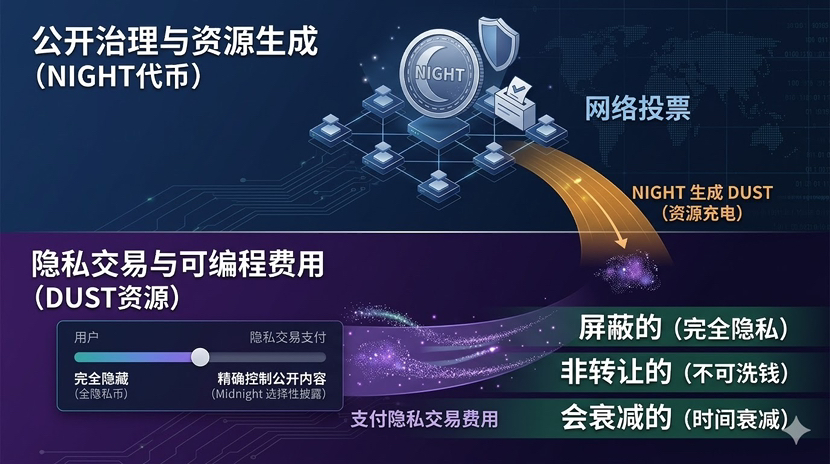
This is the meaning of 'programmable privacy'—you can precisely control which information is public and which is kept confidential.
Dual-token model: Separation of governance and privacy
Midnight adopts a unique dual-token design, which is relatively rare in the blockchain field.
NIGHT is a public governance and capital token. Holding NIGHT allows participation in network governance voting, while NIGHT will automatically 'generate' DUST—it's like 'charging' your privacy usage rights.
DUST is a special resource: it is shielded (completely private), non-transferable (cannot be transferred to others), and will decay (if not used, it will gradually disappear). The only use of DUST is to pay for privacy transaction fees.
The cleverness of this design lies in the fact that it tightly binds 'privacy usage' and 'holding tokens,' but at the same time differs from the traditional 'holding tokens to pay Gas fees' model. The non-transferable nature of DUST makes it less likely to become a tool for speculation or money laundering, which is more easily accepted at the regulatory level.
Technical foundation: Zero-knowledge proofs + Compact language
Midnight uses zero-knowledge proofs (ZKP) as its underlying cryptographic foundation. However, unlike traditional blockchain projects that use ZKP libraries directly, Midnight has developed a programming language called Compact, based on TypeScript, specifically designed for writing ZK smart contracts.
This lowers the barrier for developers—there's no need to deeply learn complex cryptographic knowledge; as long as you know TypeScript, you can write privacy contracts. This is important for the rapid development of the ecosystem.
Additionally, Midnight has mentioned Tensor Codes technology—this is a mathematical method related to AI GPU computing. The team believes that as AI hardware capabilities improve, the computational costs of zero-knowledge proofs will decrease significantly, and the costs of Midnight's privacy transactions will also reduce accordingly. This is an interesting 'future-proof' design.
Collaboration with Cardano
Midnight is a sidechain project of the Cardano ecosystem, co-developed by IOG (the Cardano development team) and Shielded. This means it can reuse some of Cardano's infrastructure, including bridging to Cardano's state.
Cardano's SPO (Stake Pool Operators) can participate in Midnight's block production without affecting their ADA operations. This provides Midnight with a ready-made decentralized validator network.
My viewpoint
Midnight's technological innovations are real—selective disclosure programmable privacy is a direction with clear demand, and compliance-friendly design is also prudent. However, good technology does not guarantee success. The history of privacy blockchains is filled with projects that were technically advanced but ultimately failed.
The key question is: who will come to use this network? Regular users or businesses? If it's businesses, are they willing to migrate to a new privacy chain or build their own? These questions will only have answers after the mainnet goes live.