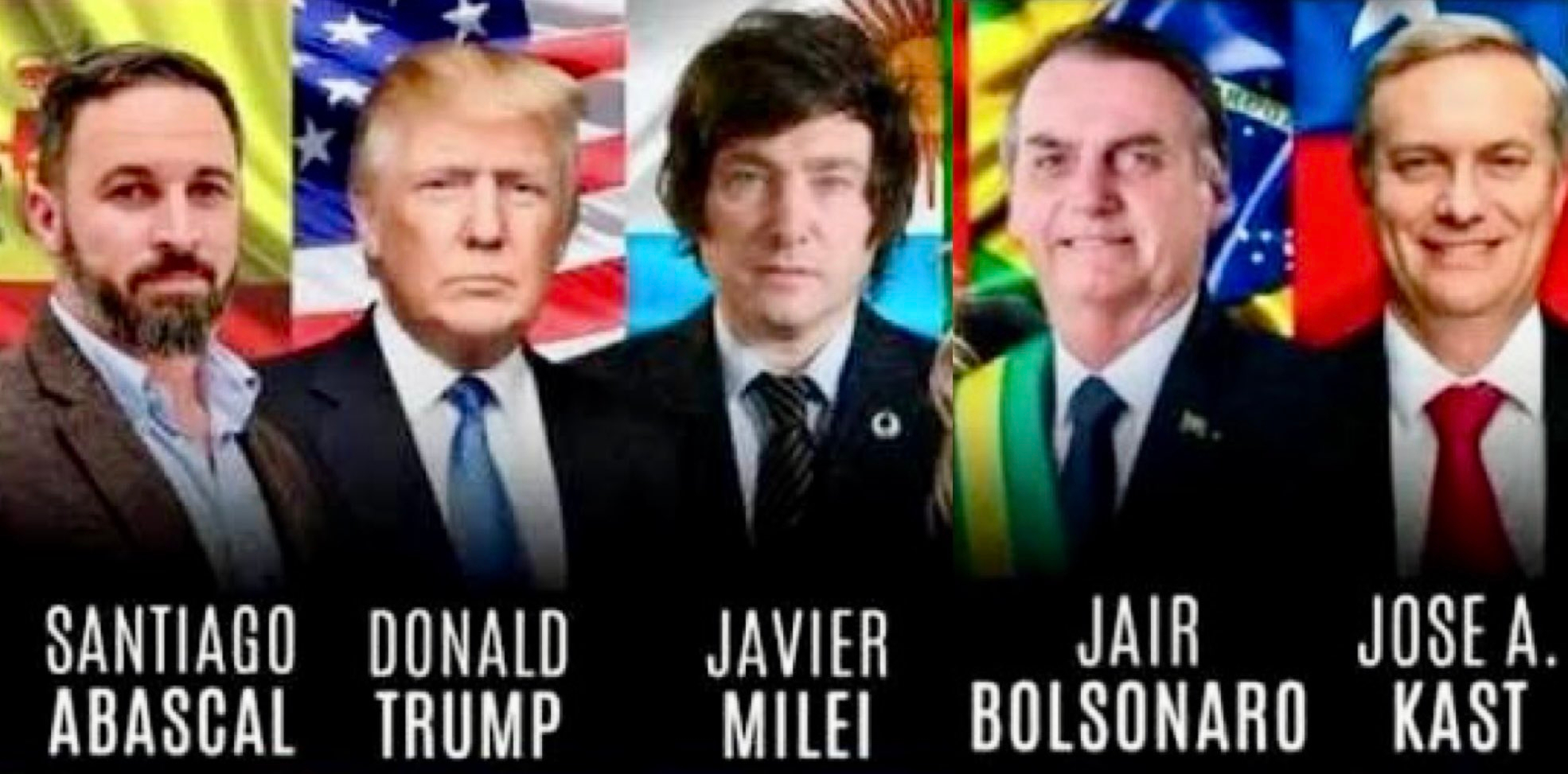
CULT OF BRAGGING
How the verbal poverty of certain leaders ended up becoming a political style, and a symptom of intellectual degradation.
There are times that produce statesmen and others that produce loudmouths. Ours, unfortunately, seems fascinated with the braggart: that character who confuses volume with intelligence, rudeness with authenticity, and outburst with bravery. Certain leaders are no longer required to think well, but to hit hard; not to argue, but to humiliate; not to elevate public conversation, but to drag it into the mud with the ease of someone who feels comfortable in it.
Javier Milei has made insult a verbal identity. Donald Trump turned expressive poverty into a trademark. Jair Bolsonaro made vulgarity a form of presence. Santiago Abascal resorts to a rough, primary, and binary rhetoric, where nuance is a threat. And José Antonio Kast, with a drier and less histrionic cadence, also exhibits a rhetorical precariousness that betrays conceptual narrowness: flat phrases, poor rhythm, scant argumentative density, and an alarming difficulty in taking language beyond the slogan. All of them, each in their own way, represent the same misery: that of thought reduced to slogans and politics lowered to outbursts.
Schopenhauer distrusted hollow grandiloquence and noise disguised as depth. Hannah Arendt insisted that thinking is essential to not abdicate judgment. And Jürgen Habermas argued that a healthy democracy depends on the strength of the best argument, not on the strength of the shout. That idea today seems like archaeology: we have moved from the better argument to the most viral loudmouth.
The problem is not aesthetic. It is not about asking for leaders with the diction of a Shakespearean actor. It is about something more serious: "speaking poorly, persistently, often reveals poor thinking." Language is not an adornment of thought; it is its architecture. When vocabulary shrinks, so does the ability to nuance, distinguish, compare, infer, and understand. And when that occurs in power, the entire society degrades its standards. The coarse leader not only exhibits his poverty: he makes it aspirational.
That is why their followers imitate the method. On social networks, this is seen daily. In the face of criticism, there is not a refutation, but a pack. The content is not debated: an offense is thrown. An idea is not countered: a disqualification is attempted. The troll is the perfect child of this era: he does not argue because he cannot; he insults because it suffices. And as digital banality rewards the brief phrase, the aggressive grimace, and the instant clip, the platforms end up being less a space for deliberation than a pedagogy of simplification.
The contrast with great leaders is brutal. Lincoln could condense in a few words a moral and political vision of our common destiny. Churchill understood that language was also resistance, and Mandela did not need to lower himself to convince, because his authority did not come from outbursts, but from intellectual stature. They all shared a fundamental conviction: to govern requires thinking, and thinking requires language.
Today, however, we have normalized the rustic loudmouth, the braggart with minimal vocabulary, the leader who insults because he cannot formulate an intelligent sentence, who simplifies because he cannot comprehend, and who bulldozes because he cannot persuade. And part of the public, exhausted or intellectually untrained, celebrates this indigence as if it were frankness. What a sad era: stupidity is no longer disguised; it is voted for, applauded, and shared.
Without thought, there is no deliberation. Without deliberation, there is no political community. And without dignified language, what remains is not authenticity, but regression. Braggadocio is not an anecdote of style: it is a disease of the public spirit.
In the end, the problem is not that they lack intelligence; the problem is that they have an excess of stupidity.