
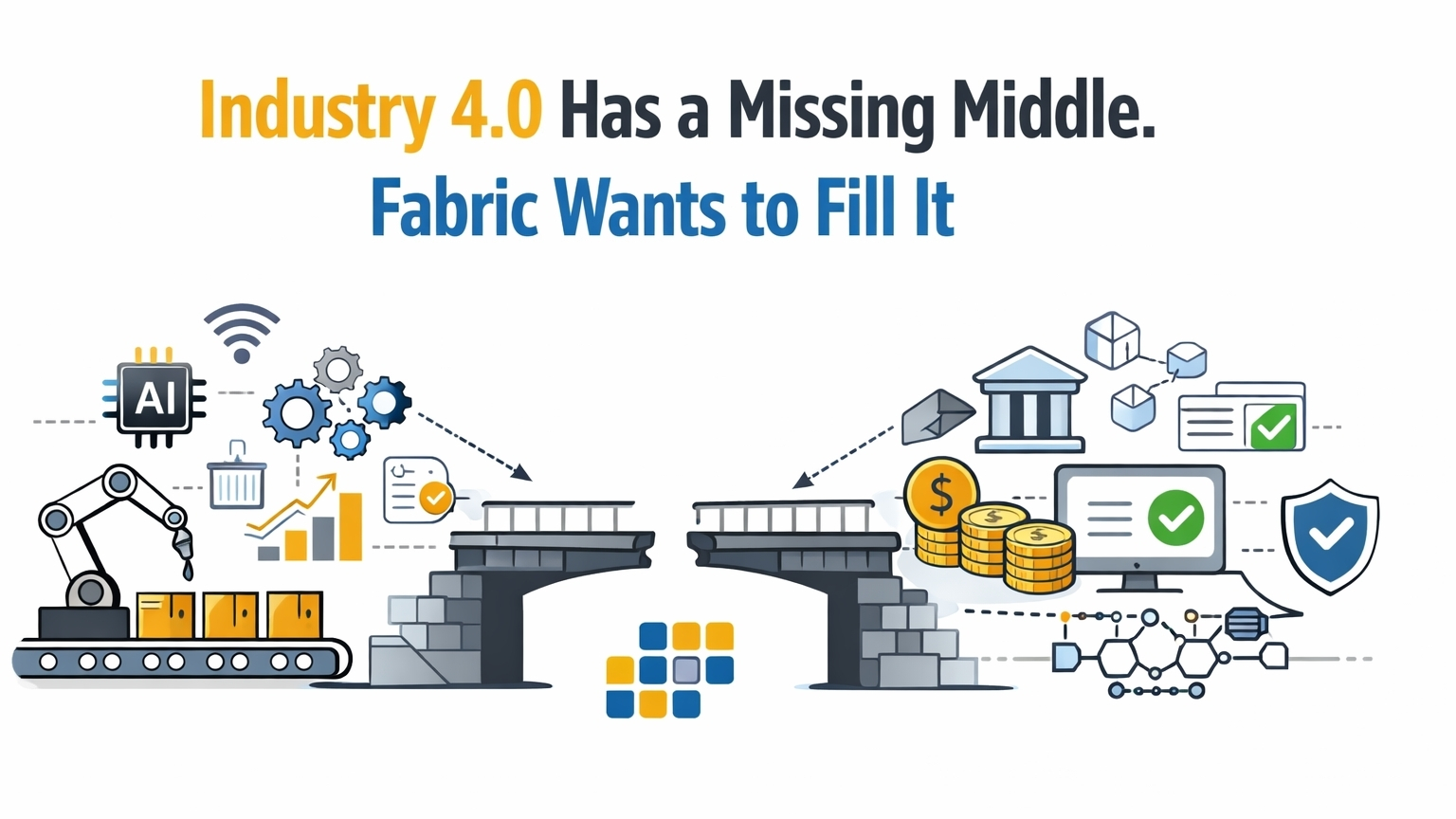
I remember the first time I saw a “smart” system fail in a very dumb way. It was not in crypto. It was in a warehouse. Boxes were stacked right. The scanners worked. The software dashboard looked polished. Trucks came in on time. On paper, it was smooth. In real life, one bad data handoff slowed the whole chain. A scanner logged the item. The payment system did not see it. The inventory app showed a delay that was not real. Staff started calling each other, then checking files by hand, then blaming the network. Same goods. Same machines. Same people. Just one broken link in the middle, and the whole setup went from “automated” to “held together by stress.” That scene comes back to me when I look at Industry 4.0 and the case for Fabric Foundation and ROBO. People like to talk about robots, AI, machine learning, smart factories, token rails. Fine. Those are useful pieces. But the ugly truth is this: most global systems do not fail because the robot arm cannot move. They fail because one system cannot trust, read, or act on what the other system just said. That is the dead zone. The gap between action and proof. Between event and value. Between “it happened” and “the rest of the network knows it happened.” That is where I think Fabric sits. Not as another glossy layer making noise about the future. More like the part that can make automation less fragile. The market, by the way, tends to ignore this kind of thing at first. It is easier to sell a flying robot than a data relay. Easier to hype a chain than explain how machines, apps, and payments need a middle layer to work together. But that middle layer is where real systems either hold up or crack. Suppose a city kitchen during rush hour. Orders come in from delivery apps, walk-ins, phone calls, and table staff. The cooks are fast. The food is good. But the tickets are coming in from four places, in four formats, with small errors and delays. One says “no onions.” One misses the note. One marks paid. One does not. The problem is not cooking. The problem is coordination. Without someone or something sorting the orders, checking the facts, and routing them cleanly, the kitchen turns into a mess with sharp knives. Global automation is not much different. Machines can do tasks. AI can score patterns. Blockchains can settle value. Sensors can report state. But none of that means much if the signal arrives late, arrives wrong, or arrives in a format the next system cannot use. That is why I see Fabric Foundation as a serious piece of this puzzle. It aims to serve as the connective logic between systems that were not built to trust each other from day one. And yes, this sounds less fun than moon-talk. Good. Useful things often do. The reason ROBO gets my attention is not because it waves the “future of everything” flag. I have seen too many projects hide weak design behind big slogans. What interests me here is the narrower question: can this network help turn disconnected industrial actions into shared, usable truth? That question matters in trade, logistics, robotics, supply chains, energy systems, even machine-to-machine service models. Say a robot in a factory completes a step. That act may need to trigger three things at once. It may need to update a record, release part of a payment, and signal the next machine. In old systems, those actions may sit in separate silos. One lives in factory software. One in a bank rail. One in a cloud app. Humans then patch the gaps. Email here. Spreadsheet there. A rushed call at 7:40 p.m. because a shipment status does not match the invoice status. People call that automation. I don’t. I call that expensive pretending. Fabric’s role, from my view, is to reduce that pretending. It tries to create shared coordination between systems that need to react to the same event. That may sound small. It is not. In big systems, small delays turn into real money leaks. One false reading can slow an order. One missing proof point can stall financing. One mismatch can force manual review. Then the whole “smart” stack looks a lot less smart. I think this is also where newer crypto users get tripped up. They assume value comes from the loudest narrative. AI token. Robotics token. RWA token. Choose your sticker. But labels are cheap. What matters is whether the protocol helps solve a real choke point. And in the case of industrial automation, the choke point is often not compute, not storage, not even hardware. It is trust between systems. Not emotional trust. Functional trust. Can one machine act because another machine sent a valid signal? Can software release value because a real-world step got confirmed? Can an outside party audit that process without begging five departments for screenshots? These are not sexy questions. They are still the right ones. I have a personal bias here. I trust infrastructure stories more than performance stories. If a project says it will “change everything,” I usually lean back. If it says it wants to help old systems and new systems work together with less friction, I lean in a bit. Not because that line is flashy. Because that is how the real world tends to move. Slowly. In layers. With old parts still bolted to new ones. And that is why Fabric makes sense to me as middleware for Industry 4.0. Not because it promises a clean reset. It does not need one. It aims to work in the messy middle where firms actually live. That middle is where adoption gets real. A shipping firm does not care about crypto poetry. A robot operator does not care about token memes. A plant manager wants fewer broken handoffs. Faster checks. Cleaner proof. Less time spent asking, “Did this actually happen or did the app just say it happened?” If Fabric can help answer that in a live system, ROBO has a stronger footing than many projects that get more attention. I think the next industrial wave will not be won by whichever tool shouts the loudest. It will lean on the layer that helps machines, apps, and value rails move from isolated action to coordinated action. That is a harder problem. Less glamorous. More important. So when I think about Fabric Foundation, I do not see a side story. I see the missing desk in the control room. The place where signals get checked, routed, and turned into something useful. Not magic. Not noise. Just the kind of middleware global automation has been missing for longer than people want to admit.
@Fabric Foundation #ROBO $ROBO
