

@MidnightNetwork #night $NIGHT
⭐ The emergence of the Midnight privacy foundation represents a fundamental shift in this architecture, bringing us closer to what is now referred to as "rational privacy". It is not about hiding information or creating a black box where rules do not apply; rather, it is about giving individuals and organizations the ability to choose what to reveal, to whom, and under what specific conditions. It is a middle ground that treats privacy not as an all-or-nothing switch, but as a programmable dial. In this new landscape, the project acts as the underlying connective tissue — a fourth-generation infrastructure — that allows participants to coordinate with a level of sophistication previously impossible in open blockchains. It enables a world where we can prove the veracity of a claim without ever exposing the underlying data that makes it true.
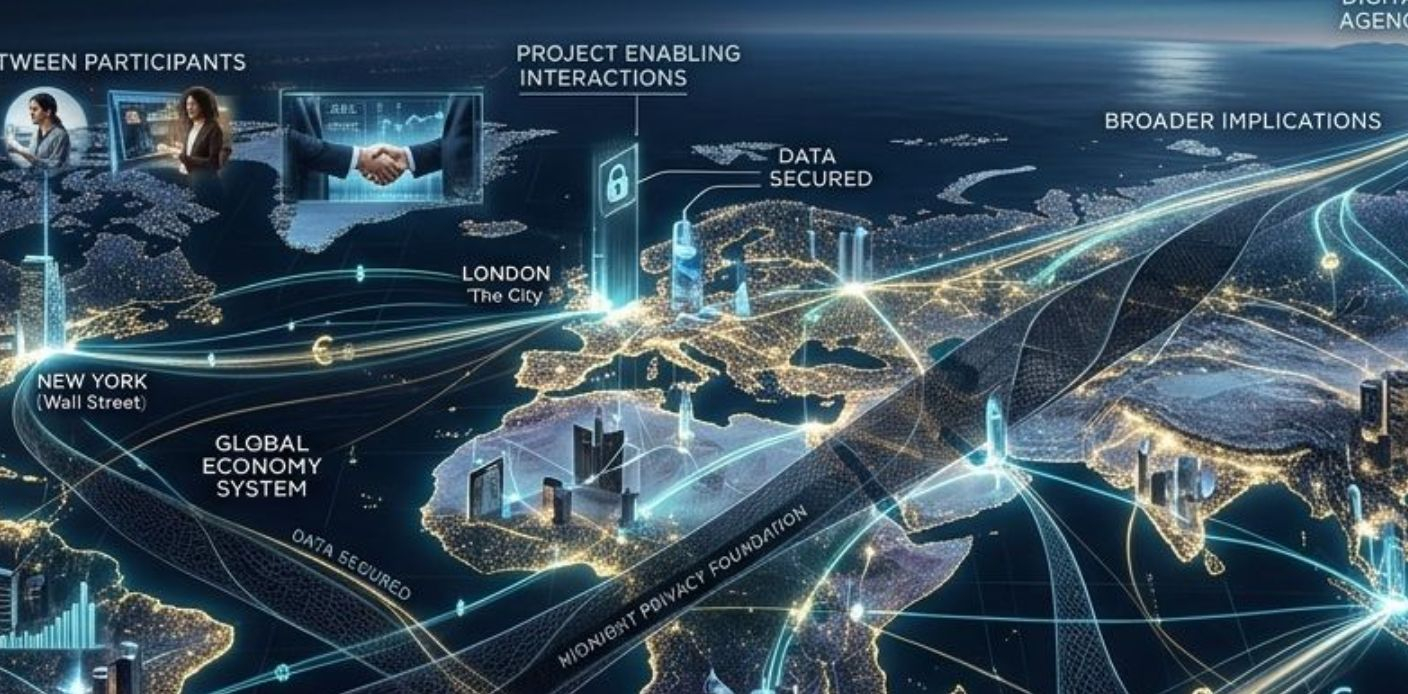 Imagine a global marketplace where coordination among participants occurs smoothly and invisibly. A provider can demonstrate that they have the inventory and regulatory capacity to fulfill a large-scale contract without revealing their internal pricing structures or their list of subcontractors to competitors. A bank can verify a user's solvency or identity without needing to access their social security number or their complete transaction history. In these interactions, Midnight acts as a silent and trusted mediator. It provides the mathematical proof — the 'handshake' of validity — while ensuring that the private information of the participants remains local and encrypted. This separation between consensus and data exposure allows the network to agree that a transaction is valid without needing to know the reason or the identity of the participants.#noche
The project achieves this through a dual-state architecture that separates the public governance ledger from the private execution world. By utilizing a dual-token system, where one asset, NIGHT, guarantees the transparent governance of the network, while another, DUST, drives private computations. The system ensures the stability of the economy and absolute privacy. It creates a "battery" effect for participation: by having a stake in the network, the energy necessary to manage private affairs is generated. This design eliminates the friction of high transaction costs and vulnerability to value leakage, allowing the system to adapt to the level of global institutions. The first signs of this adoption are already being observed as major telecommunications and financial companies begin to operate the infrastructure, signaling a departure from the stigma of the "dark web" regarding privacy and its recognition as a fundamental civic and commercial requirement.
When we consider the broader implications, we realize that we are witnessing a restructuring of the social contract for the digital age. This system restores the freedoms of association, commerce, and expression by eliminating the permanent shadow of surveillance that has loomed over the internet since its inception. It enables the tokenization of real-world assets, the secure exchange of health data, and the creation of private voting systems that are publicly verifiable. We are no longer forced to choose between a centralized world that protects our secrets but controls our access, and a decentralized world that grants us freedom but leaves us exposed. This foundation creates a space where these two ideals can finally coexist, turning the "glass house" of the global economy into a private and secure sanctuary that still remains connected to the world $NIGHT
