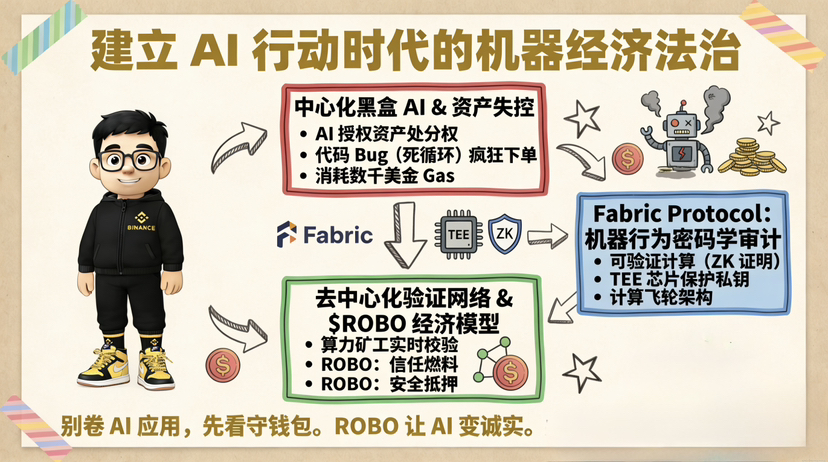
The day before yesterday, a friend of mine who does high-frequency trading encountered a moment of panic with an Agent. He authorized part of the API for a newly emerging fully automated strategy Agent overseas, and as a result of a code bug on the other party's server, that AI went into a logical dead loop, frantically placing orders and consuming thousands of dollars in Gas fees and transaction fees in just 15 minutes. This illustrates a brutal fact: when AI has the authority to dispose of your assets, if its operating environment is still a centralized black box, then this prosperity is essentially built on quicksand.
Following this pain point, you can understand why $ROBO (Fabric Protocol) has been so highly discussed recently on Binance. It is not creating a shell application that rides the hype; it is doing the dirtiest, hardest, but also the most valuable work in the AI era: establishing cryptographic audits for machine behavior.
From a technical perspective,@Fabric Foundation The most attractive underlying card of Fabric is verifiable computation. Current AI assistants might say they helped you buy low-cost chips, and you can only choose to trust them; but in Fabric's logic, every inference and decision made by AI must generate an immutable mathematical proof on a decentralized network.
In terms of specific implementation paths, Fabric cleverly combines TEE (Trusted Execution Environment) with a hybrid solution of ZK (Zero-Knowledge Proof). Traditional decentralized computing often falls into the quagmire of inefficiency, but Fabric constructs an architecture called the computing flywheel by deploying trusted nodes at the hardware level. In this system, the complex reasoning processes of AI assistants are confined to run within protected hardware enclaves, while the resulting execution traces are compressed into lightweight cryptographic proofs for network-wide notarization. This design not only solves the black-box trust issue but also physically shields against external malicious code sniffing, providing a hardware-level security barrier for AI to handle sensitive financial private keys.
Moreover, Fabric is not building a simple single-layer chain, but a layered sharding architecture specifically optimized for machine communication. It has thoroughly decoupled the verification and execution of instructions: the upper layer is responsible for high-frequency AI decision flows, while the lower layer processes the value settlement of $ROBO through a highly parallel consensus engine. This asynchronous verification mechanism allows the network to support thousands of Agents conducting second-level interactive audits simultaneously, without the task paralysis caused by network congestion like Ethereum. This underlying reconstruction tailored for the unique high-frequency, low-value, and high-security needs of Agent interaction is the technological moat that enables Fabric to stand as a foundational protocol in the AI era.
The network's verification nodes, meaning those real miners renting out CPU or GPU computing power, will verify this proof in real time: Is the logic compliant? Has the instruction been tampered with? Only through consensus across the network can AI's actions be finally released. This cross-validation directly removes AI from the risk of single-point server crashes.
Looking at the economic model of $ROBO , it has a very clear value capture path. The current circulating market value is about 125 million USD, while the 24-hour trading volume often exceeds 80 million USD. This extraordinarily high activity indicates that capital is crazily pricing its attributes as a liquidity provider.
ROBO plays the role of trust fuel here:
Essential consumption: Every audit of AI behavior requires paying ROBO to the verification nodes as computing power rewards.
Safe collateral: To become a high-privilege verification node, a large amount of $ROBO must be staked, which locks liquidity at the underlying level.
Of course, as a deep analysis, we must see the other side of the coin. The biggest potential risk for Fabric currently lies in delayed balancing. Adding a layer of decentralized auditing will inevitably sacrifice some response speed. In scenarios like flash loans or rapid purchases where milliseconds matter, are users willing to accept slight delays for absolute safety? This is the critical turning point for whether ROBO can transition from the lab to large-scale commercial use.
From a macro perspective, we are at the critical point of shifting from AI conversation to AI action. AI coins that can only draw pictures and write poems may just be fleeting, but foundational protocols like Fabric, which attempt to build a machine economy legal system, are the long-distance runners that can catch the next wave of institutional funding.
My judgment is clear: Don't get caught up in those AI applications that have already skyrocketed in valuation. Before the true explosion of AI Agents, first see who is helping everyone guard their wallets. The value of ROBO lies not in how smart it can make AI, but in how honest it can make AI.