
Today I went to drink coffee, my friend is a seasoned taster, and I am just a novice who is satisfied with casually ordering a latte.
After drinking the second cup, he held my cup, smelled it, took a sip, and smiled as he said: “This cup of yours is definitely not made from premium beans; the way you hold the cup and the aftertaste of the first sip can tell that.” I was stunned at the time. He didn’t even ask me which coffee shop I had been to, how many times I had bought beans, or how many times I had swiped my card; just from the way I held the cup and the action of taking the first sip, he instantly tagged me as an 'outsider' that I wanted to hide.
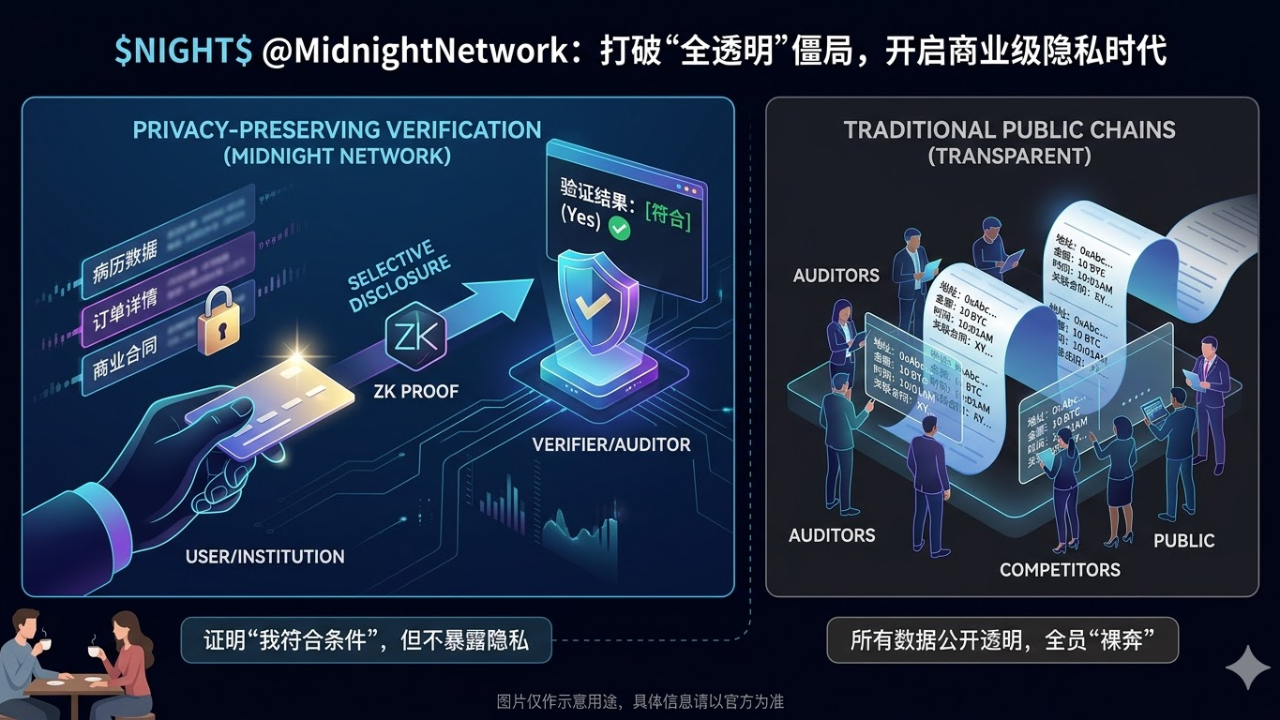
Isn't this the essence of selective disclosure? You only need to prove one thing to be true, and all other background stories can be hidden. Behind $NIGHT @MidnightNetwork , the white paper turns this concept into the underlying architecture of the blockchain: using ZK proof, you can prove to anyone that “I meet a certain condition,” but what the other party receives is only a yes/no result; as for how you meet it, there is not a trace left. The transparency of existing public chains is at the level of 'bare running'. When you make a transaction, the address, amount, time, and even every interaction related before and after can be clearly traced by the whole world.
Privacy? Non-existent. Imagine a law firm executing client contracts on-chain; the competing firm next door could know who they signed with, how long the confidentiality clauses are, and where the payment nodes are the very next day. This kind of "full transparency" is not a moat in the business world; it is a self-destruct mechanism. Midnight thoroughly separates verification and disclosure: legality can be publicly proven, while sensitive details always remain local. It uses ZK-SNARKs, where the prover holds private data to generate a very small proof, and the verifier only needs a few milliseconds to check if this proof is correct, without needing to see the original data. This asymmetry of "knowing vs. verifying" is simply a natural business barrier. The white paper cites several examples that particularly excite me:
Medical data sharing: Hospitals prove that patients meet the enrollment criteria for a certain clinical trial without having to throw all medical records, genetic reports, and allergy histories on-chain at once;
Supply chain financing: Factories prove they have real orders and inventory without exposing who the downstream customers are or what the purchase prices are;
Insurance claims: Users prove that the accident meets the compensation terms without having to publicly disclose their dashcam footage, hospital invoices, or even GPS tracks.
The common point of these scenarios is: the need to "prove I can", but absolutely not to "reveal everything about me". What I admire most about Midnight is not that it takes privacy to the extreme, but that it finally allows "compliance" and "on-chain" to no longer be adversaries. In the past, traditional institutions stubbornly refused to go on-chain, not because they hated blockchain, but because regulatory requirements demanded they maintain control and confidentiality over certain data. The public chain's "everyone can see" completely blocked this path. Midnight gave them a way out: what regulators need to see can be submitted with ZK proofs; business secrets never leave the corporate firewall. Institutions can satisfy audits while protecting their core competitiveness.
If this path is successful, the real user base of Midnight is not us retail investors who browse DeFi every day, but those banks, insurance companies, and supply chain giants that hold vast amounts of real assets and have always wanted to use blockchain but were scared off by transparency. This market is terrifyingly huge, but the entry barrier is also high — slow decision-making, strict due diligence, and pilot cycles measured in years. I still can't guarantee whether it can truly pry open this door.
The Compact language makes writing contracts as simple as writing TypeScript, which indeed lowers the barrier for developers; however, from getting the code to run to enterprises daring to switch their real production environments over, there is still a long way to go that requires time, trust, and real cases to fill the gap. After finishing the coffee, he helped me order another cup of premium beans and said, "Next time I will teach you how to hold the cup and smell the aroma, so you won't be seen through at a glance." Midnight is actually doing the same thing — it doesn't require you to reveal all your cards, just that you can prove the most critical statement, "I meet the conditions."
As for whether it can truly bring this mechanism into the traditional business world, I have no answer now. But just like before finishing my coffee, I also didn't know what I would order next.