
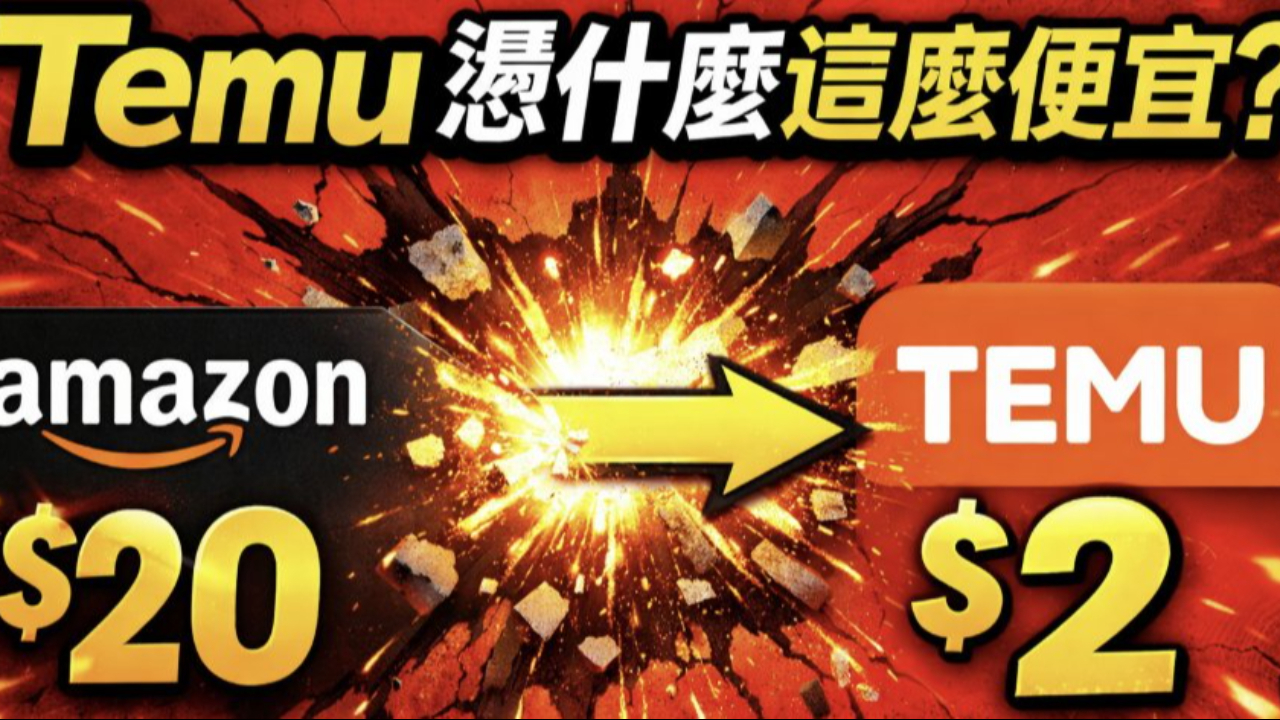
The business war behind a 'price revolution'
If you've been scrolling through social media lately, it's almost impossible not to have seen Temu's ads.
"Shop like a billionaire."
"Only 1 dollar."
"Worldwide free shipping."
In just two years, this platform has transformed from being almost unknown to one of the highest downloaded shopping apps globally.
In the United States, Europe, and Asia, Temu has sparked a huge price war.
But many people actually have a question in their hearts:
Why can Temu be so cheap?
How did it sweep the global market?
Behind this is actually a very sophisticated business strategy.
One, the birth of Temu: Pinduoduo's global plan
Temu's parent company is Chinese e-commerce giant PDD Holdings (Pinduoduo).
Pinduoduo's rise in the Chinese e-commerce market is itself a miracle.
Founded in 2015.
In just a few years, its market value has surpassed JD.
And the core of Pinduoduo's success is summed up in one sentence:
Drive prices to the extreme.
In the Chinese market, they use the 'group buying model' to lower costs, making products cheaper than Taobao.
But the problem is:
Competition in the Chinese market has become too fierce.
So Pinduoduo made a decision:
Move this model to the global stage.
Thus, in 2022,
Temu was born.
Two, Temu's core weapon: extreme low prices
Temu's biggest feature is its unbelievably low prices.
You might see:
Phone case: 1 dollar
Headphones: 3 dollars
Clothes: 5 dollars
Many products are even cheaper than Shein, Amazon, and AliExpress.
Why?
There are three reasons.
1 Directly connect to factories
Temu's supply chain model is very straightforward:
Factory → Platform → Consumer
No brand owners.
No agents.
No distributors.
All intermediate costs have been cut out.
This model is called in China:
C2M (Customer to Manufacturer)
It means:
Consumer demand → Directly linked to factory production.
So prices can be driven very low.
2 Platform subsidies
Another reason is:
Temu is 'burning money.'
To seize the market, Temu actually heavily subsidizes product prices.
The price of many products is even:
Below cost.
The reason is simple.
First, seize the market.
After users become accustomed, prices will gradually rise.
This is actually a strategy used by many tech companies.
For example:
Uber
Amazon
TikTok
3 Advantages of the Chinese supply chain
China's biggest advantage is:
Manufacturing capability.
A large number of products are originally produced in China.
Temu simply connects these factories directly to the global market.
In other words:
It does not create the supply chain.
But rather reallocating the supply chain.
Three, Temu's explosive growth
Temu's growth rate can be said to be one of the fastest in e-commerce history.
Launched in 2022
2023 saw explosive downloads
In just one year:
More than 200 million downloads
Ranked number one in the US App Store.
Even at one point exceeding:
Amazon
TikTok
Instagram
Temu's marketing strategy is very aggressive.
1 Extremely high advertising expenditure
Temu has spent billions on advertising in the United States.
Super Bowl
YouTube
TikTok
Instagram
Temu is everywhere.
According to market estimates:
Temu's daily advertising expenditure
Reaching millions of dollars.
2 Community viral growth
Temu also heavily uses 'community viral growth.'
For example:
Invite friends
Draw free products
Group buying discounts
This is actually the play that Pinduoduo is best at.
Rapid dissemination through social relationships.
3 Gamified shopping
Temu has also turned shopping into a 'game.'
For example:
Turntable
Discount treasure box
Limited time countdown
These designs will encourage consumers to continuously open the app.
In psychology, it is called:
Variable Reward Mechanism
Similar to gambling mechanisms.
Four, the war between Temu and Shein
One of Temu's biggest competitors is Shein.
The two are actually very similar.
But there are key differences.
Shein
Mainly:
Fast fashion
Core product:
Clothing
Supply chain:
Rapid production
Temu
Mainly:
All-category e-commerce
Product range:
Home
Electronics
Clothing
Tools
Toys
Almost everything.
So many people call Temu:
Super cheap version of Amazon.
Five, why does Temu make Amazon nervous
The emergence of Temu has made Amazon very alert.
The reason is:
Temu has changed the price structure.
On Amazon:
Product prices usually include:
Brand fees
Storage fees
Logistics fees
Platform fees
But Temu directly drives these to the lowest.
So the price may only be:
30%-50% of Amazon's prices.
For many consumers:
Cheap is king.
Six, Temu's controversies
Of course, Temu's rapid growth has also come with many controversies.
1 Product quality
Many people criticize Temu:
Quality is unstable.
Because the price is too low.
Some product quality may not meet expectations.
2 Logistics time
Most of Temu's products are:
Direct shipping from China.
So logistics time is usually:
7-15 days.
Not like Amazon's 2-day delivery.
3 Regulatory pressures
Governments in Europe and America are also starting to pay attention to Temu.
Including:
Data security
Tariff issues
Supply chain transparency
More regulation may come in the future.
Seven, how far can Temu go?
This is a question many people are asking.
Temu's model actually relies heavily on:
Low cost + subsidies.
But in the long run:
Subsidies cannot last forever.
So Temu's future may see three scenarios.
Scenario one: Become a new e-commerce giant
If Temu successfully establishes brand and user habits.
It may become a global e-commerce platform like Amazon.
Scenario two: Price advantage disappears
If subsidies decrease, prices will rise.
Consumers may return to other platforms.
Scenario three: Regulatory constraints
If governments start to restrict cross-border e-commerce.
Temu's expansion speed may slow down.
Conclusion
Temu's success is actually not coincidental.
It combines three key factors:
Chinese supply chain
Extreme low price strategy
Aggressive marketing
These three things combined form a very powerful business machine.
But at the same time, Temu also represents a new problem:
When global e-commerce enters 'extreme price competition',
Brands, quality, supply chain, regulation,
Everyone will start to reshuffle.
In the next ten years, the e-commerce world is likely to split into two camps:
On one side is
Brands and quality.
On the other side is
Extreme low prices.
And Temu is one of the core players in this war.
