
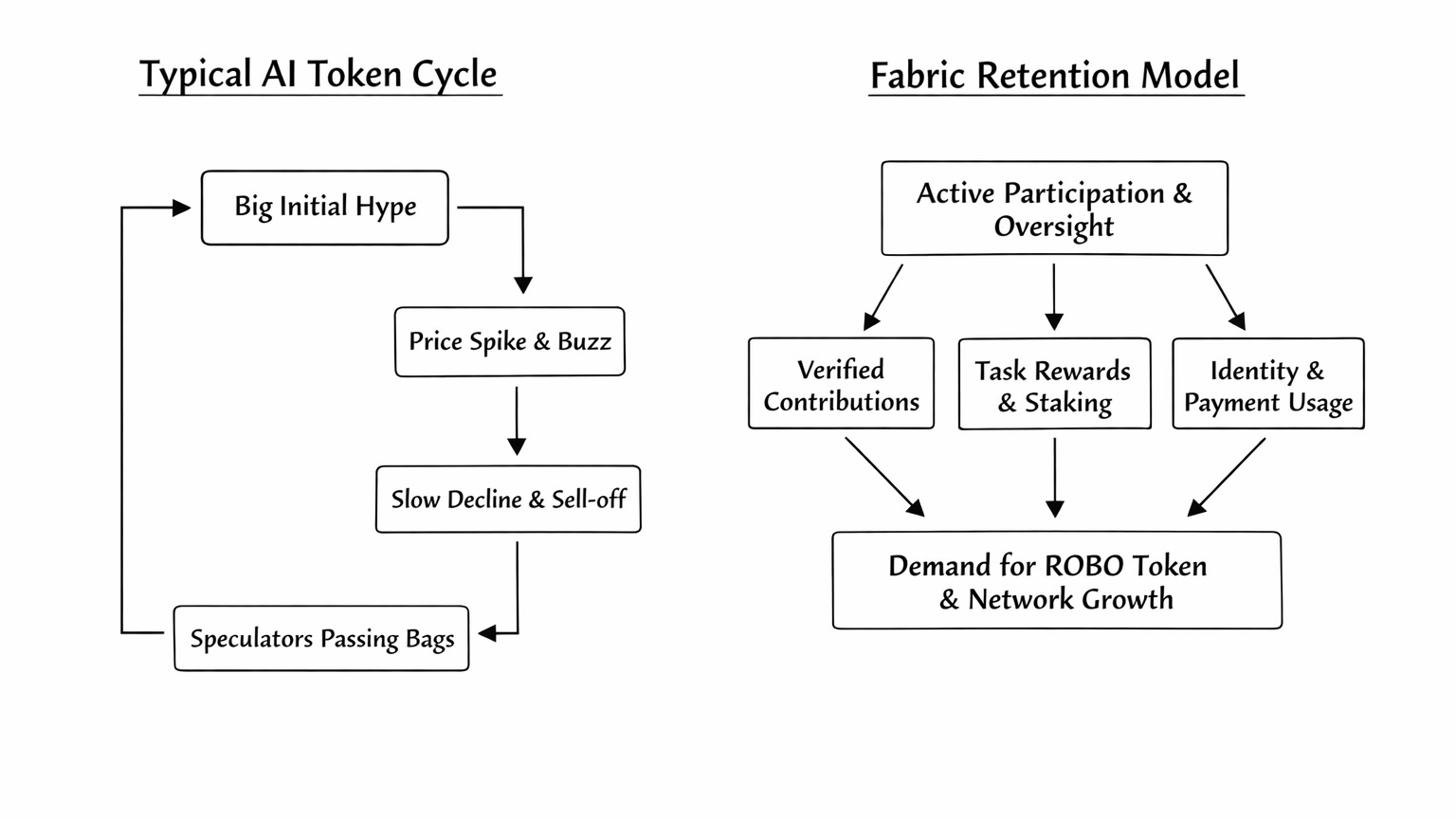

I remember staring at a watchlist a few nights ago after yet another AI token had done the usual thing. Big first move, loud timeline, then the slow bleed when nobody had a reason to stick around except hoping for the next bounce. That was the frame I carried into Fabric. I did not come to it thinking about machine ethics. I came to it like a trader looking for the leak in the story. Where does attention fade? Who actually stays? What keeps a market from becoming a one-week rental? The more I read Fabric’s whitepaper and token design, the more it changed how I think about ethics in this corner of the market. Not as a soft idea. As a retention mechanism.
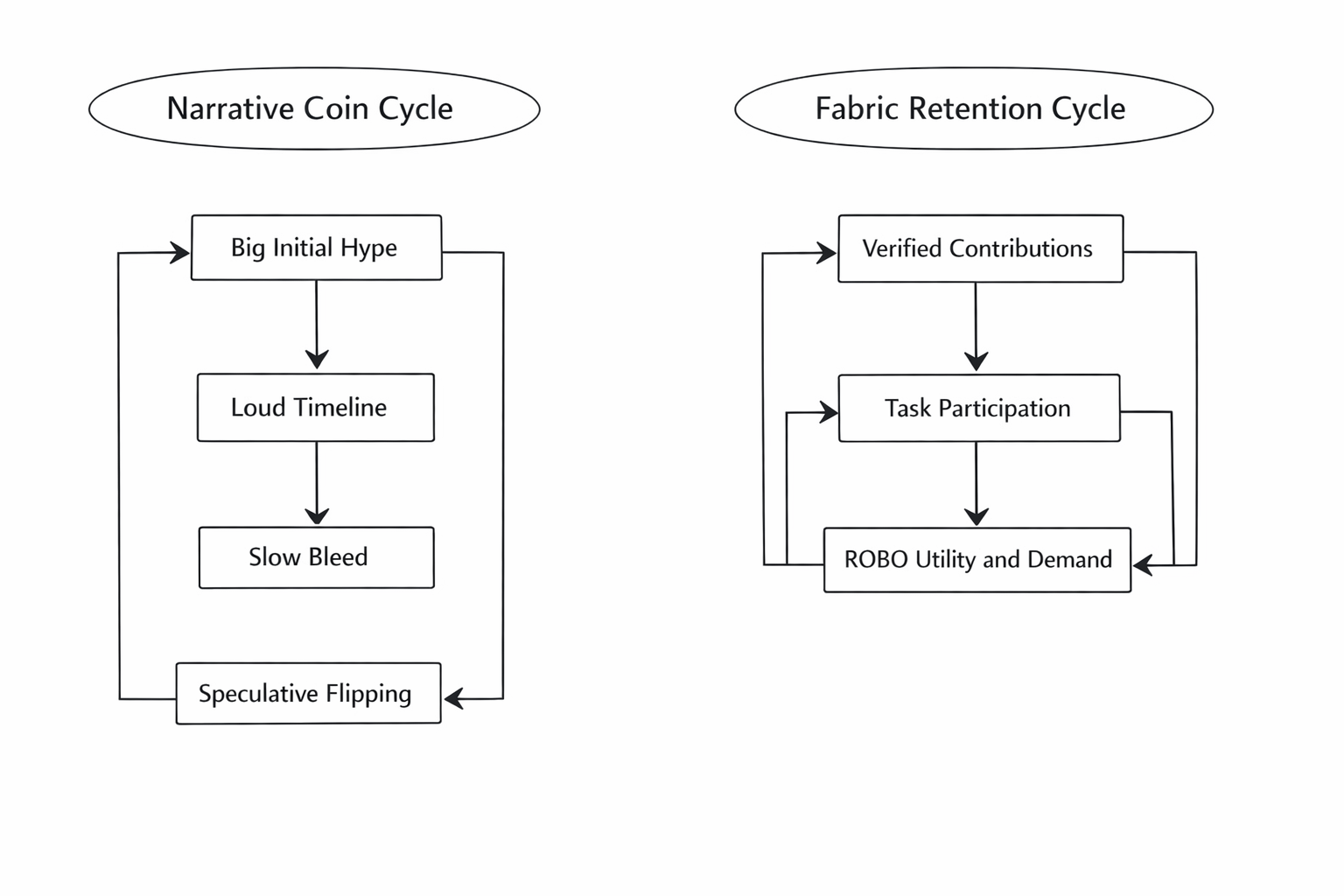
That is the part I think a lot of investors miss. Fabric is trying to make machine behavior observable, criticizable, and economically legible. Its core pitch is not just “robots onchain.” It is that data, computation, and oversight should sit on public ledgers so humans can contribute, evaluate, and be rewarded. The whitepaper even sketches a “Global Robot Observatory,” where humans observe and critique machine behavior, especially around edge cases. Think of it like moving ethics out of a policy PDF and into a feedback loop that can actually be tracked. For traders, that matters because systems with visible feedback loops tend to produce stronger user habits than systems built only on abstract future promises.
Here’s what changed my view. I used to think machine ethics was mostly a regulation story. Important, yes, but too fuzzy to price. Fabric made me look at it more like market structure. If a network gives users, developers, operators, and reviewers a reason to keep interacting after launch, that can support retention in a way most narrative coins cannot. Fabric’s own design keeps leaning into active participation. The whitepaper is explicit that rewards are tied to verified contribution, that participation units only create operational benefits if you actually engage, and that passive holding alone is not the point. That is not just legal framing. It is a clue about how they are trying to engineer repeat involvement instead of idle spectatorship.
Why does that matter? Because retention is the real filter. I do not care how clever a token sounds on day three if by day thirty the only remaining activity is traders passing bags to each other. Fabric at least has a theory for keeping people in the loop. Fees for payments, identity, and verification are meant to be paid in ROBO. Builders are expected to buy and stake ROBO to participate. Some protocol revenue is designed to be used to acquire ROBO on the open market. And participation during robot activation is linked to priority access for actual task allocation, not just symbolic community points. In plain English, they are trying to connect ethics, usage, and token demand into the same circuit. That is more interesting to me than another AI chart with no durable reason for users to come back.
Still, I would not romanticize this. The tradeoff is obvious. Fabric’s model is ambitious enough that it may outrun real user behavior for a while. An observability layer sounds good on paper, but there is a huge difference between saying humans can critique machines and building a market where enough qualified humans do that consistently. Retention cuts both ways. If contributors do not stick, if robot activity stays more conceptual than real, or if oversight becomes too narrow and insiders dominate it, the ethics layer stops being a moat and starts looking like branding. The whitepaper itself flags governance risk and says early decision-making may involve a limited set of stakeholders. That is not a small issue.
The current market data is why I am interested but not fully sold. ROBO’s live market cap is around $90 million, with roughly 2.231 billion tokens in circulating supply, while Etherscan shows over 41,000 holders. That tells me the market has definitely noticed it. But attention is not the same as retention. A token can collect holders quickly and still fail to build repeat, non-speculative usage. I am watching whether holder growth is followed by actual recurring participation around staking, governance, builder entry, and whatever early robotic work verification looks like in practice. If those loops do not thicken, then the ethics angle remains intellectually interesting but economically thin.
What would change my mind either way is pretty simple. Bullish, I want to see evidence that Fabric’s ethical architecture produces repeat behavior, not just nice language. More contributors returning, more verified work, more real demand for identity, payments, and coordination. Bearish, I would back off fast if the token keeps trading hot while the participation layer stays shallow. I have seen that movie too many times.
If you’re eyeing this, do not buy the headline and call it research. Track the retention. Track whether machine ethics on Fabric becomes something users actually do, not something holders merely quote. That is the trade. Watch the loop, not the slogan, and act before the crowd realizes which one matters.
@Fabric Foundation #ROBO $ROBO
