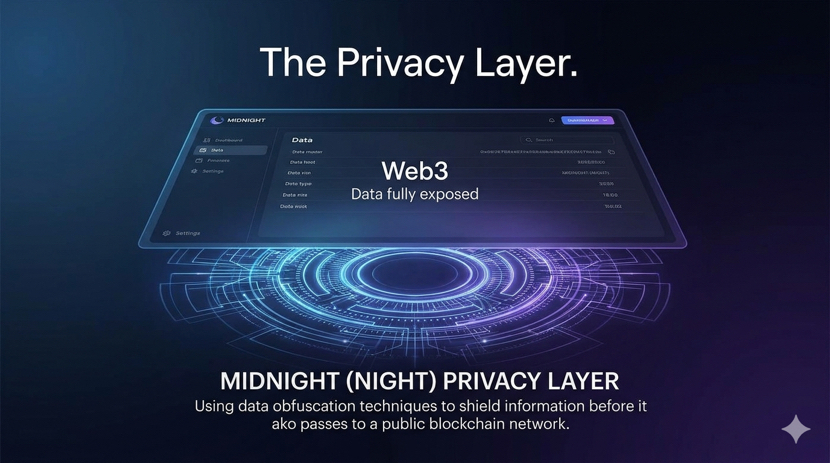
If you’ve been around crypto long enough, you know the pattern: a new blockchain launches, promises scalability or speed, and then fades into the background once the hype cycle moves on.But Midnight (NIGHT) is trying something different. Instead of competing on raw transaction speed or gas fees, it’s focused on something the industry has struggled with for years — privacy that still works with regulation.
And recently, the project has been moving from theory to real infrastructure.
Why Midnight Exists in the First PlacMost public blockchains are completely transparent. That transparency is useful for verifying transactions, but it creates a major problem: everything is visible.
Wallet balances
Transaction history
Smart contract interactions
For personal payments this might be acceptable, but for businesses, healthcare systems, financial institutions, or governments, it’s not.
That’s where Midnight comes in
Midnight is designed as a privacy-focused blockchain connected to the Cardano ecosystem, allowing applications to handle sensitive information while still proving that transactions are valid.Instead of hiding everything or exposing everything, Midnight tries to strike a balance: data can remain private, but proofs of correctness are still public.
The technology behind this is zero-knowledge proofs, which allow someone to prove something happened without revealing the underlying data.
In simple terms:
• You can prove compliance without revealing internal data.
• You can verify identity without exposing personal details.
• You can confirm a transaction without showing the entire record.
The Architecture: A Privacy Sidechain to Cardano
Technically, Midnight operates as a sidechain connected to the Cardano ecosystem.
This design allows it to offload privacy-heavy computations away from Cardano’s main chain while still benefiting from its security model.
Key technical features include:
• ZK-SNARK cryptography for privacy verification
• Compact smart contract language designed for developers familiar with TypeScript
• Cross-chain compatibility so privacy tools can eventually be used across different networksThe idea is that developers will be able to build decentralized applications where sensitive data stays private by default, but can be selectively revealed if needed.The project calls this approach “rational privacy.”
The Dual Token Model: NIGHT and DUST
One of the more interesting design decisions in Midnight is its two-token economic model.
Most blockchains use one token for everything:
governance, gas fees, staking, and security.
Midnight separates those roles.
NIGHT
• Governance and value token
• Tradeable on exchanges
• Used to participate in network decisions
DUST
• A shielded resource generated by holding NIGHT
• Used to pay for private transactions on the network
This structure helps reduce volatility in transaction costs and maintains privacy for operational payments.
The Roadmap Is Moving Toward Mainnet
The biggest current development around Midnight is that the project is transitioning from token launch to actual infrastructure deployment.
The network is currently moving through a series of phases:
Hilo Phase
• Establish liquidity and distribution of the NIGHT token
• Ensure exchange accessibility and ecosystem awareness
Kūkolu Phase
• Launch of the federated mainnet
• First production-level privacy applications begin deploying
Mōhalu Phase
• Greater decentralization
• Cardano stake pool operators join as validators
• Staking incentives introduced
The federated mainnet launch is expected around March 2026, marking the moment the network begins running real applications instead of only test environments.
Token Distribution and Community Growth
One reason Midnight gained attention quickly was its massive distribution campaign.Through the “Glacier Drop” program, more than 4.5 billion NIGHT tokens were distributed across multiple blockchain communities, reaching millions of wallets across different ecosystems.
The goal was simple:Instead of concentrating tokens among insiders, Midnight tried to create a wide base of early users and developers.This distribution strategy helped the project build early liquidity and exchange listings.
Market Performance and Volatility
Like most new crypto assets, NIGHT’s price has been volatileAfter launching and listing on major exchanges, the token surged roughly 188% in its early trading period, before cooling down as supply entered the market.Recently, the token has traded around $0.04–$0.05, with a market capitalization in the hundreds of millions.One factor influencing price pressure is the gradual unlocking of previously distributed tokens, which could continue through 2026.Enterprise Interest Is Already Emerging Another interesting development is the list of organizations involved in early infrastructure.Reports suggest potential node operators and infrastructure partners include companies such as:
• Google Cloud
• Vodafone
• MoneyGram
• eToro
These partnerships are meant to provide enterprise-grade validation infrastructure for the early network phases.If these integrations materialize fully, Midnight could position itself as the privacy layer for enterprise blockchain applications.Why Some Developers Are Paying Attention Developers are watching Midnight for one main reason:
Programmable privacy.The blockchain industry has struggled with privacy solutions that are either:
• Too complicated to build with
• Too restrictive for compliance
• Or completely opaque for regulators
Midnight tries to solve that by letting developers choose what data stays private and what becomes verifiable.If that approach works in practice, it could unlock new use cases in:
• Financial compliance systems
• Identity verification
• Supply chain confidentiality
• Medical data management
• enterprise DeFi
The Big Question: Can It Gain Real Adoption?Right now Midnight sits in an interesting position.The technology concept is compelling.
The distribution was massive.
The roadmap is progressing.
But the real test will come once the mainnet launches and real applications begin running on it.
If developers actually build meaningful privacy-preserving applications, Midnight could become one of the most important infrastructure layers in the Cardano ecosystem.
If not, it risks becoming another technically impressive blockchain that never found product-market fit.Midnight isn’t trying to replace Ethereum or Solana.Instead, it’s trying to become something different:A privacy engine for Web3, where data protection and compliance can coexist.And if the upcoming mainnet launch delivers on its promise, NIGHT could quietly become one of the more interesting infrastructure tokens of the next cycle.