

The past eleven years have shown that Bitcoin has demonstrated strong resilience in responding to random intercontinental submarine cable failures, but it may be affected by targeted attacks.
According to a study released earlier this year, nearly three-quarters of submarine fiber optic internet cables (which carry about 99% of international internet traffic) would need to fail simultaneously to have a significant impact on Bitcoin.
Wu Wenbin and Alexander Neumueller from the Cambridge Centre for Alternative Finance stated in a study published in February and last revised on March 12 that they used P2P network data from 2014 to 2025 and 68 verified cable failure events, employing a national-level cascading model to assess the resilience of Bitcoin's physical infrastructure.
They stated that this is the first long-term study on Bitcoin's resilience to submarine cable failures, which helps answer the long-term question of "What happens to Bitcoin if the internet goes down?"
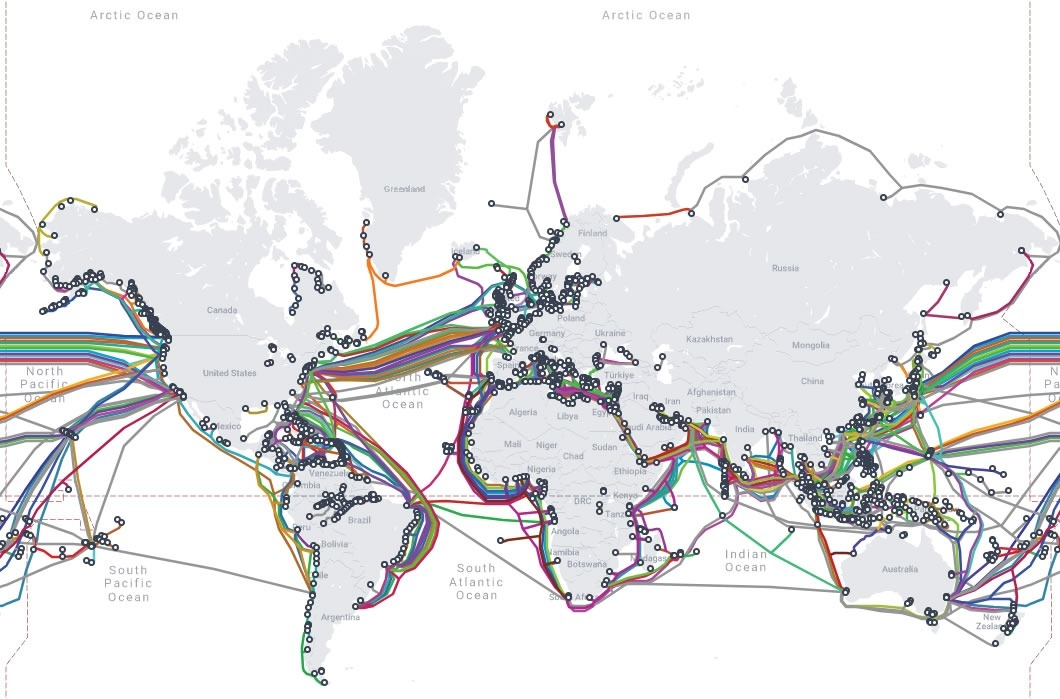 Submarine cable distribution map. Source: SubmarineCableMap
Researchers found that the critical failure threshold caused by the random removal of submarine cables is between 0.72 and 0.92, meaning that 72% to 92% of inter-country submarine cables need to fail to cause more than 10% of network nodes to disconnect.
However, the Bitcoin network is more vulnerable when targeted attacks occur at specific submarine cable bottlenecks, with researchers stating that such attacks are "an order of magnitude more effective," and the critical failure threshold is between 0.05 and 0.20.
Tor routing enhances resilience
The study also found that Tor (onion routing) "sets up composite barriers to network disruption" because the current relay infrastructure is highly concentrated in well-connected European countries.
Tor is similar to a virtual private network (VPN), where website traffic is forwarded through a chain of servers operated by global volunteers, adding a layer of privacy encryption with each hop, similar to the multi-layer structure of an onion.
The Bitcoin network hides the physical locations of nodes through Tor, with studies showing that 64% of Bitcoin nodes are almost "invisible" to researchers.
Under the current relay geographic structure, the application of Tor enhances network resilience rather than introduces potential vulnerabilities, the study states.
This is because the Tor relay infrastructure is primarily concentrated in Germany, France, and the Netherlands—countries that have extensive and redundant submarine cable connections—therefore, cable failures have little impact on relay capacity.
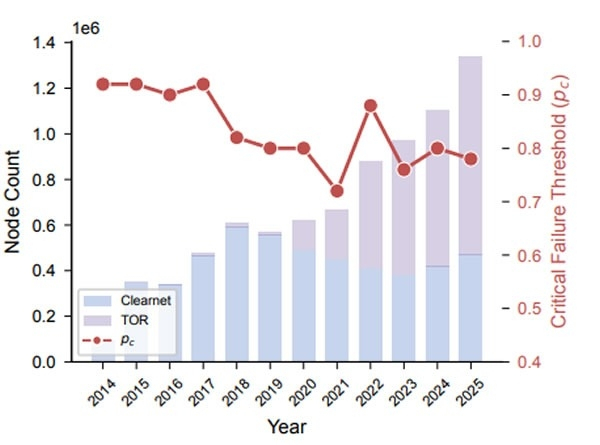 As the adoption rate of Tor increases, the resilience of the Bitcoin network gradually improves. Source: Wu Wenbin and Alexander Neumueller
Cable events have almost zero correlation with BTC prices.
Researchers concluded that 87% of the 68 confirmed historical cable failure events had less than 5% impact on nodes, and the correlation between cable events and Bitcoin (BTC) prices is essentially zero, with a statistical correlation coefficient of only -0.02.
They also pointed out that the geographical diversification of BTC mining "has not substantively changed infrastructure resilience," which is more related to physical cable topology rather than hash power distribution.