

Why does Web3 privacy feel like it's been going in circles for so many years?
When we entered the industry, we believed in transparency and immutability, but when enterprise-level applications want to share the pie, this kind of 'naked running' transparency has become a stumbling block.
Once data touches the regulatory red line, the project party is left in a panic.
Recently, I've been reviewing the design logic of @MidnightNetwork ; I feel this project is indeed quite interesting. It didn't just pile on ZK proofs but instead created a so-called 'rational privacy,' reconstructing the underlying logic of data flow.
Not long ago, I saw Midnight switch the cryptographic curve from Pluto-Eris to BLS12-381, and my first reaction was that these people finally figured it out.
Using non-standard curves may look advanced, but maintenance later is a bottomless pit. After switching to standardized curves, the verification time was directly cut from 12 milliseconds to 6 milliseconds, and the proof size shrank to 5k.
Don't underestimate this 1k difference; in high-frequency trading, it's not just performance optimization; it's practically a double booster for network throughput. Moreover, for developers, this standardization means a significant reduction in the CPU overhead of recursive proofs, especially in conjunction with that Compact language that has a TypeScript flavor. Even a Web2 developer who just switched careers can write a privacy contract without feeling like they're reading a foreign language, as the system can automatically generate succinct proofs.
What I am most optimistic about is that Midnight does not intend to become a fully masked 'black box' like Zcash.
It operates on Selective Disclosure, which is programmatic selective disclosure.
For example, in DeFi lending, you only need to prove that your credit score or assets meet the standard, without having to lay all transactions bare in the sunlight. This logic of 'useful is private' essentially leaves a backdoor for regulation while not allowing sensitive data to leak. This leads to the dual-token closed loop of NIGHT and DUST: if you hold NIGHT, it automatically generates DUST, and DUST is non-transferable, purely serving as transaction fee fuel. This 'battery model' directly cuts off money laundering and malicious transfer ideas, as the fuel itself cannot circulate, thereby greatly reducing pressure from regulators.
A few days ago, NIGHT opened on Binance spot, and I watched the K-line all day. A 10% pullback is actually quite normal, especially since 24 million airdropped tokens directly hit the market, and with the initial circulating supply accounting for 70% of the total supply, a high turnover rate is inevitable.
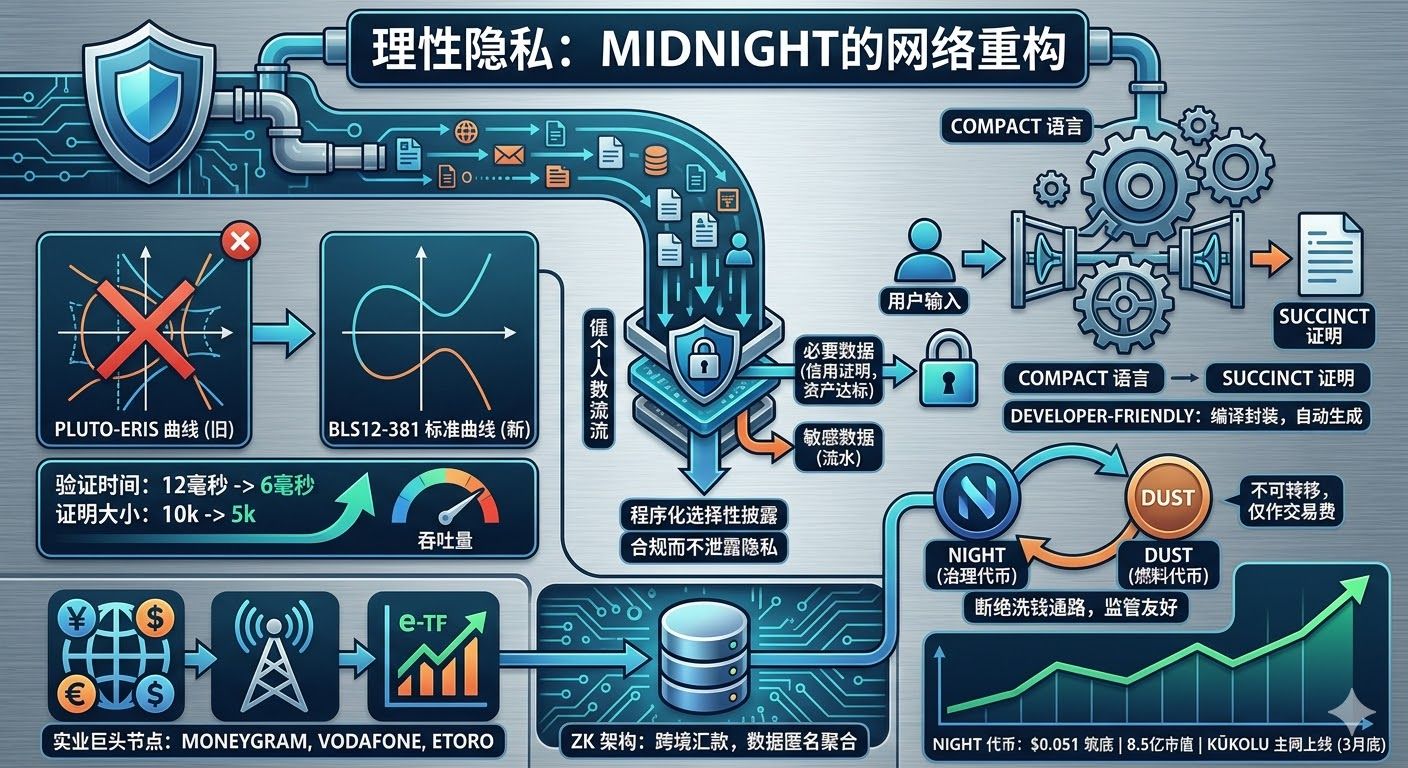
Interestingly, the price of NIGHT has stabilized around $0.051, with a 24-hour trading volume breaking 130 million, indicating that the underlying liquidity support is very stable.
This wave is not simply retail FOMO; it is institutions and veterans probing the depth. Especially considering that the nodes in the subsequent federation are all giants like MoneyGram, Vodafone, and eToro, these people are not running nodes for quick gains; they want to use Midnight's ZK architecture for cross-border remittances and anonymous aggregation of telecom data.
In my view, for giants like Vodafone, if they can bring user credit data onto the blockchain lending model through ZK proofs, while remaining compliant and not selling privacy, that would be what true Web3 infrastructure should do. Midnight's Kachina framework separates public and private state ledgers quite thoroughly; during node verification, only the proof results are considered, without touching sensitive inputs. This is a different dimension of experience compared to Cardano's Plutus language. Hoskinson's decision to invest $200 million himself, avoiding the VC premium route, is actually to preserve Midnight's 'purity'.
The privacy track has now passed the 'hide and seek' phase of barbaric growth.
In the future, whoever can make privacy compliant, user-friendly, and cost-effective will survive.
Currently, the price of $NIGHT $0.051 corresponds to a market value of $850 million. Considering the institutional nodes and technical path behind it, I believe it is still in a rational bottom-building range.
If the mainnet Kūkolu can go live as scheduled at the end of March, the governance capital attributes of NIGHT will be ignited. Everyone is waiting for the real-world performance of the mainnet; if those blue-chip nodes can really operate smoothly, the leap of NIGHT from a governance token to a resource base might be the most exciting event in this year's privacy sector.
