
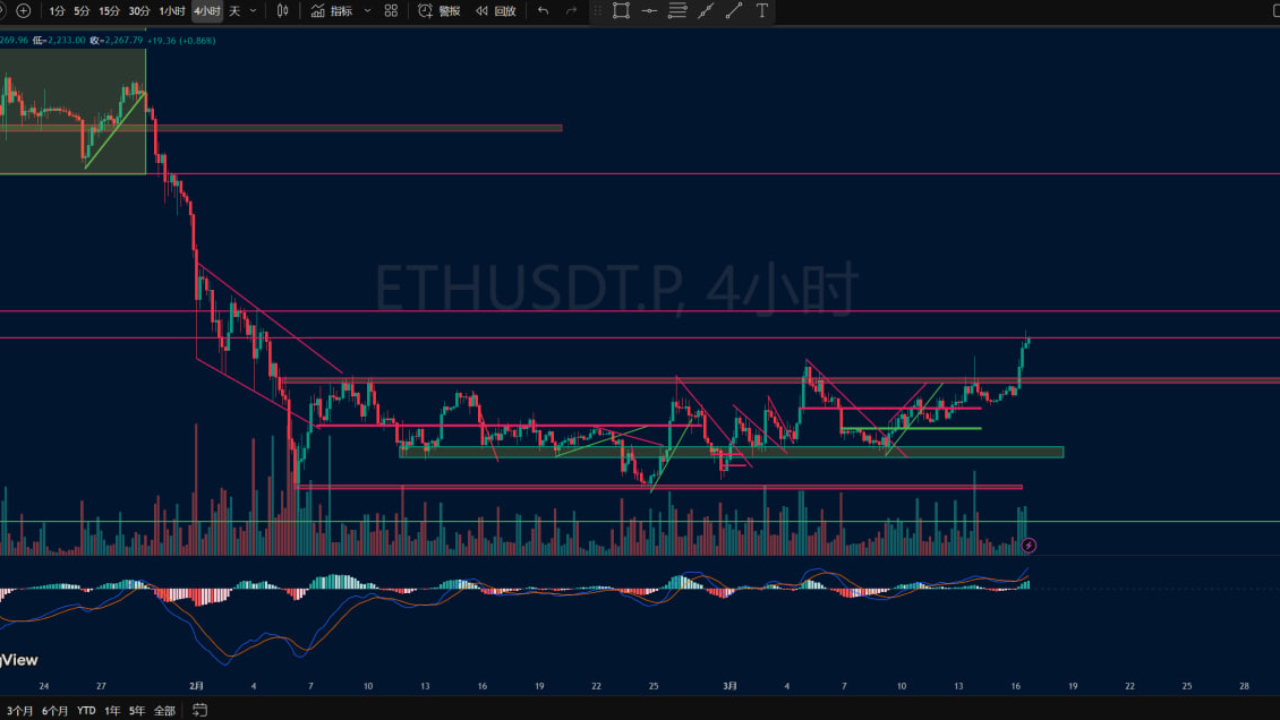

BTC quickly rebounded to around 74000 in a short period of time, and market sentiment has clearly begun to turn optimistic again. Many people are discussing whether a new bull market has already started, but from the perspective of volume and price structure as well as capital behavior, the current market state seems more like it has entered a phase of high-level stagnation rather than a new trend acceleration.
From yesterday's trend, BTC continuously rebounded from around 71000 to 74000, while ETH simultaneously rose from around 2100 to above 2260. There has indeed been a noticeable increase at the index level, but a very key detail is that the trading volume has not shown a significant synchronized expansion. This structure of rapid price increase without a significant expansion in volume usually indicates that the market is gradually transitioning from a trending rise to a consolidation phase rather than entering a new trend acceleration.
If we consider the current macro capital structure, this rhythm is actually not difficult to understand. In recent days, BTC ETF funds have reappeared, but the overall inflow speed is significantly lower than the previous phase's capital intensity. At the same time, on-chain data shows a slight increase in exchange BTC reserves, which usually means that some funds are beginning to hedge or lock in profits in the current price range. This means that institutional funds are more about controlling the market rhythm rather than continuing to push prices into an accelerated upward phase.
From the 4-hour structure of BTC, the overall situation is still in a fluctuating upward channel. The current price is approximately running around 73000, with the most obvious pressure area above between 74000 and 74800. This range coincides with the previous structural high points and the location of a dense trading area. If this position does not have a significant breakout with increased volume, the market is likely to form a high-level fluctuation in this area for a period of time, rather than directly entering a new trend market.
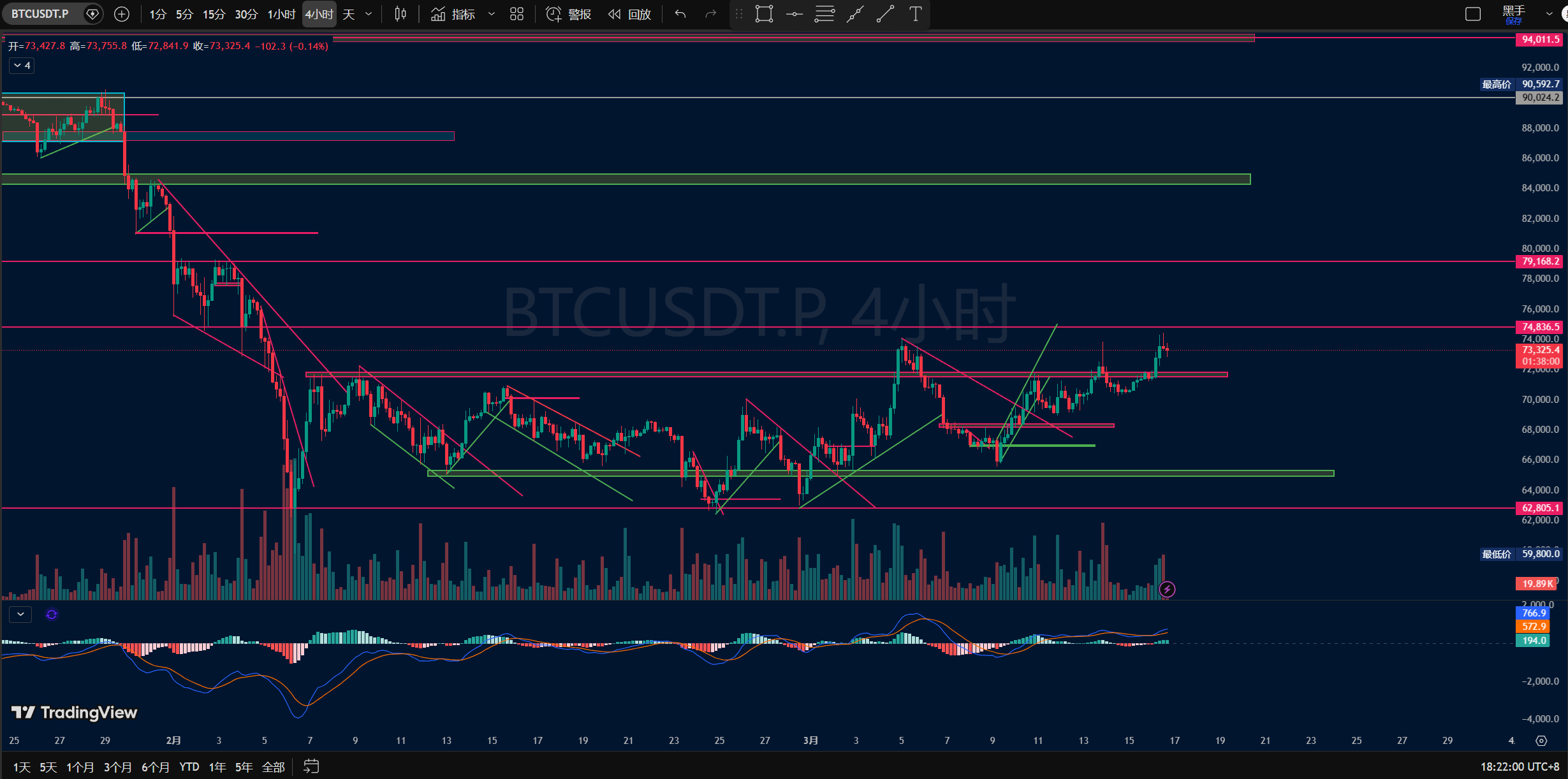
The structural support below is currently mainly concentrated in two positions. The first is around 71000, which is the first support area after a short-term structural pullback, while the stronger medium-term structural support is around 68000. As long as the price does not effectively break below this range, the overall structure can still be understood as a fluctuating bullish rebound. However, it is important to note that the MACD momentum has already started to show significant weakening, indicating that although the market still has the ability to rise, the probability of continuing to accelerate in the short term has significantly decreased.
Looking at the structure of ETH again, in fact, this round of rebound has shown that ETH's performance is significantly stronger than BTC. The current price has reached around 2260, with the recent structural resistance concentrated in the 2340 to 2360 area. This range is a large area of trapped positions formed during the previous decline. If the price can break through here with increased volume, ETH may lead to a relatively independent market trend.
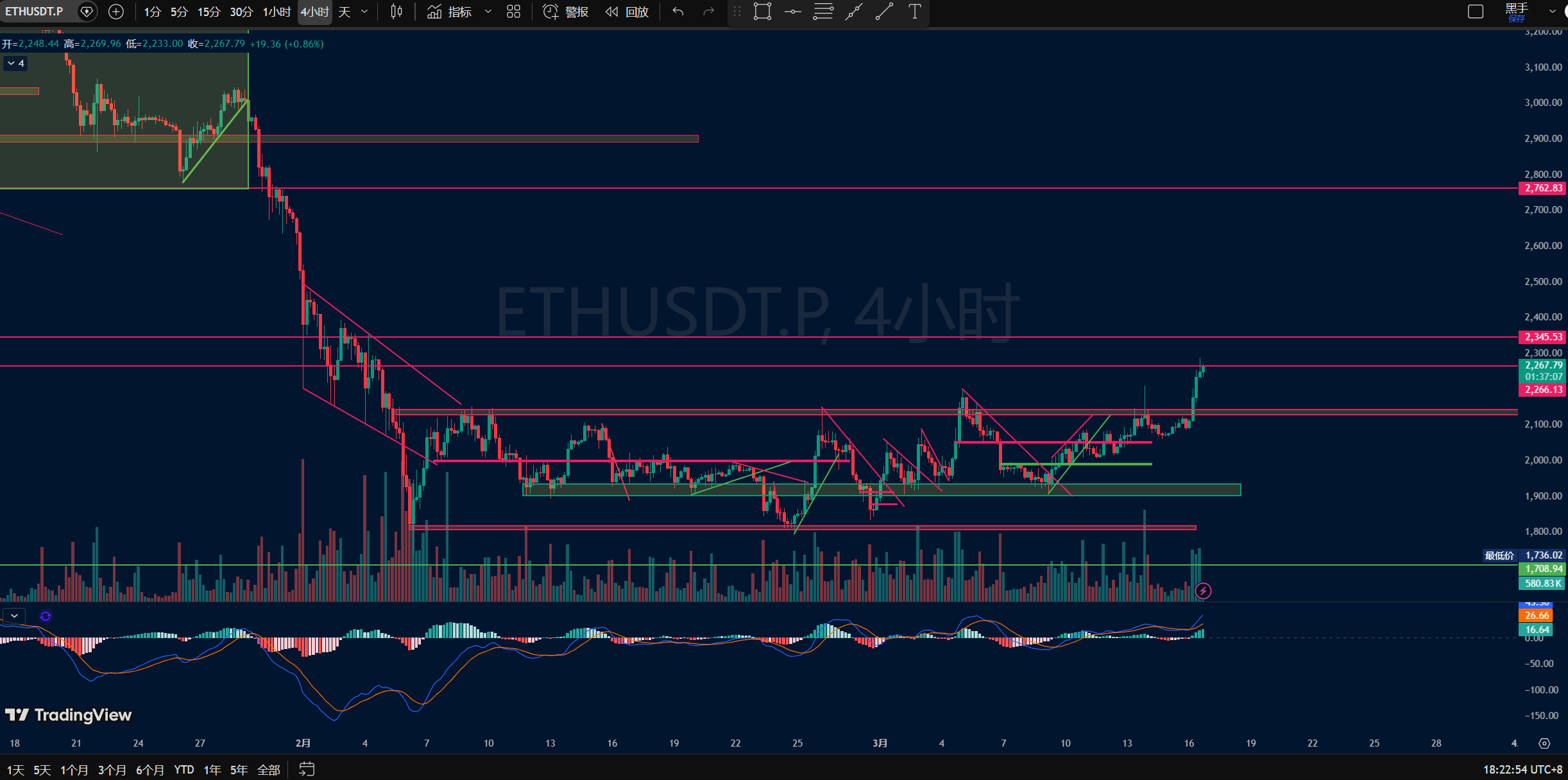
In terms of support below, the short-term structural support for ETH is around 2100, while more critical trend support is at the 2000 round number. As long as the price can maintain above 2000, the overall structure can still be understood as a fluctuating consolidation in an upward trend.
From the overall market structure, a relatively obvious phase change has already emerged, that is, the market is gradually transitioning from a trend market to a fluctuating market. In a trend market, making money relies more on directional judgment, while in a fluctuating market, making money relies more on trading rhythm. This is why many people who make money in a trending phase often end up giving back profits during a fluctuating phase.
Based on the current structural judgment, I personally tend to believe that the previous phase of apparent sending money market has basically ended. The market is more likely to enter a period of stagnation combined with short squeezes, meaning that the index level may not continue to see rapid increases, but funds will begin to gradually seek new profit directions.
From a historical cycle perspective, during this stage of index fluctuation and ample liquidity, the sectors most likely to exhibit independent market trends are typically small and medium-cap altcoins. Recently, some early signals can actually be seen, with many small and medium-cap projects starting to deviate from BTC's rhythm and showing independent upward structures.
Therefore, in the next period of time, trading opportunities in the market are likely to gradually shift from index assets like BTC and ETH to hot narratives or altcoin sectors that attract more capital attention.
In the short-term structure, if BTC can effectively break through 74000 and show significant volume, market sentiment may still experience a short-term surge. However, if it cannot break through this range, the market is likely to remain in a high-level fluctuation zone. In this structure, frequently chasing highs is often not the best strategy; patiently waiting for a clearer structure is often more important.
Finally, I would like to ask everyone a question: Do you think this round of market will be $BTC the first to break through 80,000 and open up space, or will capital first push out the altcoin market? Feel free to share your thoughts in the comments. — Black Hand @黑手Garry

