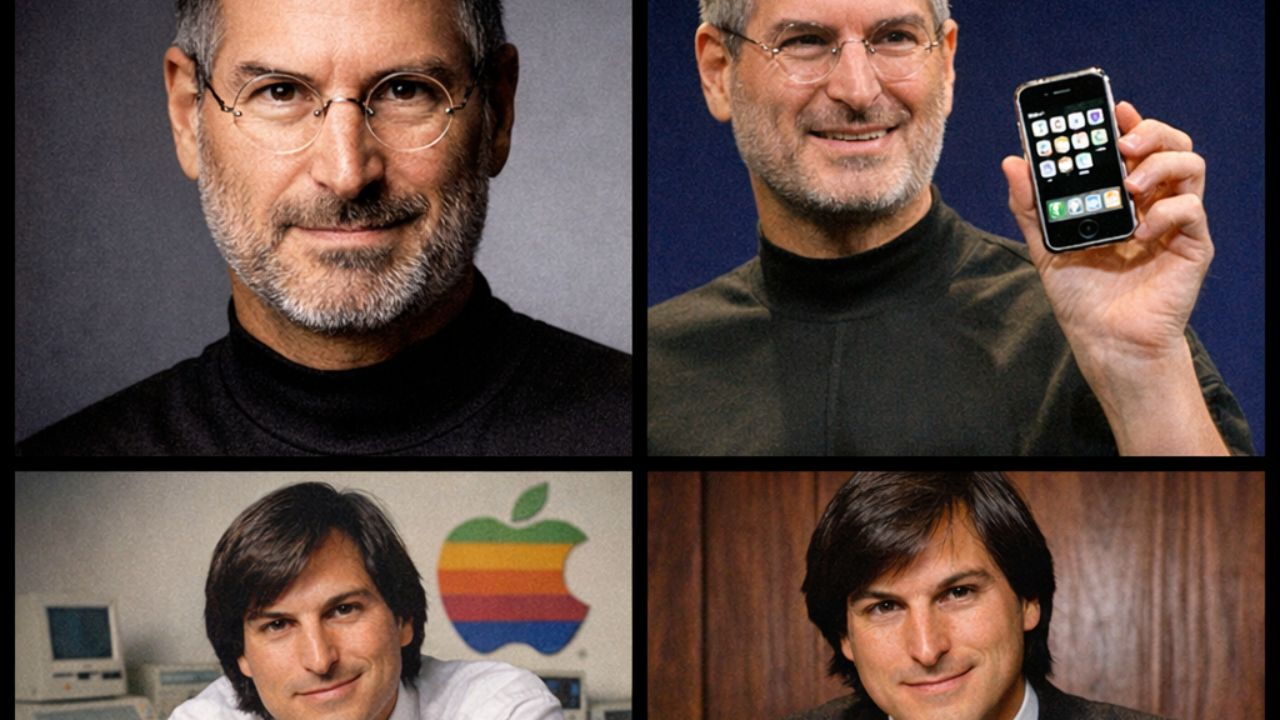
In the history of the technology industry, few individuals have been able to simultaneously change the computer, music, mobile, and entertainment industries like Steve Jobs. The company he founded, Apple, grew from a small garage startup into one of the world's most valuable and influential technology companies.
The rise of Apple is not just a story of a company's success; it is a legend about innovation, design, perseverance, and rebirth after failure.
1. Garage Startup: The Beginning of a Technological Revolution
In 1976, at just 21 years old, Steve Jobs and his friend Steve Wozniak founded Apple in a garage in California. At that time, the computer industry was still dominated by large enterprises and research institutions, making it nearly impossible for ordinary people to own their own computers.
Wozniak was a technical genius, while Jobs was a dreamer with strong business and product intuition. The two launched the first product, Apple I, which, although just a circuit board, opened the door to the personal computer market.
What really made Apple a hit was the Apple II launched in 1977.
It was one of the first commercially successful personal computers, featuring color display, keyboard, and expandable design, and quickly became a popular product for businesses and home users.
Within just a few years, Apple's revenue grew rapidly; the company went public in 1980, setting one of the largest IPOs in U.S. history at the time.
Two, Macintosh: Changing the way computers are used
In 1984, Apple released another groundbreaking product: the Macintosh.
The biggest innovation of this computer lies in the graphical user interface (GUI) and mouse operation. At that time, most computers still required command input to operate, while the Macintosh allowed users to operate through icons and windows.
To promote the Macintosh, Jobs launched one of the most famous ads in history—the 1984 Super Bowl ad.
This advertisement symbolized Apple's fight against the tech giant IBM and also marked the beginning of the personal computer liberation.
However, although the Macintosh was technologically advanced, its high price, coupled with internal power struggles, led to Apple’s board ultimately ousting Jobs in 1985.
This was one of the biggest setbacks in Jobs' life.
Three, being ousted from Apple: a turning point in failure
After leaving Apple, Jobs founded a new company, NeXT, focusing on high-end workstations and software systems. Although commercial success was limited, its technical architecture later became an important foundation for Apple's operating system.
At the same time, he also acquired a small animation company—later became Pixar.
In 1995, Pixar launched the world's first fully computer-animated feature film, Toy Story, which was a huge box office success and completely transformed the animation film industry.
During this time, Jobs transformed from a rebellious entrepreneur into a mature business leader.
Four, returning to Apple: the most classic corporate revival in history
In 1997, Apple was on the brink of bankruptcy due to a chaotic product line and financial issues, and ultimately acquired NeXT, allowing Jobs to return to Apple.
At that time, Apple was in very bad shape:
The product line was too complex
Market share decline
The company is suffering heavy losses
After Jobs took office, he made several key decisions:
1. Cut down on many products
Only four product lines were retained, simplifying the company structure.
2. Launching revolutionary design products
In 1998, the iMac was launched, shocking the market with its transparent color design.
3. Reshaping the Apple brand
Launched the classic ad Think Different, positioning Apple as a symbol of creativity and innovation.
These strategies quickly put Apple back on the path of growth.
Five, iPod and iTunes: Reshaping the music industry
In 2001, Apple launched the iPod.
In a situation where MP3 players already existed, Jobs completely transformed the music industry through simple design and the iTunes ecosystem.
The core concept of the iPod is:
"1,000 songs in your pocket."
Through the iTunes music store, Apple successfully established a legal digital music download market, allowing the recording industry to find a new business model.
The iPod sold hundreds of millions of units worldwide, bringing huge revenue to Apple and significantly enhancing Apple's brand influence.
Six, iPhone: The smartphone revolution
In 2007, Jobs introduced the iPhone at a classic launch event.
At that time, the mobile phone market was dominated by brands like Nokia and BlackBerry, and phones were mainly used for calling and texting.
Jobs said a historically changing statement:
"Today, we are going to reinvent the phone."
The three core innovations of the iPhone:
1️⃣ Multi-touch screen
2️⃣ Complete web browsing experience
3️⃣ App ecosystem
After launching the App Store in 2008, developers around the world could create applications for the iPhone, forming a massive digital ecosystem.
This not only changed the mobile phone industry but also transformed the entire internet and software economy.
Seven, iPad and ecosystem
In 2010, Apple launched another revolutionary product: the iPad.
The iPad, positioned between a phone and a laptop, quickly became an important device in education, entertainment, and business markets.
Apple also gradually built a complete product ecosystem:
iPhone
Mac
iPad
Apple Watch
AirPods
iCloud
This integration model of hardware + software + services has resulted in extremely high user stickiness for Apple.
Eight, Jobs' product philosophy
Steve Jobs' most important contribution was not just launching products, but establishing a product philosophy.
1. Extreme simplicity
Jobs was deeply influenced by Zen and design philosophy; he believed:
"Simplicity is harder than complexity."
Apple's product design pursues minimalism while possessing powerful functionality.
2. Hardware and software integration
Jobs did not believe in "modular technology"; he insisted that Apple must control:
Hardware
Operating system
Software ecosystem
This is also an important reason why Apple can maintain a high-quality experience.
3. The combination of technology and humanities
Jobs once said:
"Apple stands at the intersection of technology and humanity."
This is also the core reason why Apple can create both powerful and beautiful products.
Nine, Jobs' passing and Apple's future
In 2011, Steve Jobs passed away due to illness at the age of 56.
At that time, many were worried that Apple was losing its soul, but under Tim Cook's leadership, the company continued to grow.
Apple's market value grew from several hundred billion dollars to a trillion-dollar level, becoming one of the most valuable companies in the world.
Conclusion: A person who changed the world
Steve Jobs was not the most skilled engineer, nor the best manager, but he possessed a very rare ability:
Seeing the future and turning it into a product.
From personal computers to smartphones, he drove multiple technological revolutions.
Apple's success also proves one thing:
Truly great products are not just technological breakthroughs, but also change the way people live.
And Steve Jobs' story has also become one of the most classic legends in the history of entrepreneurship.