

I have a friend who works in automation engineering, and their company installed a batch of industrial robotic arms last year.
After the installation, he told me something that made him a bit uneasy: those robotic arms work sixteen hours a day, creating considerable value, but they are completely transparent in the economic system—no accounts, no identities, and no way to independently receive or pay compensation. All the value generated directly belongs to the company that purchased them, and the machines themselves do not exist in an economic sense.
I didn't respond to him directly at the time, but this question has been on my mind.
Until I saw Fabric and @virtuals_io announce their partnership, along with the involvement of @openmind_agi, I suddenly realized: the technical conditions for machines to exist as independent economic entities are being pieced together simultaneously in these three directions.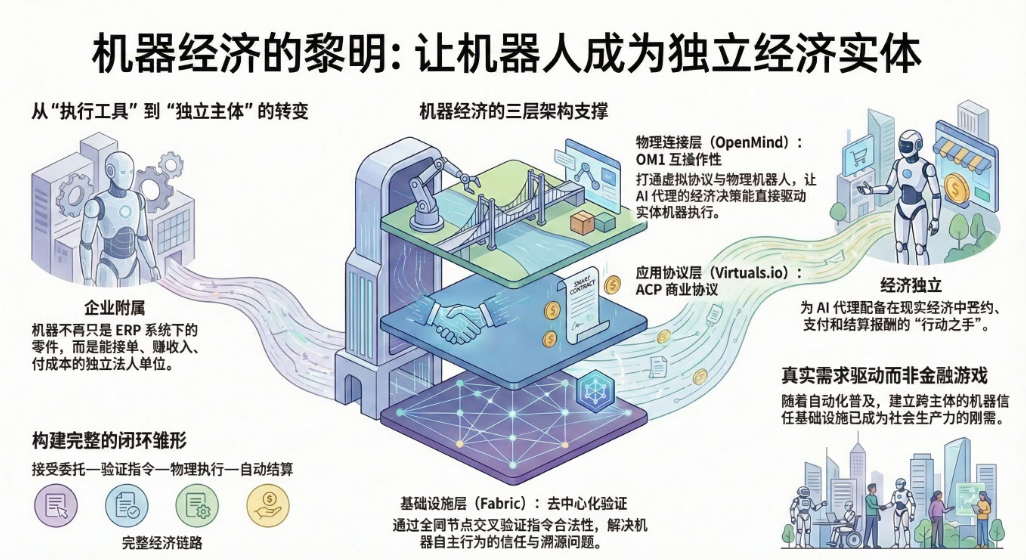
First, clarify what these three directions are doing individually, as many people have mixed them together.
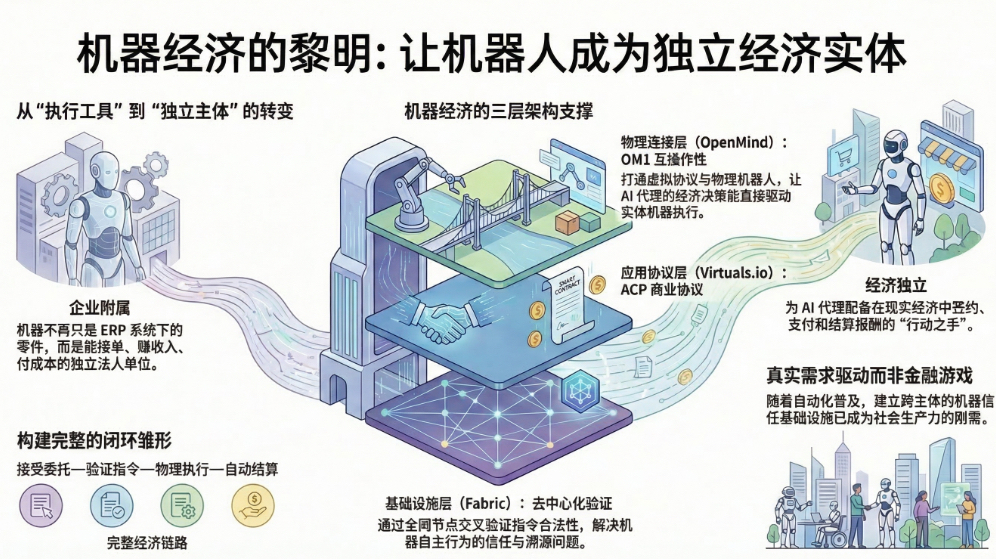
Fabric operates at the infrastructure layer. Its core logic is: before a robot executes any physical or digital instruction, that instruction must undergo verifiable computational review through a decentralized network. All network nodes cross-verify whether the source of the instruction is legitimate, whether the content has been tampered with, and whether the execution logic is self-consistent, and only then is it allowed to proceed.
This issue addresses a fundamental trust problem: in a world with an increasing number of machines that are more autonomous, who guarantees that what these machines do is authorized, traceable, and not maliciously tampered with? Fabric's answer is: not relying on a central server, but on cryptographic proof and consensus across the network.
@virtuals_io is working at the application layer. Its Agent Commerce Protocol, abbreviated as ACP, is a set of protocols that allows AI agents to autonomously complete economic actions in the real world—signing contracts, making payments, accepting commissions, and settling tasks. In one sentence: ACP is providing AI agents with a "hand" to act in the real economy.
@openmind_agi's OM1 operates at the connection layer. It accelerates interoperability between ACP and OM1, allowing seamless collaboration between agents on the virtual protocol layer and robots in the physical world. An AI agent can receive tasks through ACP and then pass instructions to real physical robots through OM1, with the entire process requiring no human intermediaries.
Combined, these three directions allowed me to see for the first time a complete embryonic form of a machine economy closed loop.
In the past, when we talked about "AI agents," we were basically referring to matters in the digital world—writing code, generating content, processing data. The results of these tasks are bits, not atoms.
The combination of Fabric, Virtuals, and OpenMind attempts to extend this link into the physical world. AI agents receive commissions through ACP, control robots to perform real physical tasks through OM1, and Fabric's infrastructure ensures the entire execution process is verifiable and has a responsibility chain.
Once this closed loop is operational, a robot is not just an execution tool; it can be an independent economic entity—taking tasks, earning income, paying costs, and recording credit history.
The question my friend mentioned has a possible answer within this framework.
Then I will talk about my real judgments, including the aspects I find promising and the areas I still have doubts about.#robo
What is promising is the size of this direction itself.
The trend of automation and robots replacing labor is unquestionable; it is only a matter of speed. However, this trend currently lacks a key piece of infrastructure: a mechanism for machines to be recognized, trusted, and settled within the economic system. The traditional solution is to connect machines to the enterprise's ERP system, using the enterprise's credit to back the actions of machines. This model can work within closed enterprises, but it is insufficient in an open, cross-entity machine economy.
The decentralized verification layer provided by Fabric, the agent commerce protocol provided by Virtuals, and the interoperability provided by OpenMind combine to build a trust infrastructure for the open machine economy. The value of this infrastructure does not depend on the success of any single application but on how many different applications are willing to build on it.
What raises doubts is the complexity at the execution level.
The technical collaboration of three independent teams means that any problem in any link will affect the overall experience. The term interoperability sounds simple, but truly connecting systems with completely different technical architectures is much more complex than what is stated in the announcements. The acceleration of ACP interoperability by OM1 is still ongoing, and the specific landing details and timeline are worth continuous observation.
Moreover, the participation threshold for physical robots is inherently high. Fabric's network requires a sufficient number of real devices to connect to form an effective verification network; the cold start problem is the first hurdle for any physical infrastructure project.
But what I ultimately want to say is a judgment that is more fundamental than technical details.
Most AI-related cryptocurrency projects are telling the story of "AI + Blockchain"—wrapping the narrative of AI in tokens, but at the core, it is still a financial game of tokens.
This tripartite collaboration is different; it is about "qualifying machines to participate in the economy" itself. This is not just a narrative; it is a real existing demand, and as the level of automation deepens, this demand will only become more urgent and will not disappear.
The risk of doing infrastructure is slow implementation and long monetization cycles. But once it becomes the standard, the moat is hard to shake.
I don't know who will ultimately be the winner of this combination, but I know this direction is correct.
Being a step ahead in the right direction is worth much more than being ten steps fast in the wrong direction.