
The genesis block of the last week of March 2026 is getting closer. Recently, I just ran the Midnight Kachina protocol in my local environment. To be honest, this feels completely different from my previous experience running L2 Rollup on Ethereum.
Many people ask me, why not directly make it L2, instead of creating a Partner Chain? At first, I thought this was just reinventing the wheel. But when I tried to deploy an application involving "sensitive medical data sharing," I realized IOG's ambition: the security of L2 is tied to the mainnet, but its privacy is often also "transparent."
Under the L2 architecture, all state transitions ultimately need to be sent back to L1 for verification, just like you are wearing an invisibility cloak, but your footprints are clearly visible in the snow. The Partner Chain path chosen by Midnight essentially creates a 'physical separation' between the execution layer and the verification layer. Its verification logic is independent, maintained by institutions like Google Cloud and Blockdaemon.
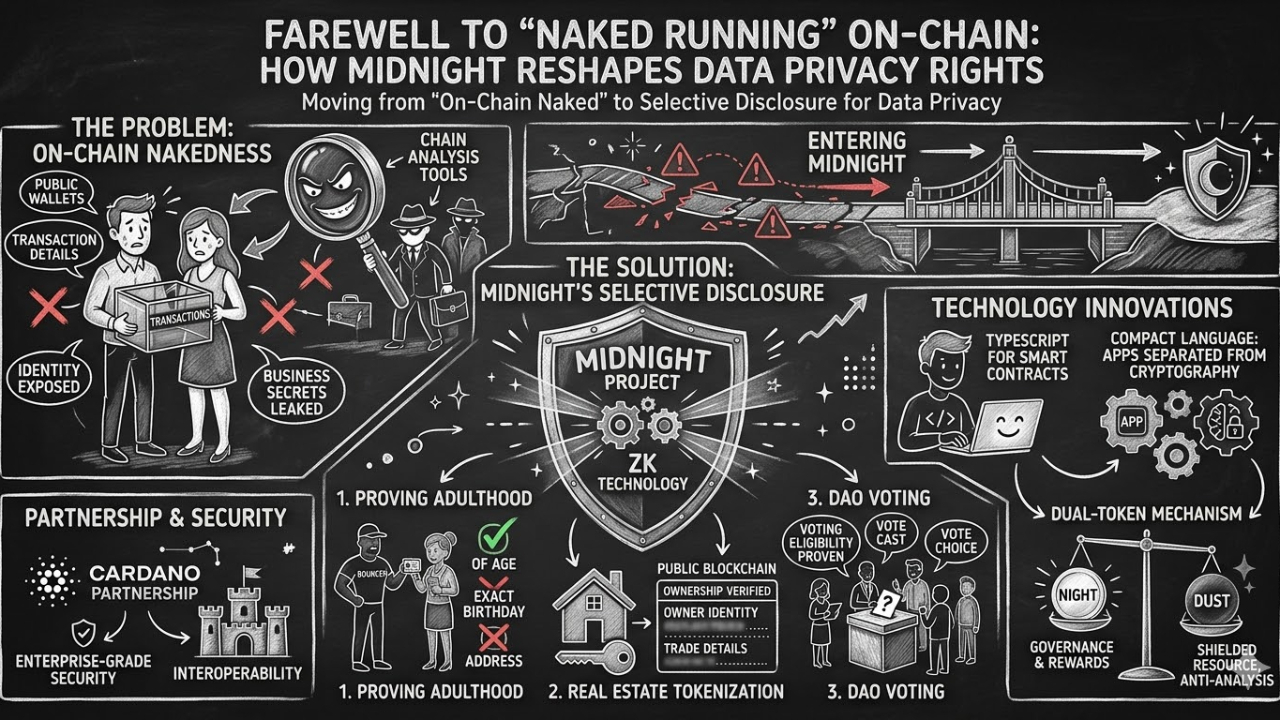
I was initially worried that this 'federal system' would weaken security. But in practice, I found that it leaves space for 'compliance'. On Midnight, privacy is not the kind of 'dark web-style total black', but 'programmable transparency'. I can implement a logic through ZK-SNARKs: I can prove to regulators that I am not money laundering, but I do not need to tell them about every transaction of buying coffee. This sense of balance is a very persuasive business chip for developers like me who want to engage in institutional business.
Of course, this also comes at a cost. The security of Midnight does not completely depend on Cardano; it is more like a 'Multi-chain Pivot'. Through LayerZero, my application can directly access the liquidity of more than 140 public chains. I tested the transmission efficiency of cross-chain proofs yesterday; although the current test network still has delays, this concept of 'privacy as a service' is indeed much more imaginative than sticking to a solitary island ecosystem.
The most concerning issue of DUST (time tax) for everyone, I calculated: holding 1000 $NIGHT can accumulate 50 DUST every day. If you only transfer occasionally, this battery mode is very enjoyable; but if you trade high-frequency contracts like I do, you must accurately calculate your DUST Cap. This is actually the official way of using an economic means to perform 'anti-spam trading' attacks. Retail investors feel the threshold is high, but what I see is the long-term activity of the network.
My current strategy is: to continue stabilizing in the Cardano staking ecosystem while keeping an eye on the performance of institutional nodes in the Kūkolu phase. As long as the circuit audit passes after the mainnet goes live, I will definitely rush to seize the first-mover advantage for this 'compliant privacy' business.#night