
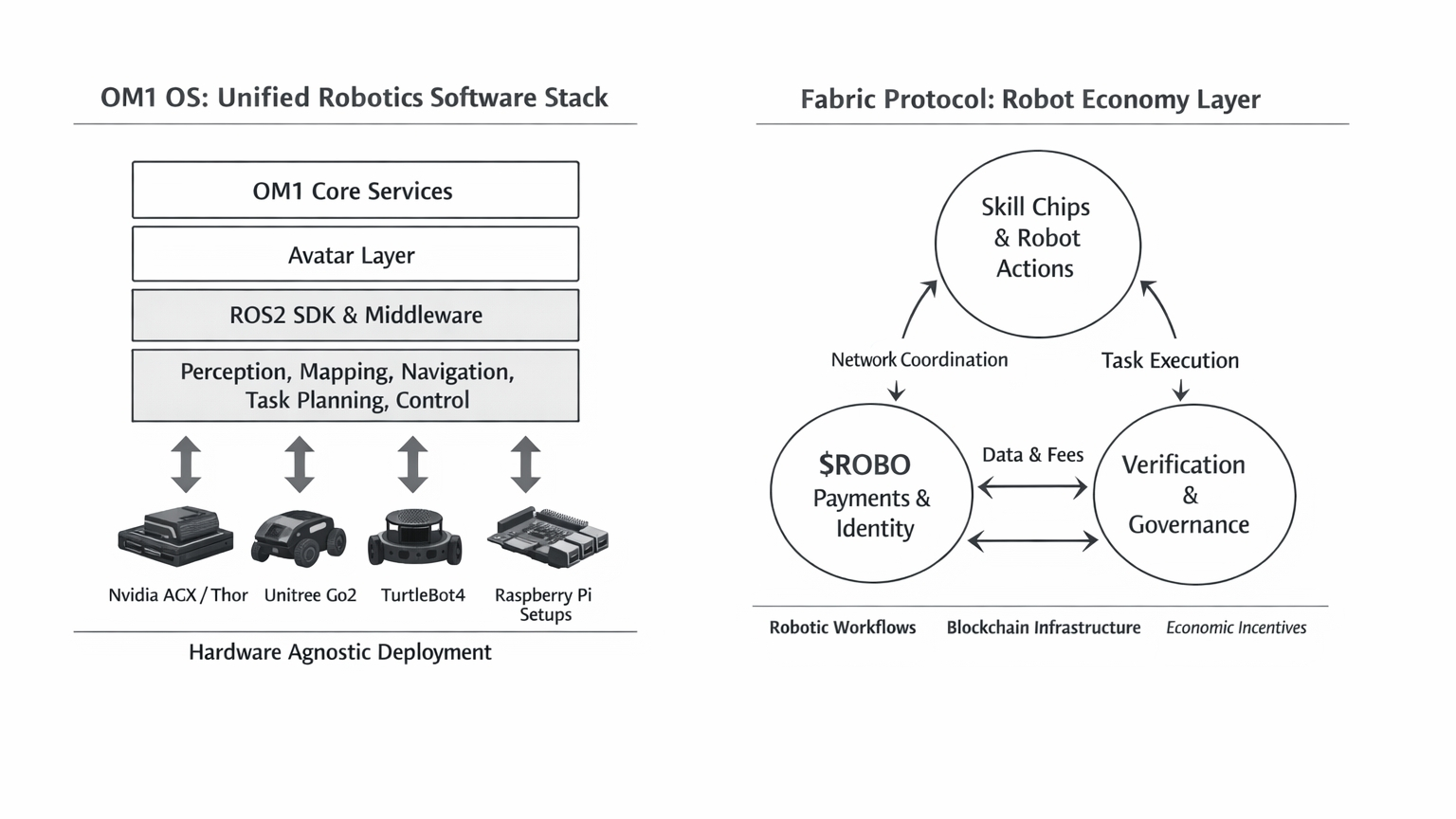

remember watching a robotics token rip for a few sessions and realizing I had no real answer to the only question that mattered after the candles cooled off. Not whether the chart looked good. Not whether the narrative sounded fresh. Just this: what keeps people, machines, and developers coming back once the first burst of attention fades? That’s why I’ve been looking at Fabric through the OM1 angle rather than the usual token angle. OM1 is not just another shiny AI wrapper. OpenMind’s current docs describe it as a modular, hardware agnostic robot OS with core services like OM1 itself, an avatar layer, and a ROS2 SDK, all packaged as containerized components that handle perception, mapping, navigation, task planning, and low level control. That matters because retention in machine networks usually lives or dies at the operating layer, where real tasks either repeat cleanly or break in annoying ways. 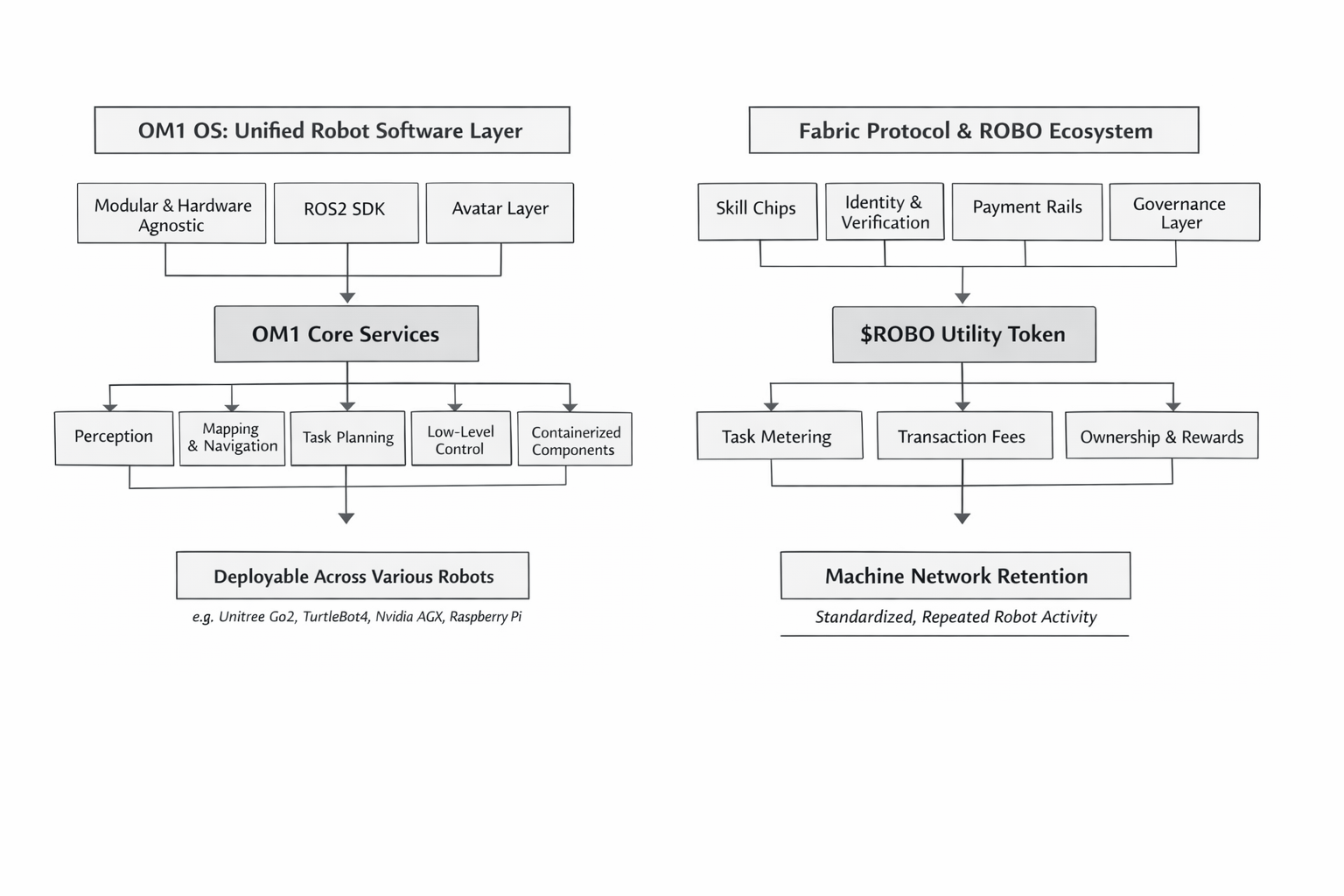 The practical insight for me is simple. If Fabric wants traders to believe machine activity can become durable economic activity, then OM1 has to make robots easier to deploy across different hardware without forcing teams to rebuild the stack every time they change form factor, sensors, or compute. Think of it like the difference between a one-off robot demo and a common operating language for fleets. The docs already show OM1 being pushed across platforms like Nvidia AGX and Thor, while separate integration guides cover machines such as Unitree Go2, TurtleBot4, and even Raspberry Pi based setups. That does not prove product market fit by itself. But it does show the project is at least attacking the right bottleneck: getting intelligent machines onto a shared software layer instead of leaving every deployment stranded in its own little kingdom. And here’s where Fabric becomes more interesting to me than a lot of AI-adjacent tokens. The Fabric whitepaper frames the protocol as the coordination layer for building, governing, owning, and evolving general purpose robots, while OpenMind positions OM1 as the software layer that makes those robots usable in the first place. Fabric’s own materials say robot skills can be modularized as “skill chips,” while $ROBO is meant to pay fees tied to payments, identity, and verification, with the network initially on Base before a longer term move toward its own L1. In plain English, the trade is not just “AI plus token.” The bet is that an OS layer can standardize machine behavior enough for a blockchain layer to meter, verify, and price machine work. If that loop ever becomes real, retention stops being a social metric and starts looking more like recurring machine throughput. Still, this is exactly where I get cautious. A modular OS sounds great on paper, but modularity also creates surface area. More services, more containers, more interfaces, more ways for latency, maintenance, and integration bugs to creep in. Even OpenMind’s own docs read like a project that is still deep in build mode, with platform-specific setup requirements, middleware dependencies, version constraints, and guides that make it obvious this is not plug-and-play for ordinary users yet. For traders, that is not a side note. That is the tradeoff. If OM1 remains mostly a builder story, retention may stay stuck with developers and speculators instead of spreading into repeat commercial robot usage. That’s also why I would not read current market action as proof that the architecture has already won. As of March 17, 2026, ROBO is trading around the low four cent area, with a circulating supply around 2.23 billion and market cap around the low-to-mid $80 million range, while Binance listed it on March 4 with a Seed Tag, which is explicitly used for newer, higher risk assets. Fabric’s own disclosures are even more direct: the token does not represent equity, dividends, or revenue rights, and the documents openly warn about regulatory, governance, technology, liquidity, and demand risk. I actually respect that candor. But for anyone trading this, it means the market can price narrative access much faster than the network can prove repeated robotic utility. So what am I watching? Not louder branding. Not exchange chatter. I’m watching whether OM1 keeps expanding into credible deployments where the same software layer supports repeated machine tasks across multiple hardware types, and whether Fabric can convert that into measurable demand for identity, verification, and payment rails instead of one-time curiosity. That is the retention problem in its cleanest form. Do intelligent machines come back to the network because the workflow is better there, or does the market only come back because the story sounds futuristic?
@Fabric Foundation #ROBO $ROBO
