
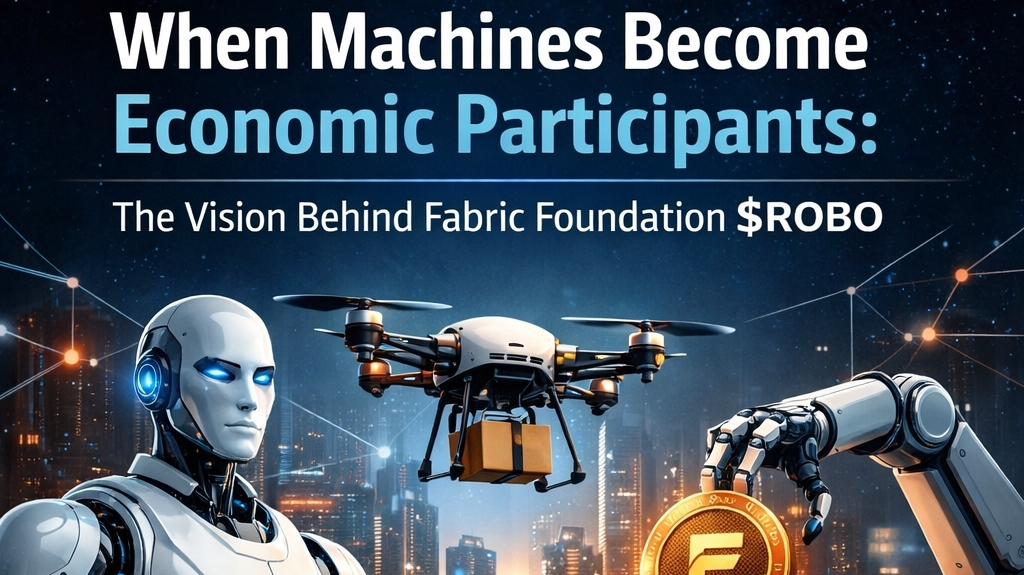
Most crypto infrastructure is built around software agents and automated scripts. Machines execute commands but they do not participate in the economy themselves.
@Fabric Foundation is built on a very different assumption.
With $ROBO , machines are not just tools. They become economic participants. A robot or AI agent can hold an on-chain identity, stake a bond, earn reputation, and get paid directly for completing tasks. The machine is no longer just following instructions. It is interacting with the network as its own entity.
While digging deeper into the architecture of Fabric Foundation, what stood out to me is how the protocol treats machines as independent actors in the digital economy. Instead of routing every task through a human operator, the system allows robots, AI agents, and automated hardware to negotiate work and settle payments on-chain.
That changes the entire model of automation.
Most robotics systems today are controlled by centralized platforms. The machine performs work but the economic layer sits somewhere else. Fabric flips that structure by embedding the economic logic directly into the machine layer. The robot has an identity, it can prove its work, and it can get paid through the network using $ROBO.
That small shift opens a much bigger door. Autonomous logistics, AI service agents, industrial robots, and even delivery drones could eventually operate within a decentralized economy where machines coordinate with each other.
We talk a lot about the future of AI agents and machine automation. But the infrastructure that allows machines to actually participate in an open economy is still extremely limited.
Fabric Foundation is quietly building that layer and $ROBO is the fuel that powers it.
The next phase of crypto will not just connect people and applications. It will connect machines to the economy itself. Fabric looks like it is wiring that future together right now, one autonomous machine at a time. #ROBO
