
After enough cycles, I stopped treating price charts like truth. They are mood rings. Useful, sometimes. Honest, not often. When I first looked at @Fabric Foundation and ROBO, I did what I always do now - I ignored the candles and went straight to the payment logic. Who gets palive
For what. Under what conditions. That is where weak token models usually confess. Retail traders watch momentum; I watch whether a network can tell the difference between real labor and decorative activity. With Fabric, that question matters more than usual, because this token is meant to sit inside a machine economy, not just bounce around wallets.
Most people hear “fixed supply” and relax too early. Fine, but fixed total supply is not the same thing as clean circulation. Fabric’s whitepaper fixes ROBO at 10 billion tokens, then splits it across investors, team, reserve, ecosystem, airdrops, liquidity, and a small public sale. The part that caught my eye was not the headline number. It was the shape of the unlocks.
Investors get 24.3% and team plus advisors get 20%, both with a 12-month cliff and 36-month linear vesting. Ecosystem and community get 29.7%, with part available at launch and the rest spread over 40 months alongside Proof of Robotic Work. That matters to users because supply enters the market in layers, not as a single dump truck backing into the street.
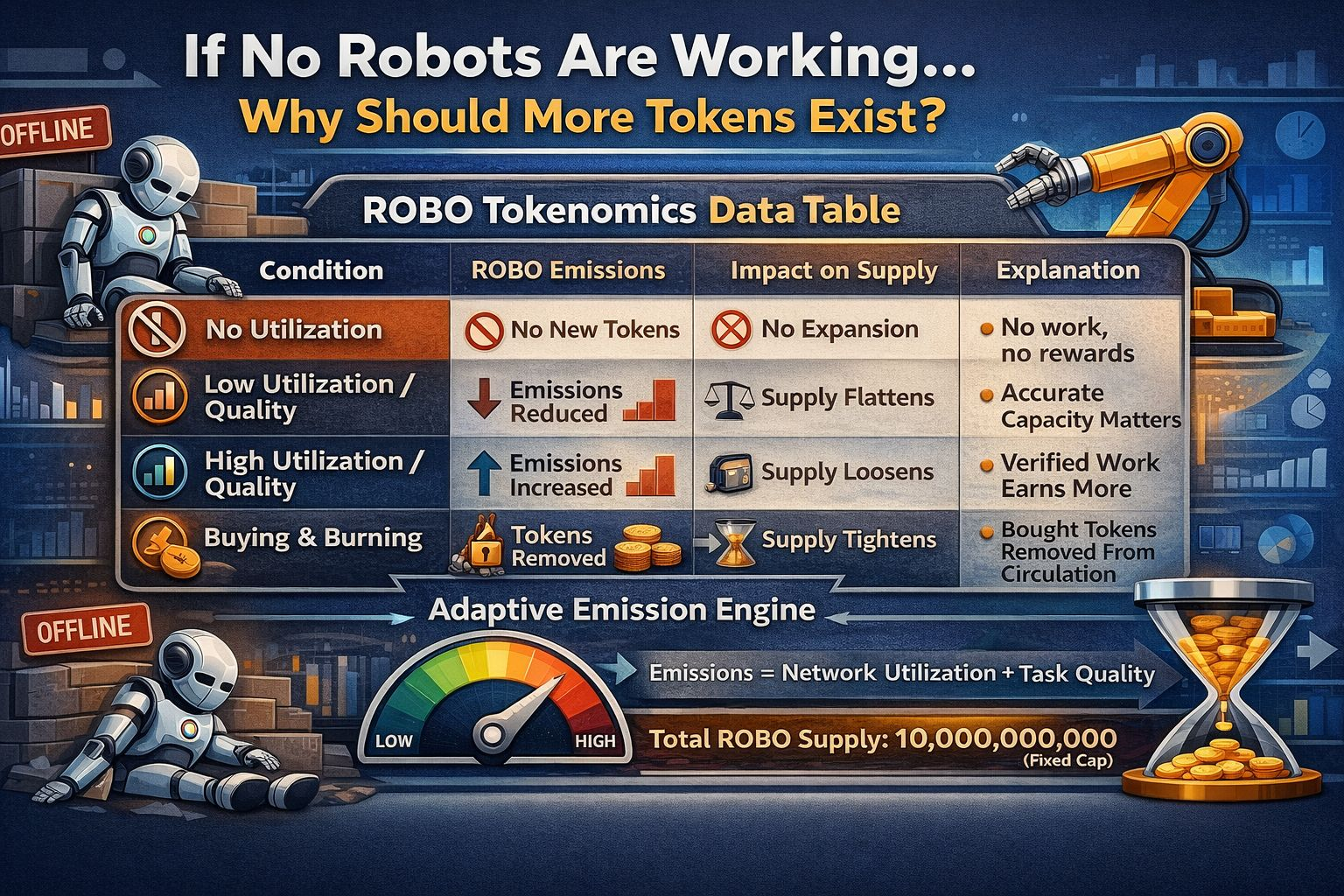
Then I hit the phrase that usually makes me suspicious - Adaptive Emission Engine. It sounds like the kind of label people use when they want inflation to feel scientific. Wait, let’s see. Fabric actually defines emissions as a controller that responds to two signals: utilization and quality. Its initial targets are 70% utilization and 95% quality, and the model caps emission changes at 5% per epoch.
So the faucet is not fully open, and it is not meant to move wildly just because sentiment changes. More important, quality below the threshold cuts emissions even if utilization is high. That is a serious choice. It says the network would rather grow slower than pay for sloppy robot output.
Because of that, ROBO reads less like a comfort token and more like a work token. I want to be precise here. The whitepaper does not promise a hard “zero work, zero issuance” switch. It does something subtler. Rewards are tied to verified contribution, and token ownership alone does not generate economic return.
A wallet with a million tokens but no work can earn nothing from the contribution system, while a much smaller holder that completes verified tasks can earn proportionally more. Okay, that is the real point.
ROBO is not designed to flatter idle holders. It is designed to bond operators, settle fees, and compensate actual data, compute, validation, and task completion. That is closer to a payroll rail than a passive yield chip. Here is where the supply-side logic gets interesting.
Fabric does not treat circulating supply as “emissions go up, therefore float goes up.” The model subtracts locked bonds, governance locks, burns, and buyback-acquired tokens from what is effectively available in the market. A token can be created and still not become easy sell pressure.
If more operators bond ROBO to register capacity, if more users lock it for governance, if slashing burns part of bad actors’ collateral, and if fee revenue is used to buy tokens back, circulating supply can tighten even while emissions continue. That is not magic. It is just accounting with consequences. Like a hotel with many rooms on paper but half of them blocked for repairs, events, and staff use - the vacancy people care about is the real one, not the blueprint.
Like any serious market design, Fabric tries to make demand come from use, not applause. Operators must post refundable performance bonds in ROBO, and those bond requirements scale with declared robot capacity. So if the network wants to serve more real work, more tokens get tied up as operating collateral.
On top of that, the whitepaper suggests sending 20% of protocol revenue into market buybacks, with purchased tokens moving into the reserve. By the way, that does not mean automatic scarcity in the dramatic sense, because reserve-held tokens are not the same as burned tokens. Still, it does mean revenue can translate into token demand instead of just good vibes on social media.
What makes the model more durable, in theory, is the maturity shift. Early on, Fabric uses activity-weighted rewards to help solve the cold-start problem. Later, as utilization rises above target, the reward layer moves toward revenue weighting. I like that. New networks often have a painful choice: either reward early contributors with inflation and invite abuse, or wait for real revenue and stay empty.
Fabric tries to bridge that gap without pretending bootstrap incentives and mature economics are the same thing. It also tries to make fake activity harder to game by rewarding verified work and graph connectivity, not just the existence of many accounts. That is how you avoid the familiar inflation trap where a network keeps paying emissions to prove it is alivealive
Still, I would not wave away the hard parts. Utilization is defined as revenue over capacity, and capacity is a human choice before it becomes a machine fact. If governance is careless, operators may overstate capability. Quality scores also matter a lot here, and quality systems can be messy in the real world.
Fabric tries to answer that with validator attestations, user feedback, slashing, and penalties: fraud can slash 30% to 50% of task stake, uptime below 98% over a 30-day epoch can burn 5% of bond and wipe out that epoch’s emission rewards, and quality below 85% can suspend reward eligibility. Those are strong guardrails on paper. Whether they feel fair in practice will depend on enforcement, not slogans.
So my personal opinion is calmer than the market usually likes. I do not see ROBO as a toy built to keep a community entertained with token drip. I see an attempt to price robotic labor with conditional issuance, bonded participation, and revenue-linked demand sinks. That is the right direction.
I also see a few open questions around measurement, governance discipline, and how reserve buybacks will be managed over time. But the core structure is better than the usual model where tokens spray outward first and economic meaning gets added later. If Fabric works, ROBO may matter because it pays for verified machine work. If Fabric does not work, the token design alone will not save it. That, to me, is exactly how it should be.
@Fabric Foundation #ROBO $ROBO
