
@Fabric Foundation #ROBO $ROBO

Introduction
If you’ve spent any time following blockchain or AI, you’ve probably noticed a common frustration: most AI systems and their underlying tokens feel trapped in digital space, far removed from tangible, real-world impact. Robots in warehouses, AI assistants at home, or autonomous delivery machines are still mostly siloed, lacking an integrated framework for governance, coordination, and economic participation. That’s where the Fabric Foundation steps in. By linking blockchain infrastructure to physical AI deployment, it’s attempting something rare—turning digital governance into real-world functionality.
What the Project Actually Does
At its core, Fabric Foundation is a non-profit building open infrastructure for intelligent machines—think robots and autonomous agents—to operate safely and productively alongside humans. The system isn’t about flashy AI demos; it’s about creating the “economic and governance rails” these machines need. That includes:
Ensuring predictable and observable machine behavior.
Enabling decentralized task allocation.
Supporting human- and location-gated interactions.
Facilitating machine-to-machine communication.
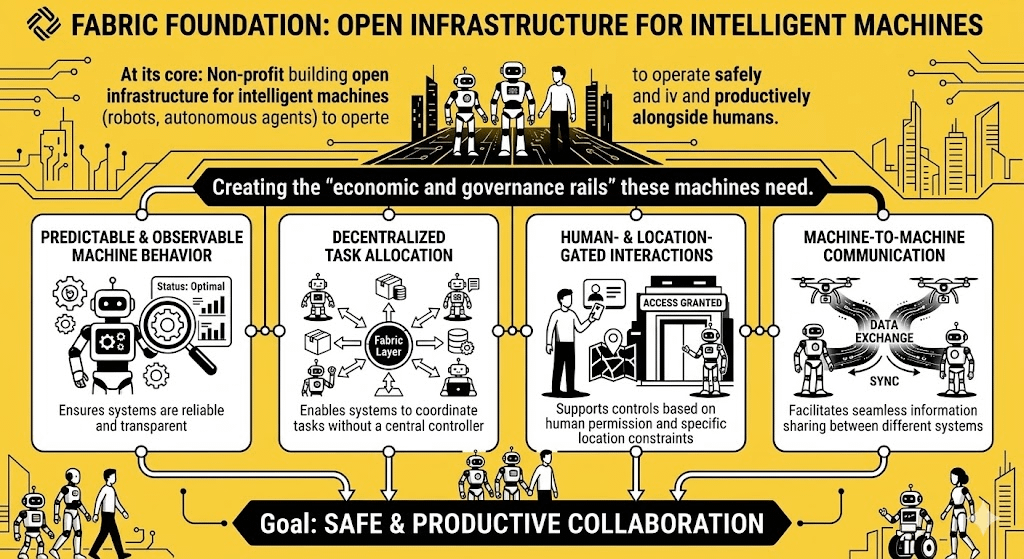
"Fabric Foundation builds the backbone for safe, accountable, and economically integrated AI, turning intelligent machines into reliable participants in real-world environments."
The idea is simple but powerful: instead of treating AI as a back-end software problem, Fabric treats intelligent machines as participants in real-world economies, with governance, identity, and accountability baked in.
One tangible way this shows up is through the ROBO token.ROBO isn’t just a speculative asset—it’s a medium that can represent payments for machine services, incentivize participation, and coordinate tasks between humans and robots. Imagine a warehouse where robotic arms, drones, and human workers are all “paid” or rewarded in a transparent, auditable way that aligns incentives for efficiency and safety.
Key Mechanism or Innovation
The standout innovation here is how Fabric integrates blockchain with physical AI. Most projects either focus on tokenomics or robotics—but Fabric merges the two through a public-good infrastructure that manages identity, accountability, and economic participation for machines.
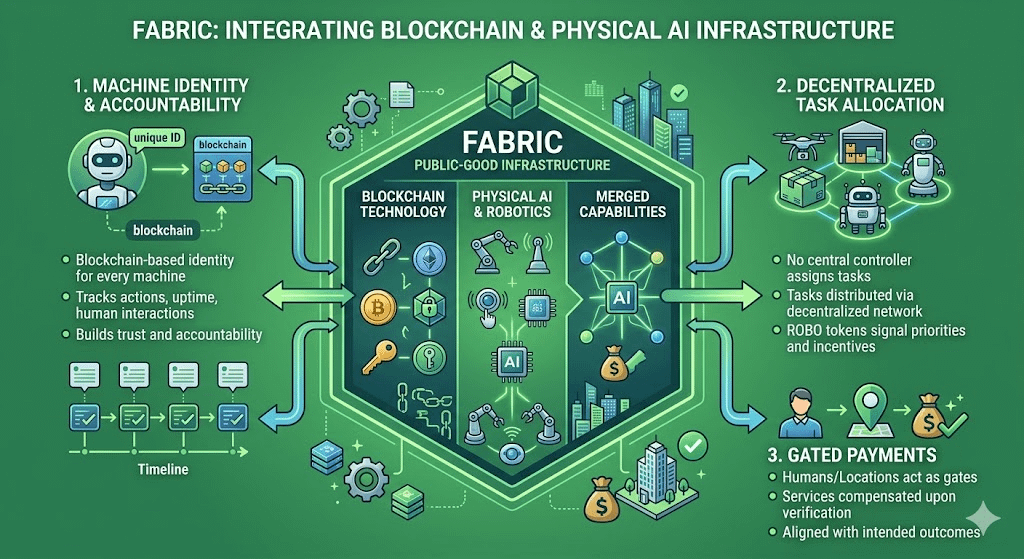
For example:
Machine Identity & Accountability: Every robot or AI agent can have a blockchain-based identity that tracks its actions, uptime, and interactions with humans.
Decentralized Task Allocation: Instead of a central controller assigning tasks, Fabric allows tasks to be distributed in a decentralized way, using ROBO tokens to signal priorities and incentives.
Gated Payments: Humans and locations can act as “gates” for payments, ensuring services are only compensated when verified and aligned with intended outcomes.
This combination of economic incentives and operational transparency is what makes Fabric more than just another AI or blockchain project—it’s a protocol for AI coordination in the real world.
Why It Matters
The implications are broader than you might think. For developers, Fabric provides an infrastructure to deploy AI safely without reinventing governance systems every time. For businesses—warehouses, hospitals, or smart home companies—it offers a predictable, auditable framework to integrate autonomous agents into daily operations.
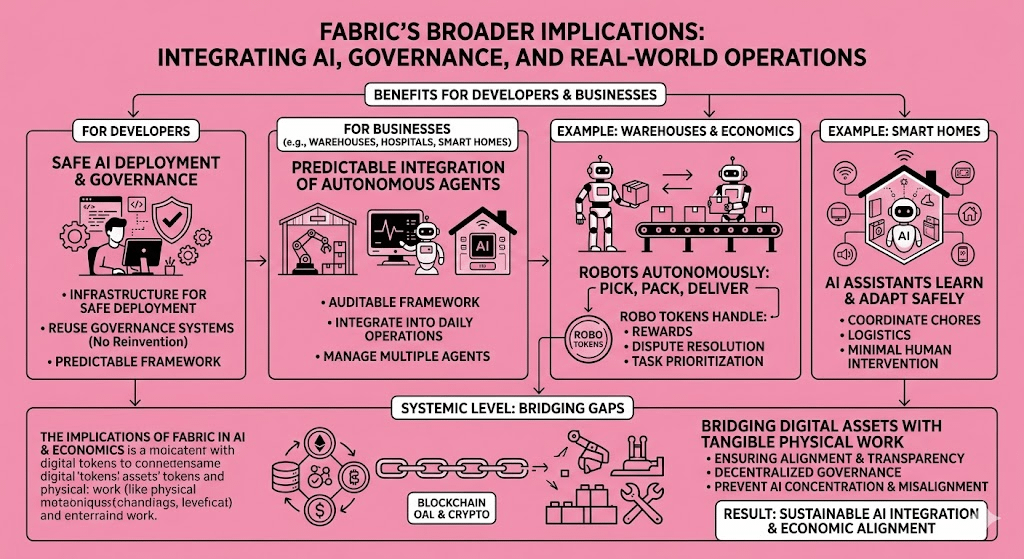
Consider warehouses: robots can autonomously pick, pack, and deliver items, while ROBO tokens handle rewards, dispute resolution, and task prioritization. Homes could see AI assistants that learn and adapt safely, coordinating chores or logistics with minimal human intervention.
On a systemic level, Fabric addresses one of crypto’s less discussed gaps: bridging digital assets with tangible, physical work. By ensuring alignment, transparency, and decentralized governance, it could prevent AI concentration and misalignment that we often worry about in emerging tech.
My Perspective
I find Fabric exciting because it tackles a practical problem rarely addressed: how do you make AI useful, accountable, and economically integrated in the physical world? That said, adoption won’t be instant. Robotics hardware is expensive, AI governance is complex, and tokenized economic models require careful tuning. The biggest challenge may be bridging the hype of blockchain with the grounded realities of human-machine collaboration. Still, seeing a system like ROBO funtion as both currency and coordination tool is promising—it hints at a future where AI isn’t just autonomous but socially and economically integrated.
Conclusion
Fabric Protocol isn’t about flashy AI or speculative token trading—it’s about building the foundational layers for intelligent machines to operate safely and productively in our everyday world. With ROBO medium of coordination, decentralized task allocation, and gated economic participation, it bridges a gap few other projects tackle: turning blockchain from a ledger into a governance tool for real-world AI. If it succeeds, warehouses, homes, and other environments could become far smarter, safer, and more economically inclusive, proving that crypto can have tangible, everyday impact.