
If everyone still thinks the AI track is just about making a few chatbots or wrapping an API interface with a new skin, then the cost of that kind of understanding is likely to be harvested by the market as liquidity.
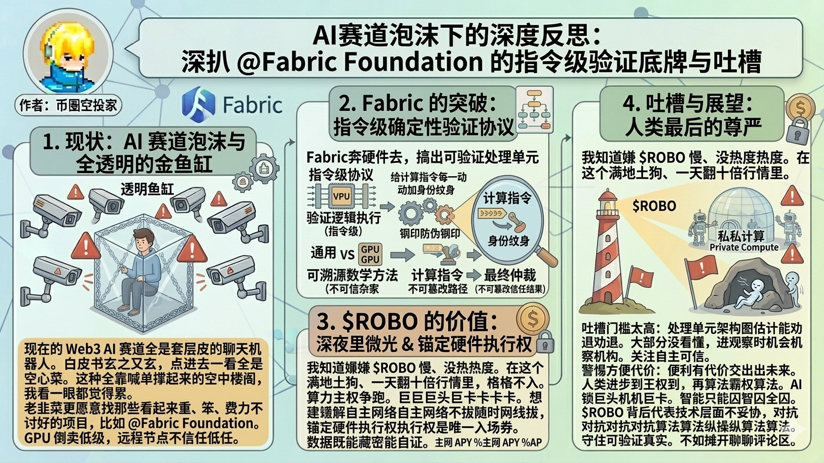
Recently, I've seen quite a few so-called AI projects on Binance Square. When I click in and look at the white papers, they are filled with obscure vocabulary; peeling away the shell, it's all just empty talk. This kind of air castle, built entirely on hype and emotion, makes me feel exhausted just by looking at it. As an old hand who has been rolling in this circle for a long time, I prefer to dig into those projects that seem particularly heavy, cumbersome, and even a bit thankless. That's also why I want to talk to everyone about @Fabric Foundation and their consistently undervalued $ROBO .
Let’s face a hard truth: the current decentralized computing market is basically engaging in low-level resource flipping. Everyone talks about GPUs and rentals, but no one is addressing the fundamental issue: when I run my AI model on an untrusted remote node, how do I know its results are genuine? Did it quietly cut layers off the neural network to save power? Did it leak my private data during computation? If these questions remain unanswered, so-called decentralized AI is just a false proposition.
What truly interests me about the Fabric Foundation is that they aren't just patching software; they're going straight for the hardware. Many know they created a verifiable processing unit architecture, but I want to discuss a seldom-mentioned technical detail buried deep in the white paper: the Instruction-Level Deterministic Verification Protocol.
This concept may sound off-putting, but its logic is actually very down-to-earth. Today's general-purpose GPUs are like a jack of all trades, but no one can keep them in check. What Fabric is doing is putting a 'digital tattoo' on every action of computing instructions. You can think of it like a strict automated assembly line, where each component automatically triggers a security stamp upon installation. In the ROBO ecosystem, computation is no longer a black box; each execution path can be traced mathematically and is non-tamperable. This means we can finally trust complex AI reasoning results just like we trust Bitcoin's ledger.
Now, let’s talk about the ROBO token. I know many people think it's slow and lacks hype. In a market filled with 'meme coins' that can skyrocket tenfold in a day, projects focused on hardware and underlying compiler protocols seem out of place. But you need to understand that the battle for computing sovereignty is an incredibly brutal marathon. Today's AI computing power is firmly grasped by a few giants; if you want to beg for crumbs in their walled gardens, you really don't need #ROBO . But if you want to build an autonomous network that won't get unplugged at any moment, this token, which anchors hardware execution rights, is your only ticket in.
I'm pretty straightforward; the current market atmosphere is quite distorted. People would rather buy meme coins that could zero out at any moment than delve into what sparse matrix acceleration or customized computation instructions are. This disregard for underlying technology is, in fact, a failure to be responsible for one's assets. The Fabric team's methodical, steady approach makes me, someone who's seen too many projects bail, feel reassured. It actually makes me feel at ease as a seasoned trader who’s used to projects running away.
Of course, I have to complain a bit; the barrier to entry for this project is indeed too high. Those architectural diagrams of the processing units in the white paper would probably scare off 90% of retail investors. But therein lies the opportunity; when most people haven't grasped what it's doing, that's when we independent thinkers should step in and observe. I don't expect it to shoot up tomorrow with a big green candle, but I'm more focused on whether we can have computational power that can self-verify in the AI era to come.
The pace of technological evolution nowadays is dizzying, but the faster it goes, the more we need to be wary of conveniences that are all flash and no substance. Every convenience comes at a cost; if you hand over your oversight of the computation process, you’re surrendering your ability to define the future.
From a philosophical angle, the progress of human civilization is essentially a history of power shifts. From divine right to monarchy, and now to the emerging algorithmic dominance. If we allow AI to be locked away in the data centers of centralized giants, the so-called intelligence will ultimately evolve into an omniscient and omnipotent prison. $ROBO It's not just a line of code behind it, but a form of technical 'non-compromise'. It attempts to combat the pervasive algorithmic manipulation with the rigidity of math and hardware.
In this digital wasteland filled with noise and false prosperity, we need projects that carry a bit of 'rebellion'. It doesn't cater to the market; it only aims to solve the core, stark, and most challenging trust issues. If you're tired of meaningless marketing slogans, take a moment to check out those who are laying the groundwork.
In this era where algorithms dictate fate, holding onto verifiable truths is our last dignity as humans.
If you have any questions about Fabric's instruction-level verification or want to vent about the current AI bubble with me, hit up the comments section, and let’s chat openly.