
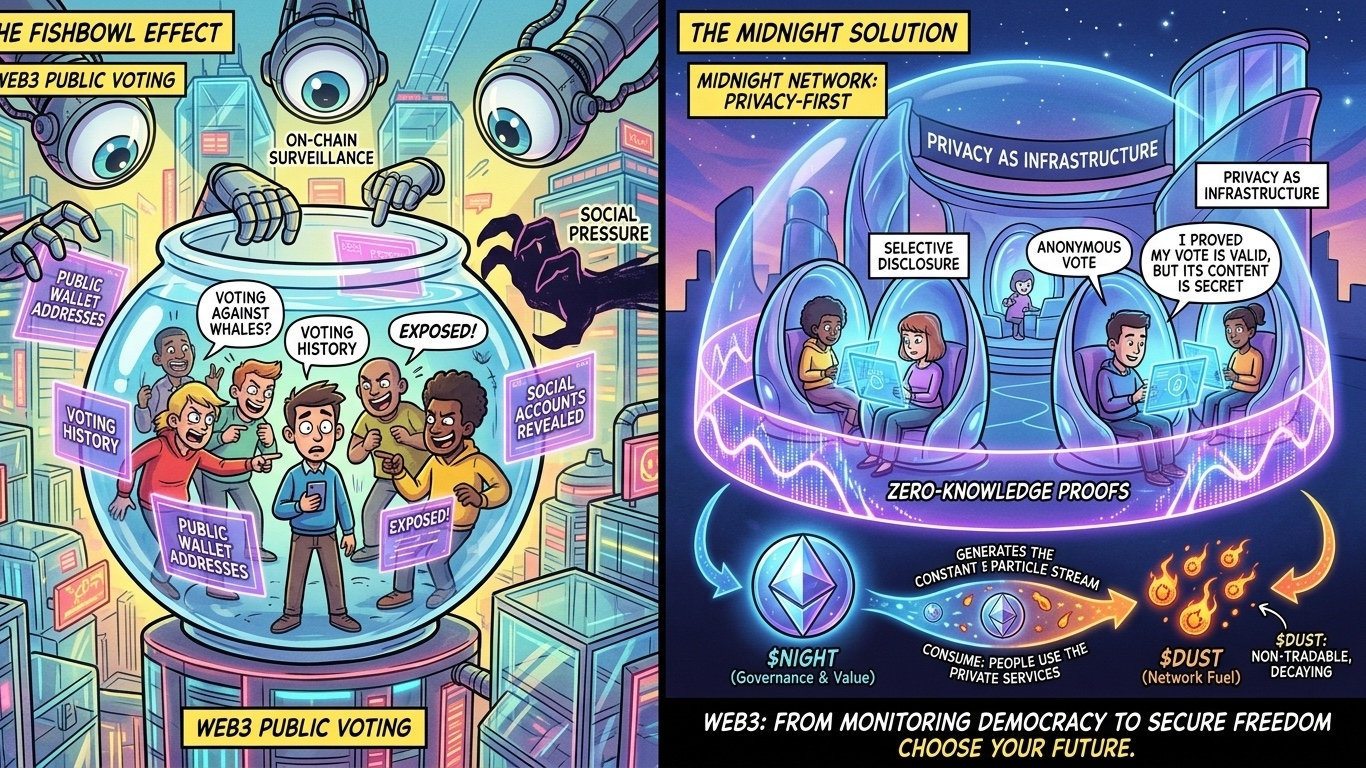
Web3 communities shout every day for 'maximum transparency,' yet they have built a glass fishbowl that never turns off the lights.
Once the DAO opens the vote, the on-chain browser becomes a public detective agency: when a whale moves the mouse, retail investors' FOMO buttons start clicking wildly. Who dares to go against big investors? Who dares to publicly oppose the proposal? A quick check of the address can expose historical holdings, associated wallets, and even off-chain social interactions.
Transparency was supposed to be a tool, but it has become a weapon. A few control the scene, while the majority can only serve as a backdrop, and real opinions are swallowed by fear. This isn't decentralization; it's clearly on-chain 'surveillance-style democracy.'
And @MidnightNetwork goes against the current, instead of piling up more complex multi-signature or quadratic voting systems, it directly engraves 'selective disclosure' into the protocol's core. Using zero-knowledge proofs: I can prove to the whole world that 'I participated in the voting, and my vote is legitimate and valid,' but whether I voted for approval or disapproval, only I know.
This move directly breaks the social prisoner's dilemma of governance. Core decisions can be anonymous, salary discussions can be blind votes, and strategic deployments in the game can be hidden in the 'fog of war.' In the real world, secret voting is the bottom line for protecting minorities and genuine expression; why does the chain require everyone to expose their soul and wallet address?
Midnight brings ZK from the cryptographic laboratory to a place accessible to ordinary DApp developers, making privacy an infrastructure rather than an optional luxury. Its dual-token model is also interesting: $NIGHT manages governance and value capture, holding it can continuously generate DUST, which is specifically used as 'fuel' for network consumption, non-tradable, with decay, designed specifically for high-frequency, private on-chain interactions.
This structure is not born for speculation, but genuinely thinking: when anonymous voting, private identity, and encrypted collaboration become everyday occurrences, how can the underlying economy avoid collapse, stalling, and abuse?
Ultimately, for Web3 to attract the mainstream, it must acknowledge a fact — people are not saints, and no one wants to live their whole life in the spotlight. Making the rules that should be public public, and protecting the privacy that should be protected, is the fundamental way to allow ordinary people to dare to come in, dare to play, and dare to express.
Midnight does not shout hollow slogans but directly installs a privacy switch in the on-chain world: making transparency serve fairness rather than hijacking human nature. This may be the real antidote for Web3 to move from a small circle to the masses. #night