
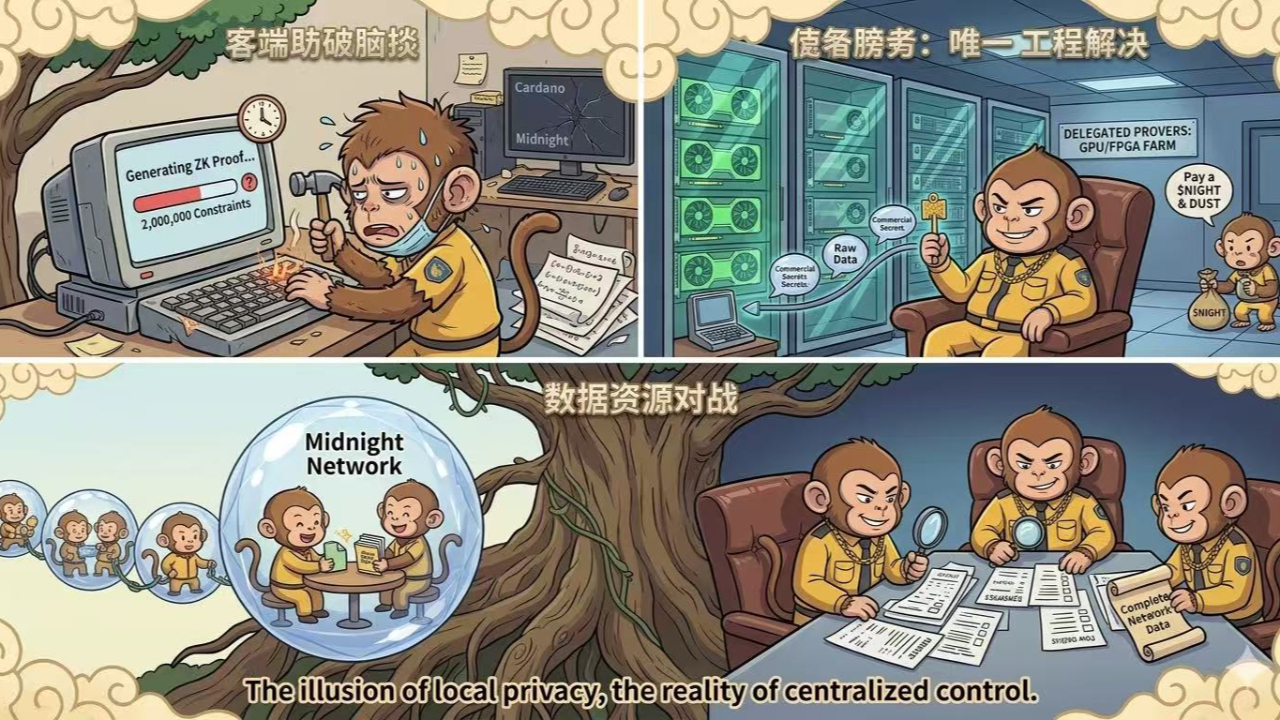

Since the mainnet is going online, let's not discuss those superficial premiums, we need to talk about some hard-core 'big truths'.@MidnightNetwork The current situation is like having built a luxury car that claims to have 'absolute privacy', only to find that the engine is so heavy that it can't move on ordinary roads, which is quite embarrassing.
First of all, this 'client proof' is just a computing power black hole.
The white paper praises 'rational privacy' to the skies, and the core logic is: data doesn't leave your front door, and all calculations are done on your own device. Sounds pretty good, right? But this goes against the most basic principle of 'computational economics'.
I tested a supply chain contract on the testnet, and it was quite astonishing—there were only three privacy condition determinations, yet it compiled to a staggering 2 million arithmetic gate constraints. My laptop, which cost over ten thousand yuan, was almost burning up while running single-core, and I had to wait 40 seconds! By the time you finish this slow computation in 40 seconds, the state on the chain has already changed, making the proof you worked so hard to compute invalid, and you'll have to start over. Isn't this just monkey business?
Second, this leads to a rather ironic 'ecological patch'.
If you can't compute by yourself and still need to do business, what can you do? You can only seek 'external assistance'. After the mainnet goes live, a bunch of 'delegated verifiers' will definitely emerge. They hold piles of high-end GPUs and custom computing cards, specifically helping others with their computations.
The most disgusting part of this is: if you want someone to help you compute, you have to send them the most original and explicit order data, payroll records, and the bottom-line prices of the supply chain, without missing a word.
Third, this directly exposes Midnight's privacy pants.
Everyone, take a look: what kind of privacy is this? From the outside, the chain is indeed full of ciphertext, and no one can see it; but in the eyes of those who possess the largest computing power in the entire network, they can see clearly what color underwear your company is wearing.
The original intention of creating a public chain was to prevent centralized institutions from stealing data. However, due to the complexity of mathematical formulas and the inadequacy of consumer-grade chips, these companies still have to obediently hand over their trade secrets to another group of landlords who possess computing power.
$NIGHT This matter has nothing to do with token price fluctuations, nor with compliance; it is simply a 'deadlock' at the physical level. With the mainnet going live at the end of the month, it's at most just a theoretical playground for geeks. When it comes to the real high-concurrency business battlefield, outsourcing computing power will be the only way out, and the concentration of private data is the 'blood tax' that this cryptographic system must pay.#night