
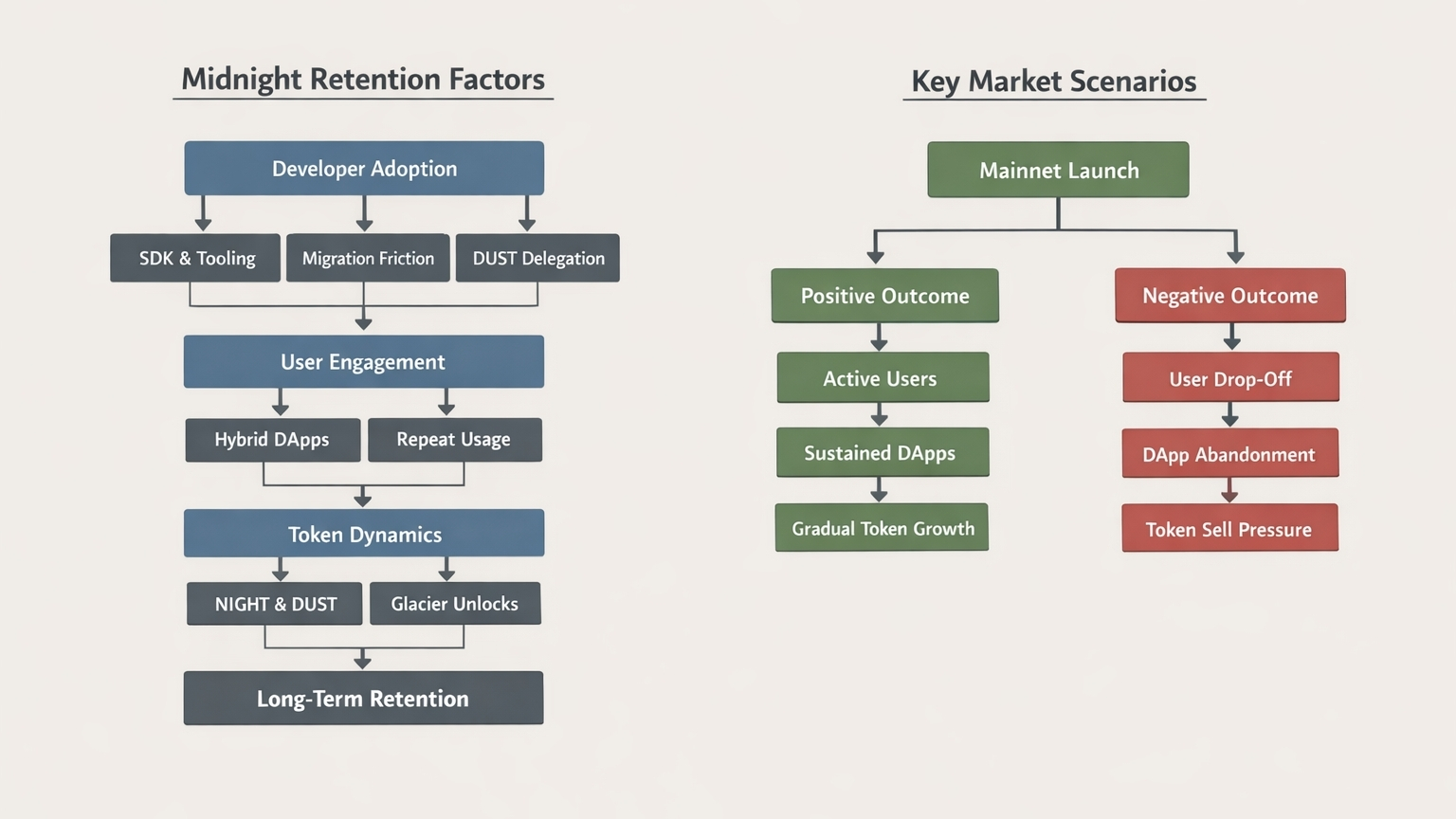

I remember the first time I looked at Midnight and thought, this is either smarter than the market thinks or harder than it looks. Usually when a privacy project shows up, traders know the script. Price reacts to the privacy label, people argue about regulation, and a lot of the discussion never gets past the headline. Midnight felt different to me because the design wasn’t really selling hidden money. It was selling controlled disclosure. That sounds subtle, but from a market standpoint it changes the whole bet. The risk is still obvious. A privacy-first chain can attract attention faster than it can keep users, and if retention breaks, the narrative breaks right behind it.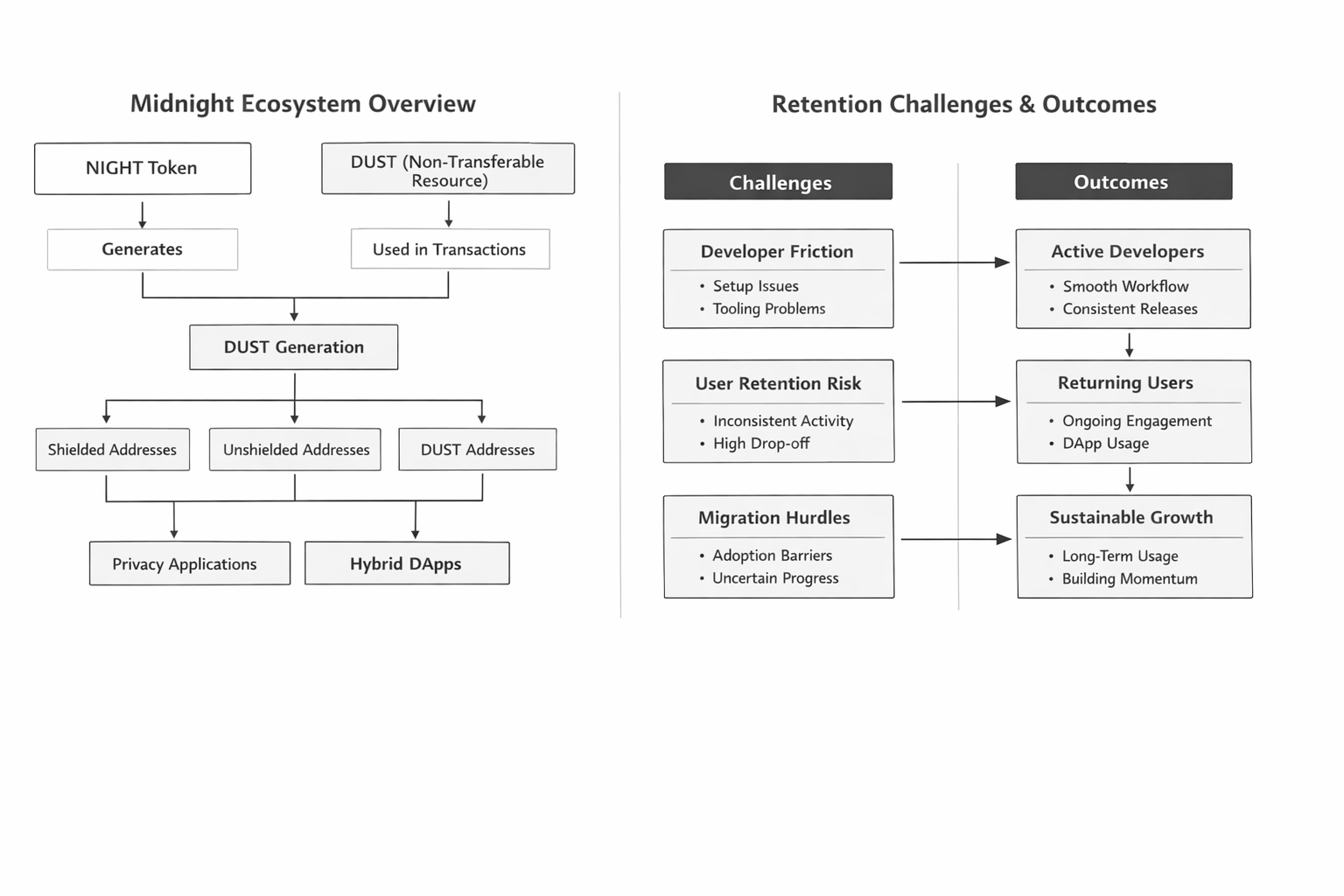
That’s the part I’d put upfront if you’re trading or investing around this. Midnight’s model only works if privacy turns into repeat behavior, not a one-time curiosity. The network’s token design is trying to force that distinction. NIGHT is the native token, while DUST is the non-transferable transaction resource. Holding NIGHT generates DUST, and DUST is what powers transactions. Midnight presents that as a way to support privacy for application data without creating anonymous value transfer rails, since DUST cannot be sent between wallets to settle debts or buy goods. Developers can also delegate DUST so users can interact with apps without directly carrying the cost burden themselves. In theory, that is a cleaner setup for real applications than the usual privacy coin framing. In practice, it means the real question is not whether people like privacy. It is whether developers can make privacy feel easy enough that users come back. That is where the retention problem stops being a side issue and becomes the whole trade. Midnight can get attention from listings, launch milestones, and the broader Cardano orbit, but none of that guarantees durable usage. Even the token release structure hints at this. The Glacier Drop redemption unfolds over a 360 day thawing schedule in four equal installments, with randomized initial unlock dates between December 2025 and early March 2026. That reduces the chance of one clean speculative burst followed by immediate exhaustion, but it also means the market keeps getting fresh moments to test conviction. If users claim, trade, and disappear, then the staggered unlocks become a recurring sell event. If they claim, build, hold, and use apps, then the same schedule looks more like a slow distribution of committed participants. Same mechanism, very different read. What got my attention recently is that the builder side is at least moving toward a real proving ground. Midnight said in February that mainnet is coming in late March 2026, and it has been pushing developers to move workflows onto preprod with updated tooling, examples, and package versions. The Preview onboarding guide also shows major SDK and token model changes, including the move to distinct shielded, unshielded, and DUST addresses, plus breaking changes in midnight-js v3.0.0. That matters because it tells you Midnight is no longer living in abstract architecture slides. It is in the messy stage where developers have to migrate, reconfigure, and prove they still want to be here once the tooling gets real. Still, here’s the irritation I can’t ignore. Real retention gets tested in friction, and the public builder chatter already shows some friction. Forum posts from March point to inconsistencies around create-mn-app, network naming, and faucet access. That is not fatal. Early networks always have rough edges. But if you are trading this like a serious workflow story rather than a headline story, those details matter more than people admit. Developers do not stick around because a roadmap sounds good. They stick around because setup is clear, docs line up with the software, and building feels less painful each month, not more. On the market side, NIGHT is not exactly being ignored. CoinGecko currently shows Midnight with a market cap around $850 million and a ranking near the top 100, while CoinMarketCap’s recent analysis had the token trading around $0.05 in mid March. That gives Midnight enough size for traders to care, but it also raises the bar. At this valuation, I do not think “privacy-first” alone is enough. The market will eventually want evidence that users are staying for hybrid applications, selective disclosure, and repeat DApp activity rather than rotating through another launch cycle. Midnight’s own roadmap points in that direction, with mainnet in the Kūkolu phase and hybrid DApps arriving later in Hua, but roadmaps do not solve retention by themselves. So what would change my mind, either bullish or bearish? I’m watching whether preprod activity turns into credible mainnet behavior, whether developers keep migrating despite the bumps, and whether DUST delegation actually helps apps reduce user friction instead of adding one more layer people have to learn. I’m also watching whether Midnight’s privacy model becomes a habit inside applications that need selective disclosure, not just a narrative people trade around for a quarter. That is the bigger picture fit here. If Midnight succeeds, it will not be because traders loved the word privacy. It will be because builders made privacy operational, repeatable, and boring in the best possible way. If you’re eyeing NIGHT, do not stop at listings, market cap, or the privacy tag. Track whether users return, whether builders keep shipping, and whether the retention problem starts shrinking in plain sight. That is where this story will either harden into substance or crack under its own design. Watch the behavior, not the slogan, because in projects like this the truth always shows up in who comes back.