

I’m looking at Midnight Network right now, and I’ll be honest it doesn’t give me excitement.
I’m not really wired that way anymore.
I’ve spent too much time watching this market repeat itself. New projects show up, new branding, new words, new promises. But underneath, it’s usually the same structure. Same problems. Same cycle. After a while, everything starts to blur together.
So when I say Midnight feels different, I don’t mean it feels brand new.
I mean it feels aware.
I’m reading through it, and I’m thinking—this project knows the old ways aren’t working anymore. It knows people are tired of choosing between two extremes: everything public or everything hidden.
And honestly, I’m tired of that too.
I’m watching how crypto still treats transparency like it’s automatically a good thing. Like if everything is visible, then everything is trustworthy. But I’m sitting here thinking—that’s not always true.
Sometimes full transparency creates more problems.
I’m looking at it from a real-world angle. If every action, every transaction, every bit of logic is permanently visible, that’s not just openness. That’s pressure. That’s exposure. That’s a system where people have to think twice before doing anything.
And I’m noticing that Midnight seems to understand that.
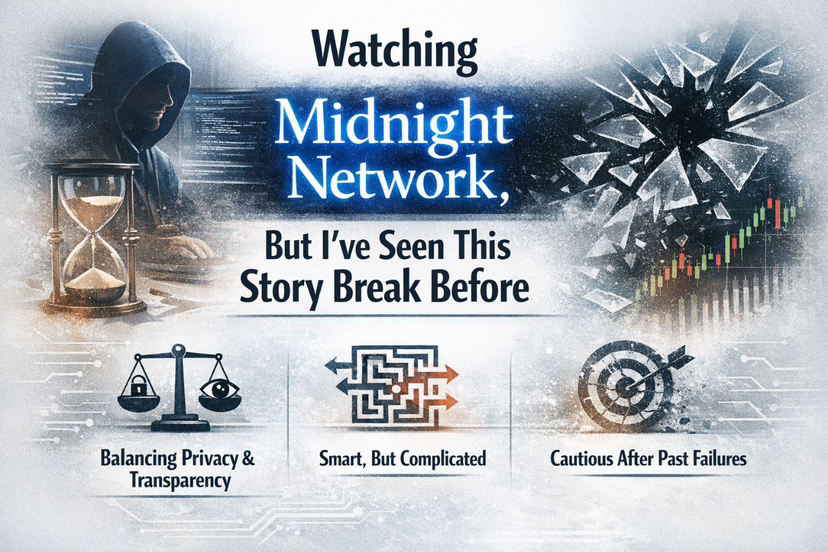
It’s not trying to say “hide everything.” I’m not getting that vibe at all. Instead, I’m seeing a project trying to figure out how to balance things.
I’m reading it as: what should be private, and what still needs to be proven?
That’s a much harder question.
And I respect that they’re even trying to answer it.
But at the same time, I’m staying cautious.
Because I’ve seen this before.
I’ve seen projects step into that middle ground and try to solve real problems. They start with good intentions. They sound smart. Everything makes sense when you’re reading through it late at night, connecting the dots.
But then reality shows up.
Builders want flexibility.
Users want safety.
Businesses want reliability.
Regulators want control.
And suddenly, all those needs start pulling in different directions.
That’s where things usually start to break.
So I’m not just listening to what Midnight is saying. I’m watching how it might hold up under pressure.
I’m asking myself—what happens when all these demands collide?
Because they always do.
Right now, Midnight feels like a compromise.
And I don’t mean that in a bad way.
I mean it feels like it’s trying to sit between two ideas that didn’t fully work on their own. Full transparency didn’t solve everything. Full privacy didn’t either. So now the question is—can something in between actually work?
That’s what I’m watching.
But here’s where I get careful.
I’ve seen this market take a good compromise and turn it into hype. Suddenly people start acting like it’s the perfect solution, like it solved everything.
And I don’t see Midnight that way.
I see it as a project trying to deal with a real problem that crypto hasn’t handled well yet.
That’s different.
And that’s why I keep coming back to it.
I’m not convinced. But I’m not ignoring it either.
Because the problem it’s targeting is real.
People don’t want their entire activity history exposed forever.
They don’t want every transaction to become a public trail that anyone can follow.
They don’t want privacy to feel like some optional feature that only exists at the edges.
And I think Midnight is stepping into that gap.
But once I see that, I start digging deeper.
I’m looking for the weak spots.
I’m looking for where the language gets vague.
I’m looking for where the promises sound big, but the actual implementation might be smaller or more limited.
Because that’s where the truth usually is.
I’m not interested in the surface-level pitch. I’m watching how this holds up when things get complicated.
And they will get complicated.
Because privacy at scale is not simple.
You have to balance proof and confidentiality.
You have to make sure systems are usable, not just secure.
You have to build something that people can trust without seeing everything.
That’s not easy.
And I’m wondering if Midnight can really handle that.
Or if it starts bending once real-world pressure kicks in.
I’ve seen serious projects fail in that exact spot.
They start strong. They look thoughtful. They attract attention for the right reasons. But over time, they adjust. They compromise more than expected. They shift to fit the environment they’re trying to survive in.
And slowly, the original idea changes.
Not all at once.
Just little by little.
Until one day, you realize it’s not quite what it started as.
That’s always in the back of my mind.
So I’m watching Midnight with that lens.
I’m not just asking what it claims to solve.
I’m asking what it needs in order to work.
What kind of system has to exist around it?
Who is it really built for?
Who does it need to satisfy?
Because those answers matter more than the pitch.
Right now, Midnight feels controlled.
Deliberate.
Like the team understands the market is tired.
Tired of loud promises.
Tired of projects that try too hard to sell themselves.
So instead, this feels quieter. More measured.
And weirdly, that makes me more cautious.
Because I’ve seen serious-looking projects fail too.
Not loudly.
Quietly.
They make sense. They attract the right people. They solve real problems. But they still don’t reach that point where people truly need them.
And without that need, nothing lasts.
So I keep asking myself—does Midnight become something people actually depend on?
Or does it stay as something people respect but don’t use?
That’s a big difference.
I do think Midnight reflects where the market is right now.
More mature.
More careful.
Less interested in extreme ideas.
More focused on what actually works.
And I think that shift is real.
People are starting to question whether full transparency was ever the right default.
They’re starting to look for something more balanced.
Something more practical.
Midnight fits into that moment.
But that also makes me cautious.
Because sometimes, a project shows up at exactly the right time, and people project their expectations onto it.
Builders see opportunity.
Users see relief.
Investors see a narrative.
And suddenly, the project becomes bigger in people’s minds than it actually is.
That makes it harder to evaluate.
And that’s kind of where I am right now.
I don’t think Midnight is empty.
I don’t think it’s just another name passing through the cycle.
I think it’s trying to solve something real.
But I also think it’s stepping into a very complex space.
Where privacy, trust, and usability all collide.
And that’s not a clean problem.
So I’m not forming a final opinion yet.
I’m just watching.
I’m reading.
I’m trying to understand what this becomes when people actually start using it.
Not when it’s being explained carefully.
Not when it’s being introduced with the best framing.
But when it’s out in the real world, dealing with real demands.
That’s the moment that matters.
And until then, I’m staying in that middle space.
Not convinced.
Not dismissing it either.
Just watching closely, trying to figure out if this is one of the few projects that can actually carry its weight…
or just another smart idea that starts strong and slowly bends under pressure.