
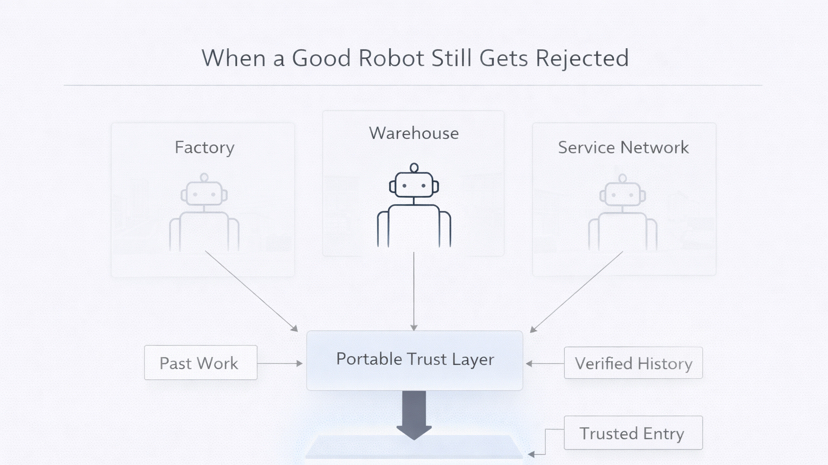
I keep thinking about one simple problem that most people ignore when they talk about robotics. Everyone gets excited when a robot can move faster work longer or complete tasks with better precision. But real adoption does not stop at performance. A robot can do everything right and still get rejected the moment it enters a new place.
That is the hidden gap.
A robot may finish hundreds of useful tasks in one environment. It may carry goods safely inspect equipment correctly or support service work without mistakes. But when it moves into a new factory warehouse or service network the next operator often has no clear way to trust what that robot already achieved before. In many cases the machine starts again from zero.
To me that feels like one of the most important reasons why robotics growth still moves slower than people expect. The problem is not always the machine. The problem is memory trust and portable proof.
This is where Robo becomes interesting in a deeper way.
Robo is not only about making machines active. It is about making their useful history matter. That changes the conversation. Instead of asking only what a robot can do right now we can start asking what this robot has already proven across real tasks and whether that proof can travel with it. That is a much stronger model for the future.
Because in the real world nobody wants to guess.
A company does not want to depend on a machine without knowing its past quality. A partner does not want to connect a robot into operations if there is no trusted signal around its behavior. A service platform does not want random machines entering the system without proof of performance. What they need is not marketing. What they need is confidence.
Robo touches that confidence layer.
It creates the idea that a robot should not arrive as an unknown object every single time. It should arrive with visible work value. That means task history reputation and verified results can become part of the machine identity itself. Once that layer exists robotics stops looking like isolated hardware and starts looking like an economy of trusted agents.
This matters more than people think.
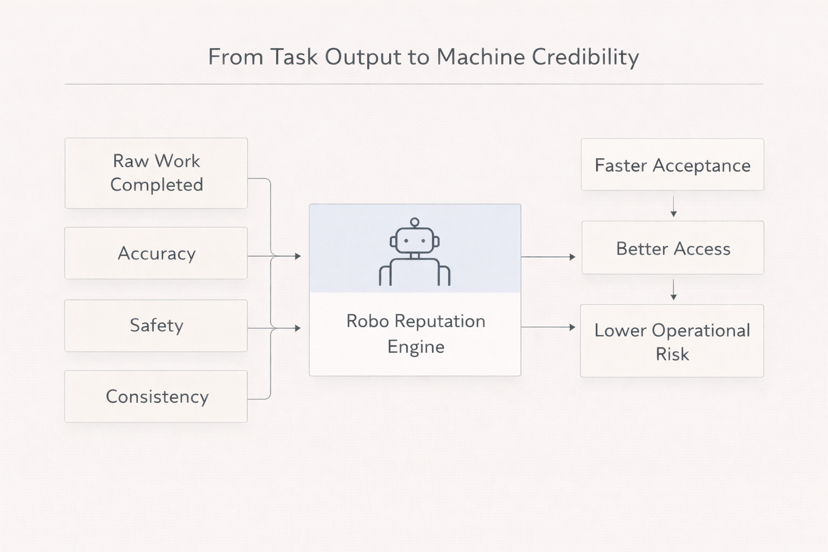
Without portable trust the market wastes time on repeated checks repeated doubt and repeated onboarding. Every new environment becomes a fresh negotiation. That slows scaling and increases friction. But if a robot carries a trusted record of what it has already done well then onboarding becomes easier risk becomes lower and the value of good machine behavior compounds over time.
That is the part I find powerful.
Robo is quietly shifting the focus from robot presence to robot credibility. And credibility is where real markets form. A machine that can prove consistent useful behavior becomes easier to deploy easier to integrate and easier to reward. Over time that could shape how platforms choose robots how businesses assign work and how machine based services build long term preference.
In simple words Robo is helping robots become known before they even begin the next task.
That is a very different future from the usual robotics story. Most projects talk about capability. Robo opens the door to continuity. Capability says a robot can perform. Continuity says this robot already has a record that makes people ready to trust it again. That second part can decide who gets access and who gets ignored.
And honestly that is why this project stands out to me.
The next wave of robotics will not be won only by the smartest machine. It may be won by the machine that can carry proof of useful behavior from one environment to another without losing its identity. If that layer becomes real then robots stop being temporary tools and start becoming trusted participants in systems that actually create value.
That is why I do not look at Robo as just another robotics name. I look at it as a project trying to solve the moment where machine performance meets human doubt. And if that problem gets solved well then robotics may scale in a much more practical way than most people are expecting right now.
Robo is not just asking whether a machine can work.
It is asking whether the world can remember that it worked well.
