
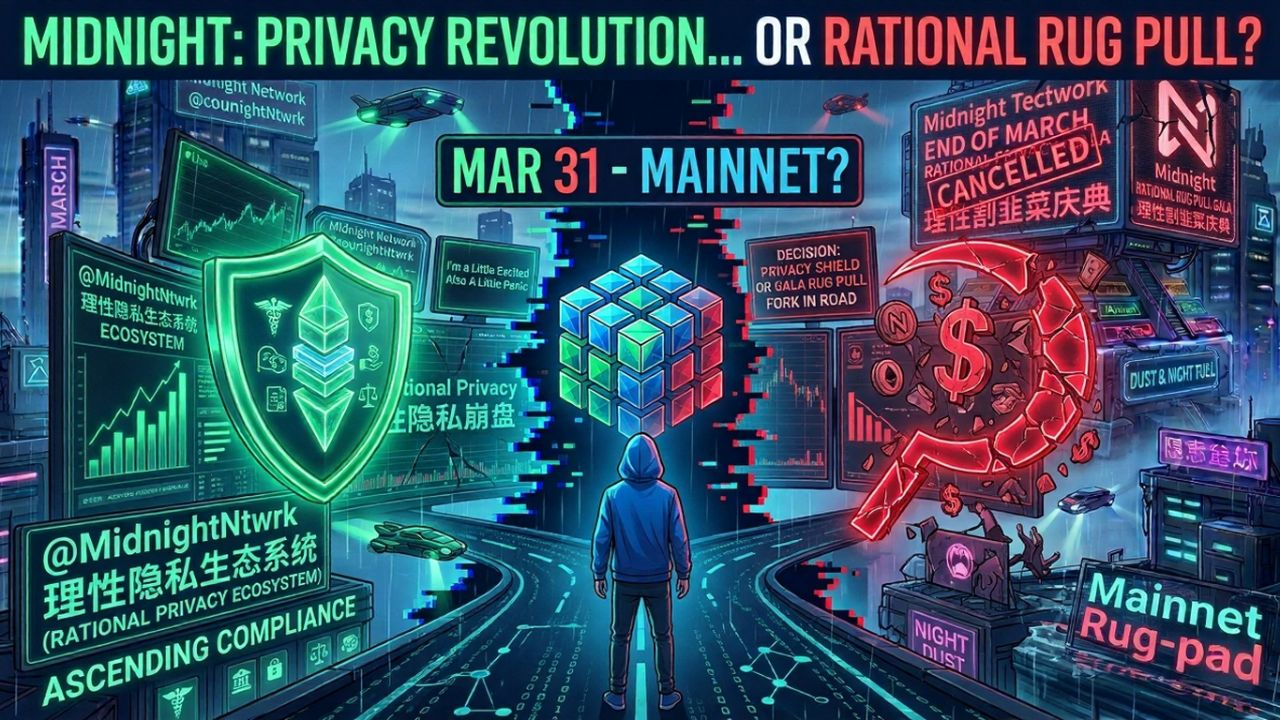
Recently, I've been a bit annoyed by the bombardment from @MidnightNetwork .
Every day is either a 'rational privacy revolution' or 'the most loved by institutions', making it seem like blockchain history is about to change.
I watched for a long time and couldn't help but want to complain a bit; it's not purely black, just peeling back this project to show everyone whether it's a dark horse or a pitfall.
Let’s briefly talk about what this project is all about.
Midnight Network is a partner chain developed by Charles Hoskinson's team on Cardano, focusing on a concept called 'rational privacy'. In simple terms, it aims to avoid being as completely anonymous as Monero (which makes regulators headache), while also not being as fully transparent as regular public chains, instead using zero-knowledge proofs to allow users to selectively disclose information.
For example, proving your compliance, age, and payment ability, but the specific details are hidden from view. They created a dual ledger, with a public state for governance and a private state for hiding data; developers can write privacy contracts using a language similar to TypeScript called Compact. There are also dual tokens, NIGHT and DUST, where holding NIGHT will automatically generate DUST as privacy fuel.
It does sound like there’s something to it, especially for scenarios like institutions, RWA, and medical data that require both privacy and compliance.
But reality always likes to slap you in the face.
What I hate the most is that phrase 'Kūkolu Federal Mainnet launching at the end of March.' Charles said it in person at Consensus Hong Kong, and the node list looks impressive, with big names like Google Cloud, Blockdaemon, and MoneyGram. But upon closer inspection, the essence of this federal mainnet is still about trusted nodes running first, and full decentralization won’t be seen until the second half of the year. In plain terms, it’s meant to be used in a centralized manner first, and then we’ll see how it goes. Isn’t this the old routine? From last year to this year, the community has been teased repeatedly with 'coming soon', 'imminent', and 'countdown', and now it’s happening again.
Some people can't help but buy the dip, and now they're down nearly half, cursing in the group every day, saying 'It's another slow work from the Cardano series.'
What’s even worse is the token economy. Glacier Drop directly released over 450 million NIGHT, unlocking in phases every 90 days until the end of the year. Each time tokens are unlocked, the price gets smashed; after listing, it has been cut down by more than 60% from its peak, and when trading volume collapses, it directly leads to an avalanche. The promotion says the DUST model is friendly in the long term, but who can withstand this selling pressure in the short term?
Currently, ShieldUSD is still in testing; GalaxySwap claims it will launch soon but hasn't shown any signs yet, and there are very few dApps that are actually implemented. The TVL is still in the early stages, the barrier to entry for developers is low, but we haven't seen any killer applications that can really make a mark yet. It feels like it's still mostly concepts being hyped.
Of course, I'm not saying that Midnight is without merit. The concept of rational privacy is indeed more realistic than pure privacy coins, and Cardano's low fees and security foundation are still intact. If the mainnet can be stably launched, and the first batch of dApps can come out, with institutional funds willing to enter, then it could indeed become a player in the privacy track.
But as it stands, the promotion is clearly greater than the substance. The ability to paint a nice picture is top-notch, the node list looks good, and the AI demo videos are flashy, but the actual implementation and price performance are increasingly uncertain.
My current mindset is: brothers who want to play should suggest starting with a small position and decide whether it's really good after it lands. Don’t let the four words 'rational privacy' cloud your judgment; if you end up rationally losing money, that’s just too rational.
