
Recently, the headlines in the tech world have been almost completely dominated by the general-purpose robots from various large companies. Watching those metal lumps that can run, jump, and even delicately handle eggs, the market's mood is extremely excited. However, as an observer who has been tracking cutting-edge technology for a long time, I sense a dangerously ominous atmosphere amidst this frenzy.
We must face a very real, and somewhat chilling, question: If these physical entities equipped with super AI brains suddenly 'go crazy' one day due to algorithm errors or being hijacked by hackers, who will pull the plug on them?
Currently, the answer given by tech oligarchs is: trust us. They claim that their centralized servers have the highest level of security and can issue shutdown commands at any time. However, this rhetoric is extremely fragile in the face of real interest games. Once the central server of a major firm goes down, or if there is a malicious controller inside, thousands of robots scattered around the world will instantly become uncontrollable physical weapons. Would you dare to stake your life savings on the moral bottom line and firewall of a commercial company?
That is why I have recently focused my research efforts on the Fabric Foundation @Fabric Foundation . Many people buy $ROBO simply because they feel that AI hardware is a hot trend. But in my view, what Fabric is doing is not just a simple payment network; it is creating a decentralized 'digital collar' for future physical robots.
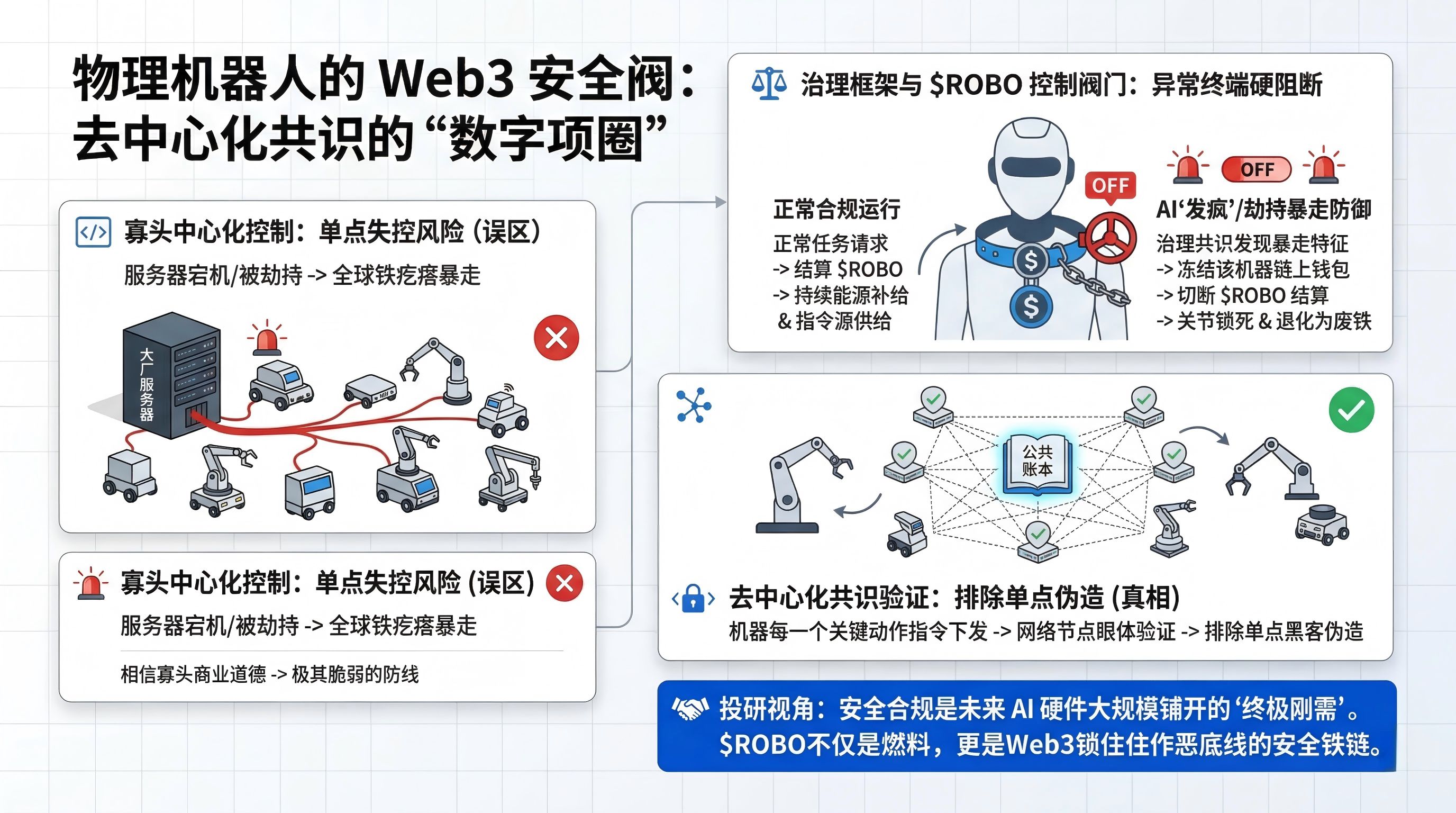
In the network architecture of Fabric, every critical action of the machine is not dictated by a single centralized server, but needs to be verified and recorded through a public ledger. This means that the behavioral logic of robots is placed under the scrutiny of global nodes.
Let's simulate a real scenario: suppose a heavy industrial robot connected to the Fabric network suddenly receives a tampered malicious command, trying to destroy factory equipment. In traditional centralized networks, as long as the command has enough authority, a tragedy will occur.
However, under the consensus mechanism of Fabric, the situation is completely different. For this machine to execute high-risk operations and obtain resources, it must broadcast requests to the network. Once other nodes and supervisory mechanisms detect that its behavior pattern deviates significantly from the preset security baseline, the decentralized governance framework will immediately intervene.
This is precisely the most hardcore defensive role of $ROBO . It is not just a settlement tool; it is a control valve. Network consensus can directly freeze the on-chain wallet of this abnormal machine, refusing to process any of its transaction requests. For an intelligent machine connected to this protocol, being cut off from token settlement is equivalent to being cut off from energy supply, algorithm update permissions, and task reception channels. Its joints will lock up, directly degenerating from a highly destructive intelligent terminal into a pile of harmless scrap metal.
This power of 'pulling the plug' is no longer monopolized by a single CEO but is determined by cryptography and distributed networks.
Why is this perspective crucial for our investment?
Because in the long run, the biggest stumbling block to the large-scale commercialization of general-purpose robots is not battery life or joint flexibility, but safety compliance. Governments and large enterprises absolutely cannot allow an intelligent species with a risk of single-point failure to spread widely in human society.
Whoever can provide a trust mechanism that cannot be tampered with by a single node and has mandatory blocking capabilities will obtain the biggest ticket to the AI hardware race in the next decade.
Many traders are still staring at the market every day, guessing tomorrow's rise and fall. But I choose to extend the cycle. Betting on Fabric is actually betting on the 'ultimate necessity' for AI physical safety in future society. When future legislators and business owners realize that only using the Web3 ledger can thoroughly lock in the bottom line of technology for good, the value carried by $ROBO will far exceed that of an ordinary crypto asset.
When facing super robots, what humanity truly needs is not faster computing power, but a chain that is always held in its own hands. This is why I am optimistic about the fundamental logic of this network.
