
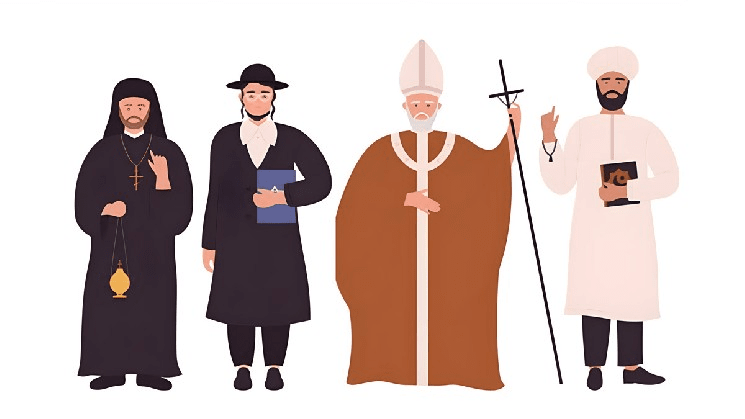
The three most widespread religions — Islam, Christianity, and Judaism — have pondered the influence of money on human morality, the unequal distribution of wealth, and extreme poverty since their inception. Now they have to grapple with a new type of money — cryptocurrency.
Islamic leaders cannot agree.
In Islam, there is no central authority like the Pope, so religious figures must decide for themselves whether cryptocurrency is halal — that is, permitted by Islamic law. Islam has strict definitions of acceptable currency and clear rules against usury.
Hamza Redzuan, an analyst at the Qatari Center for Global Banking and Finance, writes: 'Some cryptocurrencies are considered Shariah-compliant, but overall cryptocurrencies evoke mixed opinions in the Islamic world.'
'Some Islamic legal scholars argue that investing in cryptocurrencies is halal if the underlying project is halal, while others consider the entire category haram [forbidden] because the characteristics of cryptocurrencies — such as valuation based on market fluctuations and use in gambling — are deemed incompatible with Islamic law.' The National Council of Ulama of Malaysia banned cryptocurrencies in 2021 due to elements of uncertainty, gambling, and harm.
Other Islamic religious figures criticizing cryptocurrencies express concern about the lack of real value in cryptocurrencies. Islamic law researchers Mohammad Rasikh Wasiq and Mohammad Hamed Shahab write: 'Bitcoin does not meet two criteria for Islamic money. First, it has no real value, and second, the price of Bitcoin is extremely unstable. Moreover, Bitcoin and other cryptocurrencies are non-material. Considering these three criteria, Bitcoin is not legitimate in Shariah-compliant transactions and cannot serve as the basis for transactions in Islam.'
Nevertheless, there are organizations specializing in Islamic finance that have introduced rating systems for cryptocurrencies. Practical Islamic Finance (PIF) has an index that assesses the halal status of assets as 'comfortable', 'questionable' or 'uncertain'.
Moreover, just as there are Islamic financing projects providing funds without interest, there are cryptocurrency projects aimed at Islam that are attempting to comply with religious prescriptions. The Islamic project ISLM claims to provide an asset that adheres to the principles of Islamic finance and operates on the Shariah-compliant Haqq blockchain ('haqq' means 'truth' in Arabic).
He even uses Shariah Oracle, which 'ensures that all smart contracts interacting with HAQQ Wallet comply with Shariah, meaning adherence to Islamic principles and ethics.'
Redzuan says that given the ongoing discussions and Islamic crypto projects, 'there are now definitely more recommendations and regulations for Muslims wishing to invest in crypto assets in a way that aligns with their principles.'
Cryptocurrencies in Christian tradition.
2.5 billion Christians worldwide represent tens of thousands of denominations, each with its own attitude toward money and cryptocurrencies.
Many of the older and more conservative denominations have taken a hard stance. The Russian Orthodox Church has completely rejected cryptocurrency, stating that it will not accept donations in Bitcoins or any other form of cryptocurrency.
The Catholic Church, while not having a specific position on cryptocurrencies, has expressed skepticism and caution regarding new technologies. The late Pope Francis described the 'technocratic paradigm' in a speech at the World Economic Forum in January, which 'views all global problems as solvable exclusively through technological means.'
However, other Christian denominations have embraced blockchain technology and cryptocurrencies as a means to advance their mission.
In August 2024, the church from Colorado, One Hope of Colorado, tokenized the historic Old Stone Church in Fort Collins on the Polymesh blockchain. One Hope rented the church and hoped to raise money to purchase the building outright.
With Bitcoin, you reap what you sow.
For other Christians, Bitcoin provides a more ethical form of money than fiat currencies, aligning with biblical principles.
Jordan Bush, a former pastor and missionary, founded the podcast Thank God for Bitcoin. His stated goal is to 'educate and equip Christians with an understanding of Bitcoin and use it for the glory of God and for the good of people around the world.'
Bush told the magazine that Bitcoin can be a powerful tool for Christians. Several years ago, while preaching in Montevideo, Uruguay, he encountered Venezuelan refugees escaping the harsh economic situation in their homeland.
'We start asking these people why they are here and what is happening. And while we are giving them food and helping them buy furniture, doing all the usual missionary work, many of them just said: 'It's because our government has devalued our currency.'
'I got into Bitcoin, and when I started just thinking about the implications of these problems and the implications of printing money, the implications of bad monetary policy, I began to wonder if we could try to do something very similar with Bitcoin.'
The fiat money system complicates people's ability to get what they need, says Bush, as it 'mainly allows governments and central banks to create money out of thin air without any cost in a way that gives them virtually unlimited power, control, and influence.'
'They are actually establishing a system that gives them god-like power and denies sowing and reaping, saying: 'Hey, we can reap where we did not sow. Debt is just money we owe ourselves. You know, the deficit governs all of you, mere mortals, but it does not govern us.''
For Bush, this goes against what the Bible teaches, particularly regarding the metaphor of 'reaping what you sow' from Galatians 6:7-9. 'Whatever a man sows, that he will also reap. For he who sows to his flesh will of the flesh reap corruption, but he who sows to the Spirit will of the Spirit reap everlasting life,' wrote the Apostle Paul.
By not reaping what is sown, the fiat money system contradicts how, according to the Bible, the world is arranged, says Bush. The aim of his project Thank God for Bitcoin is ultimately to make Christians think more about money and its impact on spiritual life.
'We want to shed light on the story and tell about the darkness of what is happening: here is how this system works, and here are the consequences.'
'My goal is to change the hearts and minds of people and bring them to a point where they do not want to live in a rent-seeking behavior world.' The religious figure believes that people should stop wanting to receive money without producing anything new.
Bush clarifies that he does not consider Bitcoin a panacea. 'Money is mainly a means. It is a vehicle for transferring value between two people, so both parties in the transaction get what they truly need, whether it is food, clothing, or something else.'
Judaism: Bitcoin as a commodity.
According to Jewish law, cryptocurrency cannot be considered money, writes Rabbi Yehuda Shurpin of Chabad St. Louis Park. Currency 'is defined as something that a sovereign government has declared legal tender of the country and/or is a widely accepted currency used in that locality.'
Instead, Bitcoin is considered a commodity. 'In practice, this means that if you borrow Bitcoin from someone, you need to return the value of the Bitcoin you borrowed, not the Bitcoin itself.'
This is based on the principle of sea be-sea (measure for measure), where loans of goods 'must be made based on the value of the goods at the time of the loan.'
'This principle is not just an academic discussion about some ancient legal oddity; it remains relevant today,' said Rabbi Daniel Friedman, acting junior rabbi at Park East Synagogue in New York.
'For example, rabbis discuss whether people living in Israel can borrow and repay American dollars at equal value in USD. Or, to avoid payment or interest accrual, should you calculate the equivalent in shekels on the days of lending and repayment — and add or subtract accordingly?'
For thousands of years, people have discussed what makes one currency or commodity more valuable than another — far longer than Bitcoin has existed. Friedman says the key takeaway from the Talmud is 'undoubtedly the uncertain value of material goods.'
'How much do apples and oranges cost? As much as, in the opinion of the market — that is, the population as a whole — they are worth. How much do gold and silver cost? As much as, in the opinion of the market, they are worth. How much do dollars and shekels cost? As much as, in the opinion of the market, they are worth.'
He tells the story of Yankel, a poor tailor from Pinsk who could never save enough money. Hearing that there is a distant island with beaches made of diamonds, he sets sail there and, upon arrival, sees that the rumors are true. He cannot believe how rich he has become, stuffing diamonds into his pockets, hat, and backpack. But when he goes to a restaurant to celebrate his success, the waiter says: 'I don't think you understand... diamonds are worth nothing on this island! The currency here is fish!'
Yankel becomes a successful fisherman and a wealthy man by the island's standards. He accumulates a fortune and writes to his wife to put down a deposit for a mansion.
When he returns home to Pinsk, he tries to complete the payment for a house with three boats of already spoiled, foul-smelling fish. The bank clerk refuses him. Yankel is in despair, as he does not know how to pay for the house. He goes home, lies in bed, and a lone diamond falls out of his pocket. His wife picks it up and takes it to the bank, where he pays for the entire house.
Friedman writes that 'nothing in this world has real value. [...] Everything depends on supply, demand, and perceived value. Similarly, Bitcoin and other cryptocurrencies are valuable because a large number of people worldwide have decided that they should be considered valuable.'


