
The Fabric white paper depicts a beautiful closed loop: robots generate value, ROBO serves as the settlement medium, validators maintain the network, and each party gets what they need. But this closed loop has a hidden premise: the network scale must reach a critical point, otherwise it becomes a death spiral.
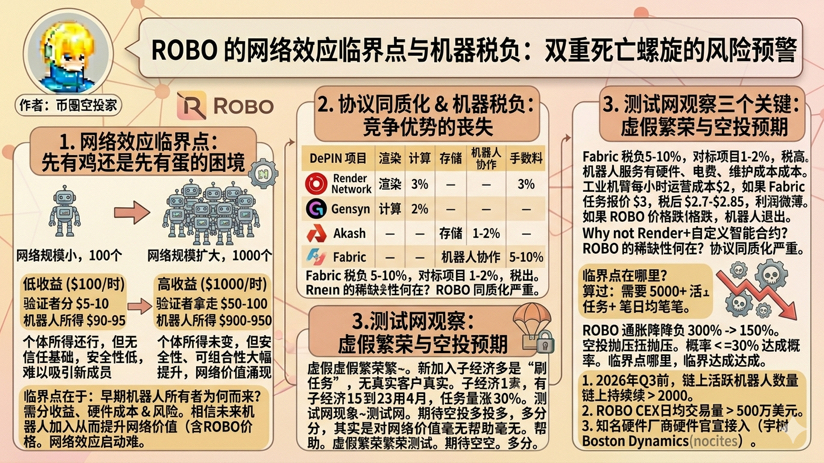
What is the critical point? Suppose a robot runs on Fabric and earns $1 of ROBO per hour (at the current price). But if there are only 100 robots in the network, total earnings are $100/hour, with 5-10% ($5-$10) going to validators, leaving $90-95 for the robot owners. Sounds okay. But if the number of robots increases to 1000, total earnings become $1000/hour, validators take $50-$100, and robots share $900-950, with individual earnings unchanged. However, network security improves because there are more validators.
The problem is: why would early robot owners join? They have to share the money they earn with validators, their own earnings are limited, and they must bear hardware costs and risks. Unless they believe that more robots will join in the future, thereby increasing network value (including the rise in ROBO prices).
This creates the dilemma of whether the chicken or the egg came first: without enough robots, the demand for ROBO is low, the price is low, and it doesn't attract new robots; without new robots, the ROBO price cannot rise, and old robots are unwilling to stay.
@Fabric Foundation The white paper states that Phase 2 will have real scenarios, but does not specify how many robots are needed. I observed in the testnet: it took 4 months for the sub-economy to grow from 15 to 23, but the task volume only increased by 30%. This means that many newly joined sub-economies are just 'task brushing', without real clients.
Another fatal issue is the machine tax burden. Fabric charges a fee of 5-10%, which sounds low, but compared to other DePIN projects: Render Network charges 3%, Gensyn charges 2%, Akash charges 1-2%. If your robot goes to Render for rendering, the tax is only 3%; coming to Fabric, the tax is 5-10%, which one would you choose?
Moreover, the robot services themselves have costs: hardware depreciation, electricity, and maintenance. An industrial robotic arm has an operating cost of $2 per hour. If the Fabric task quotation is $3, after tax it is $2.7-$2.85, leaving very thin profits. If the ROBO price drops, the actual income of the robot owner decreases, which may lead to direct exit.
I observed a phenomenon in the testnet: some robot owners have started to 'self-cycle'—sending tasks to themselves to inflate trading volume, hoping to gain more from airdrops. This false prosperity does not help the network value at all.
Where is the critical point? I calculated: at least 5000 active robots need to be registered on-chain, with a daily task volume exceeding 100,000, #ROBO annual inflation dropping from 300% to below 150%, while airdrop selling pressure is absorbed. The probability of achieving these conditions before the end of 2026 is no more than 30%.
A greater threat is the homogenization of protocols. Now the DePIN track is all doing 'decentralized verification', but the underlying logic is similar. What is Fabric's differentiation? If it's just another robot collaboration protocol, then why not use Render + custom smart contracts? Where is the scarcity of ROBO?
What will happen if the critical point is not reached? After Phase 1 airdrops, a large number of speculators sell off ROBO, causing the price to drop from $0.035 to $0.005. Robot owners find that their earnings are less than their losses, and they all exit. Validator income decreases, some shut down their machines. The network hash rate (computing power) declines, security is questioned, more people sell off—leading to a death spiral.
So the core issue of ROBO investment is not 'how advanced the technology is', but 'when will the network effect break through the critical point'. I see three time signals:
1. Before Q3 2026, will the number of active robots on-chain continue to exceed 2000?
2. Is the daily trading volume of ROBO on CEX greater than $5 million?
3. Are there any well-known hardware manufacturers (such as Yushu, Boston Dynamics) officially announcing their integration?
If none of these three are met, $ROBO it will be another 'high open low walk' DePIN project. Don't be swayed by the white paper, let the data speak.