
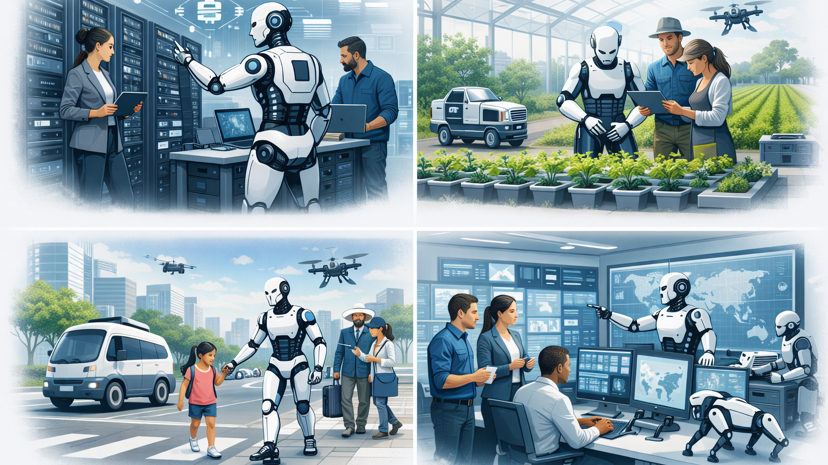

think a lot of people still hear the word “robot” and imagine something distant.
Something cold. Something metallic. Something that belongs in a lab, a factory, or a future that has not arrived yet.
I do not think about it that way anymore.
To me, the real question is no longer whether robots will become part of human life. That part already feels decided. The more important question is what kind of system will shape that future. Who will guide it. Who will benefit from it. Who will be able to build inside it. And maybe most importantly, who will be able to trust it.
That is where @Fabric stays in my mind.
What interests me about Fabric Protocol is not just the idea of robots themselves. It is the structure behind them. It is the feeling that this is not trying to present robotics as a single product, a single company vision, or a closed machine that the public is expected to simply accept. It feels more like an attempt to build the underlying environment where robotics can grow in a more open, verifiable, and collaborative way.
That difference matters to me more than people realize.
I think one of the quiet problems with emerging technology is that we often focus too much on the visible layer. We look at the machine, the interface, the movement, the headline. We ask what it does. We ask how impressive it looks. We ask whether it is faster, smarter, cheaper, or more advanced than what came before.
But the deeper question is usually about the system underneath.
What data is it using?
Who controls the computation?
How are decisions recorded?
Who sets the rules?
Can those rules be checked?
Can the network evolve without becoming chaotic?
Can people participate without surrendering all influence to a small center of power?
That is why Fabric Protocol feels more serious to me than a lot of robotic narratives I have seen.
It is not only talking about machines. It is talking about coordination.
And I think coordination is where the future will actually be decided.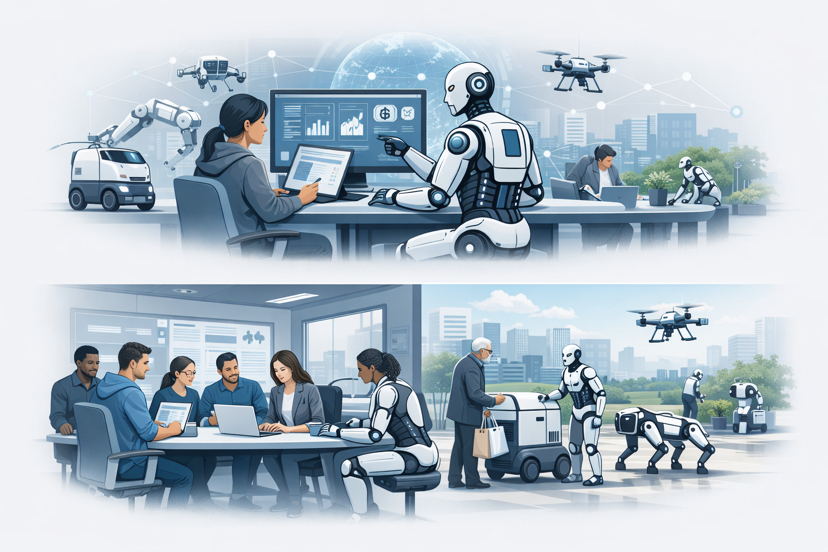
A robot on its own is just one thing. A robot inside a trusted network is something else entirely. The moment you start thinking about multiple agents, shared environments, governance, safety, data exchange, public accountability, and long term improvement, the conversation changes. It becomes less about a machine performing a task and more about an ecosystem learning how to function responsibly.
That is the part I find compelling.
Fabric Protocol, as I see it, is trying to create a world where robotics is not built in fragments. Not as isolated inventions competing in silence. Not as black boxes asking the public to trust what cannot be verified. But as part of an open network where construction, governance, and evolution can happen together in a visible and structured way.
I think that kind of foundation matters because robotics is too important to be shaped carelessly.
If robots are going to become more useful in daily systems, then trust cannot be treated like decoration. It has to be part of the architecture. The same goes for regulation. The same goes for computation. The same goes for collaboration between humans and machines. These things cannot be added at the end like a patch. They need to be built into the process itself.
That is why the phrase “verifiable computing” stands out to me.
Not because it sounds advanced, but because it sounds responsible.
There is something deeply important about a system that does not only act, but can also prove what happened, how it happened, and under what rules it happened. In a space where intelligence and automation are becoming more powerful, I do not think blind trust is enough anymore. We need systems that can be examined. Systems that can be tracked. Systems that make accountability possible without killing innovation.
That balance is difficult.
Usually, technology moves fast and governance moves late. Builders create first, and everyone else is forced to react after the consequences appear. That pattern has repeated too many times in digital life. We celebrate invention, then spend years dealing with what the invention ignored.
What I find refreshing about Fabric is that it seems to take structure seriously from the beginning.
The public ledger side of it is also interesting to me for that reason. Not because putting something on a ledger automatically makes it meaningful, but because coordination becomes stronger when actions, rules, and interactions can exist in a shared framework. A public layer can help prevent robotics from becoming an invisible game controlled by a few private actors. It can create common ground. And common ground is essential when the systems involved are powerful enough to affect safety, labor, mobility, access, and real world decision making.
I also think the idea of “agent native infrastructure” says something important, even beyond the phrase itself.
It suggests that the future is not just about humans using tools in the old sense. It is about environments where agents can operate, interact, and improve within defined boundaries. That requires more than software. It requires design that respects complexity without surrendering to disorder.
That is a hard thing to build.
And maybe that is another reason this stands out to me. Fabric does not feel like it is chasing easy excitement. It feels closer to the patient side of innovation. The side that understands that if robotics is going to become truly useful, then the infrastructure cannot be shallow. It has to support coordination between data, computation, and regulation in a way that remains workable as the system grows.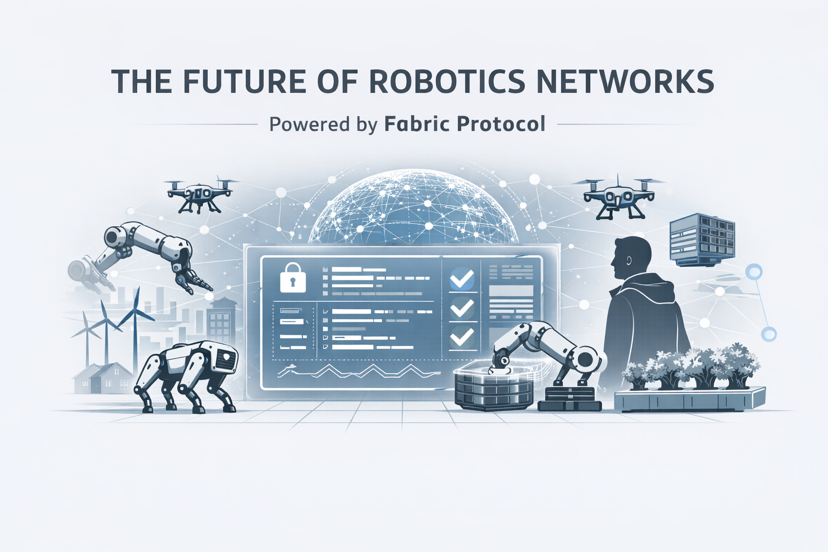
I think many people underestimate how valuable that is.
The future will not be shaped by whichever machine makes the loudest entrance. It will be shaped by the systems that can actually hold complexity together. The systems that can scale without collapsing trust. The systems that allow collaboration without creating confusion. The systems that give builders room to create while still giving society ways to inspect, guide, and understand what is being built.
That is the kind of future I imagine when I think about Fabric Protocol.
Not a cinematic future. Not a noisy future. Not a future where robots simply appear and everyone is told to adapt.
I think of a more grounded future.
A future where robotics develops inside a framework that people can participate in.
A future where governance is not an afterthought.
A future where machine collaboration is not separated from human responsibility.
A future where open infrastructure matters because trust matters.
A future where progress is not just about what can be built, but about whether it can be built in a way that remains accountable and shared.
That is why @Fabric Foundation feels meaningful to me.
It does not make me think only about robots.
It makes me think about whether we are mature enough to build the systems that robots will need around them.
And to me, that is the real story.