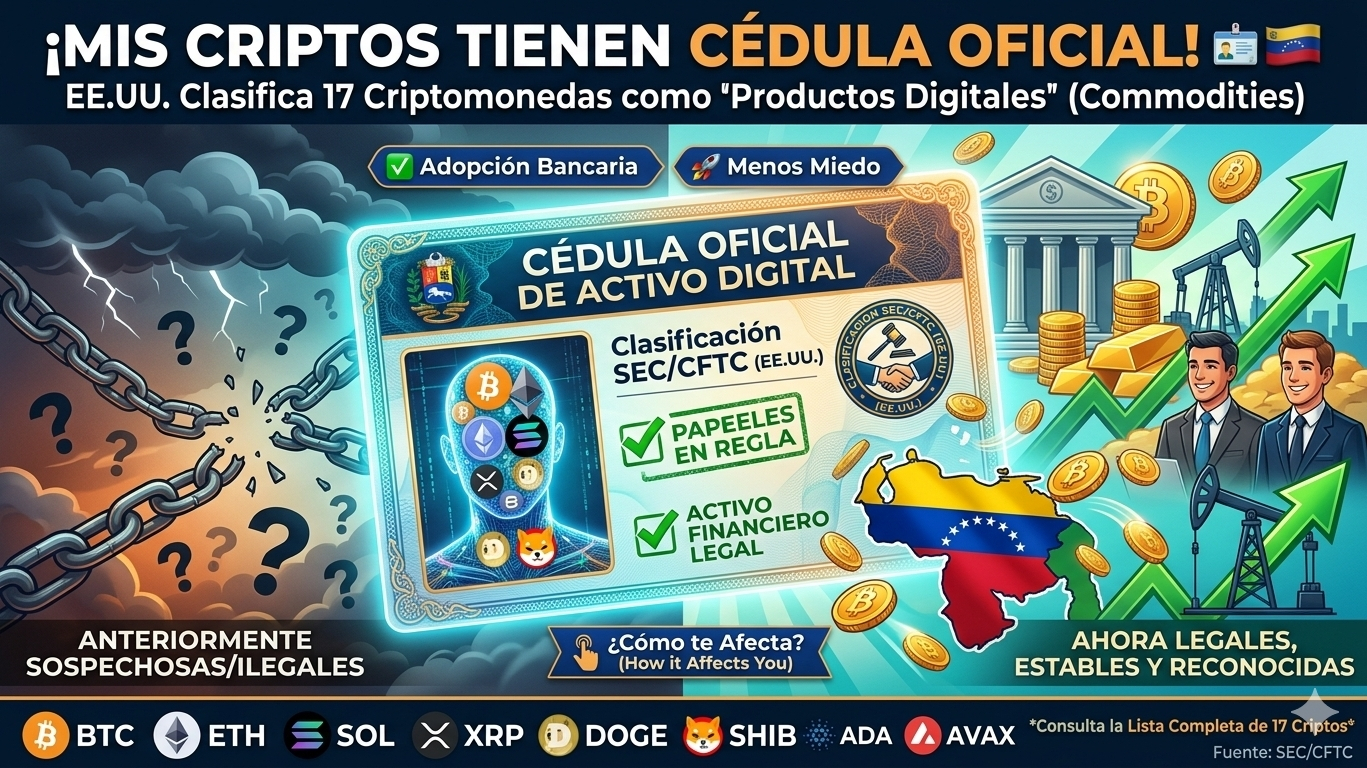
On March 17, 2026, a before and after was marked: the U.S. (the SEC and the CFTC) finally classified Bitcoin and 16 other cryptocurrencies as "Digital Products."
1️⃣ What is the news? 📰
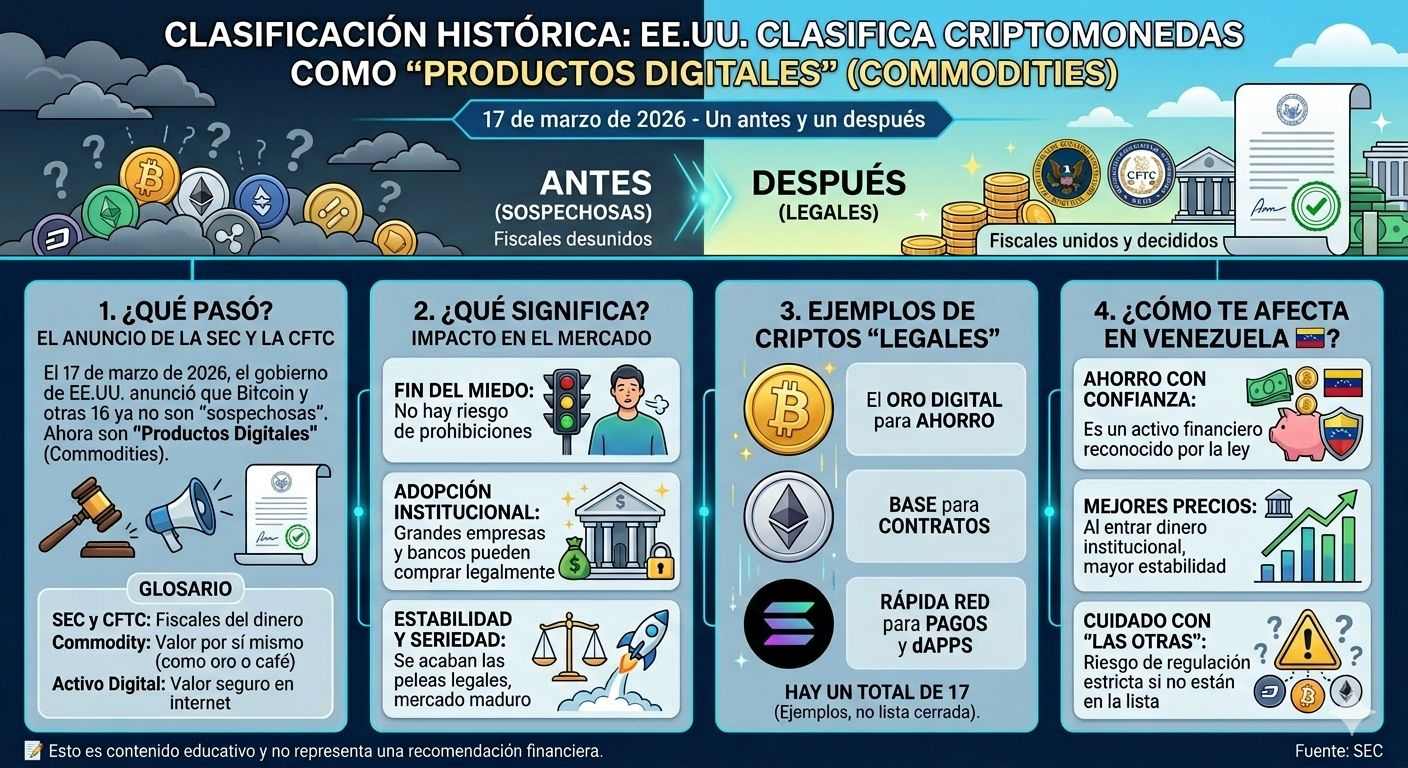
On March 17, 2026, the U.S. government (through the SEC and the CFTC) announced that Bitcoin and 16 other cryptocurrencies are no longer "suspicious." They now have an official legal classification: they are "Digital Products" (Commodities).
Quick glossary (easy terms) 🧐
SEC and CFTC: They are the "watchdogs" that protect the money in the U.S. They used to disagree; now they do.
Commodity (Product/Goods): It's something that has value by itself, like gold, oil, or coffee. By saying that cryptos are this, the government admits that they are not a scam nor do they depend on the effort of a company, but are a real asset.
Digital Asset: It is simply something that has value but you cannot touch, it lives on the internet securely.
2️⃣ What does the news mean? 🚀
It means that these 17 cryptocurrencies have "proper documentation."
There is no longer fear of them being banned for being "illegal."
Large companies and banks can now legally buy and hold them.
The legal battle that lasted for years is over, providing stability and seriousness to the entire market.
3️⃣ What are the 17 "legal" cryptos? ✅
Here is the official list and what each one is for:
Bitcoin (BTC): The digital gold. It is used to save and protect yourself from inflation.
Ethereum (ETH): A network to create contracts and apps. It is the foundation of almost the entire crypto world.
Solana (SOL): Super fast. Ideal for sending money with fees of just cents.
Ripple (XRP): Made for banks to send money between countries instantly.
Cardano (ADA): A very secure and well-planned network, used for identity and science projects.
Avalanche (AVAX): Very fast, used for advanced digital finance.
Polkadot (DOT): It is the "bridge" that helps different cryptos communicate with each other.
Chainlink (LINK): Connects street information (prices, weather) with crypto technology.
Dogecoin (DOGE): Started as a joke, today it is a currency accepted in many places and validated by its huge use.
Shiba Inu (SHIB): Very popular, used for payments and moving small amounts of value.
Bitcoin Cash (BCH): A faster version of Bitcoin to pay for coffee or groceries.
Litecoin (LTC): The "silver" digital. Very old, reliable, and cheap to move.
Stellar (XLM): Special for remittances. You send money from one country to another almost for free.
Aptos (APT): Cutting-edge technology for applications used by millions of people.
Hedera (HBAR): Used by companies like Google and IBM to securely record data.
Algorand (ALGO): Very fast and eco-friendly network, focused on efficient transactions.
Tezos (XTZ): A network that updates itself securely, ideal for maintaining long-term contracts.
📝 Note: This is not an exhaustive or closed list (the document provides "examples" to illustrate the category), but specifically names 17 digital assets as representative of this classification. Source: SEC
How does it affect you in Venezuela? 🇻🇪
Saving with confidence: If you have any of these 17, you no longer have an "experiment," you have a financial asset recognized by law.
Better prices: As money from large banks comes in, these currencies tend to be more stable and less crazy in their rises and falls.
Beware of "the others": If the currency you use is not on this list, be cautious, because those may still be pursued or strictly regulated as financial securities by the SEC.
📝 Note: This is educational content and does not represent financial advice.