

There's a detail in Midnight's design that doesn't get enough attention. Not the ZK proofs. Not the privacy layer. Not even the Cardano partnership. It's simpler than all of that, and somehow more important.
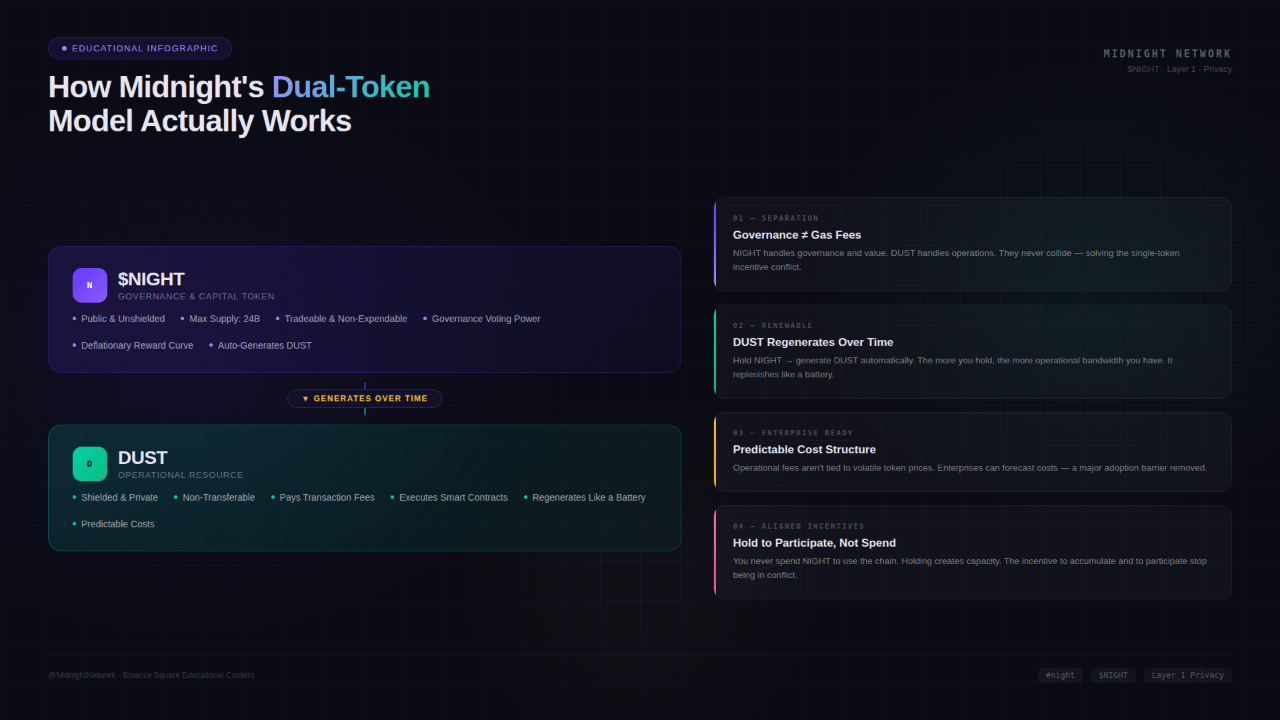
Midnight runs on two components. NIGHT is the governance and capital token it's public, transparent, tradeable. But NIGHT doesn't pay for anything on the network. It generates a second resource called DUST. And DUST is the thing that actually executes transactions, runs smart contracts, settles the operational side of the chain.
That separation sounds small. It isn't.
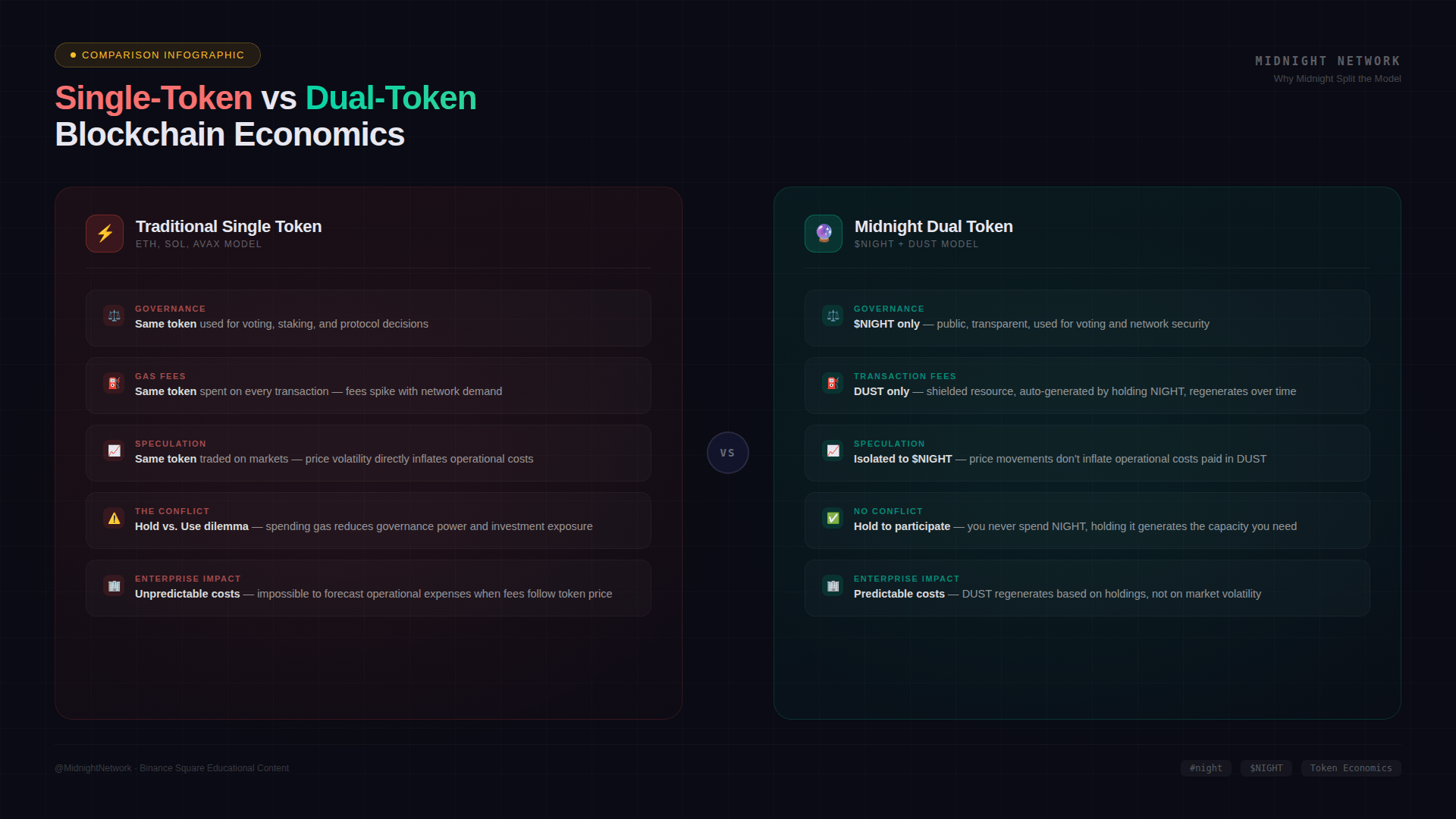
Think about how most Layer 1 blockchains work. Ethereum, Solana, Avalanche they all use a single token for everything. You stake it, you govern with it, you pay gas with it, and you speculate on it. All at the same time. And the problem with that model is that the incentives start pulling against each other in ways that are hard to see until they become expensive.
When a network gets busy, gas fees spike. That's fine for validators. It's terrible for developers trying to build applications with predictable costs. And when the token price goes up because of speculation, the cost of using the network goes up with it even if nothing about the underlying demand for the network's services has changed. You end up in a situation where success makes the network harder to use. Ethereum went through this for years before rollups gave it a release valve.
Midnight's answer is to split the problem in half. NIGHT holds the value. DUST does the work. And because DUST regenerates over time based on how much NIGHT you hold, it behaves less like a fee and more like a capacity allowance. The more NIGHT in your wallet, the more operational bandwidth you have on the network and it replenishes. Like a battery that slowly recharges.
That's where things get interesting from a game theory perspective.
In a single-token model, there's a constant tension between holding and using. If you spend your token on gas, you reduce your governance power and your exposure to price appreciation. If you hold it, you're not using the network. Midnight removes that friction. You never spend $NIGHT to use the chain. You hold it, and the holding itself produces the resource you need. The incentive to accumulate and the incentive to participate stop being in conflict.
For enterprises which is clearly who Midnight is targeting with its "rational privacy" thesis this changes the math on adoption. A company evaluating whether to build on a blockchain needs to model costs. If those costs are tied to a volatile token that could double or halve in a quarter, the financial planning becomes a nightmare. But if the operational costs are denominated in a regenerating resource that's pegged to holdings rather than market price, the budgeting conversation looks completely different.
I keep coming back to this because it's the kind of structural advantage that doesn't show up in a tweet or a price chart. It shows up three years from now when someone asks why a particular enterprise chose Midnight over a competing chain, and the answer is something boring like "we could forecast our costs."
But there's a tension here too, and it's worth being honest about it.
The DUST model assumes that holding NIGHT is sufficient incentive for network participation. If NIGHT's price stagnates or declines over a long period, the incentive to hold and therefore the incentive to generate DUST weakens. The network's operational capacity is directly tied to how much NIGHT is being held in active wallets. If large holders decide to sell, the total DUST generation capacity of the network contracts. In theory, this could create situations where network throughput drops not because of technical limitations, but because of token holder behavior.
That's not the interesting question though. The interesting question is whether the deflationary reward curve built into NIGHT's design offsets this risk. Midnight's block production rewards decrease over time, which means early validators are incentivized more heavily, and the long-term token supply tightens. If demand for DUST grows as more applications launch on the network, NIGHT becomes more valuable to hold not because of speculation, but because of its utility as a DUST generator. The reflexive loop works in NIGHT's favor as long as the network is actually being used.
And that's where the whole thesis either holds or breaks.
The dual-token model is elegant on paper. It solves real problems that single-token chains have struggled with for years. But it only works if Midnight reaches a threshold of actual usage where DUST demand is meaningful. Without that, NIGHT is just a governance token for a network that hasn't proven its adoption case yet. The token design is ahead of the network's maturity, which is both its strength and its vulnerability.
I spent some time looking at how other projects have approached this. Theta has a similar dual-token structure with THETA and TFUEL. It works, but Theta's usage has been narrower than initially projected. NEO used a GAS model for years. The pattern exists but no one has nailed it at scale in a way that validates the theory conclusively.
What makes Midnight's version potentially different is the privacy angle. If the use cases that actually need this chain regulated DeFi, healthcare verification, confidential identity systems start materializing, then DUST demand becomes structural rather than speculative. Institutions using the network for KYC proofs or supply chain verification would need consistent DUST generation, which means consistent NIGHT holdings. That creates a holding floor that isn't based on price sentiment. It's based on operational necessity.
The part nobody talks about is how that floor changes the character of $NIGHT a tradeable asset. If a meaningful percentage of supply is locked in institutional wallets for DUST generation, the circulating supply narrows. Price discovery happens on a thinner float. Volatility could increase on the upside and downside, but the baseline demand stays anchored.
I don't know if that's where this goes. The mainnet beta hasn't launched yet. The developer ecosystem is still forming around Compact. The enterprise pipeline is a thesis, not a proven funnel. But the economic design is sound in ways that most Layer 1 tokens aren't, and that's worth paying attention to even at this stage.
The market is pricing $NIGHT like a standard privacy token. I'm starting to think that might be the wrong category entirely. It might be closer to infrastructure equity something you hold not because you think the price goes up, but because holding it gives you capacity on a network you actually need to use.
Whether anyone actually needs to use it yet is the question that's still open. And it might stay open for a while.