
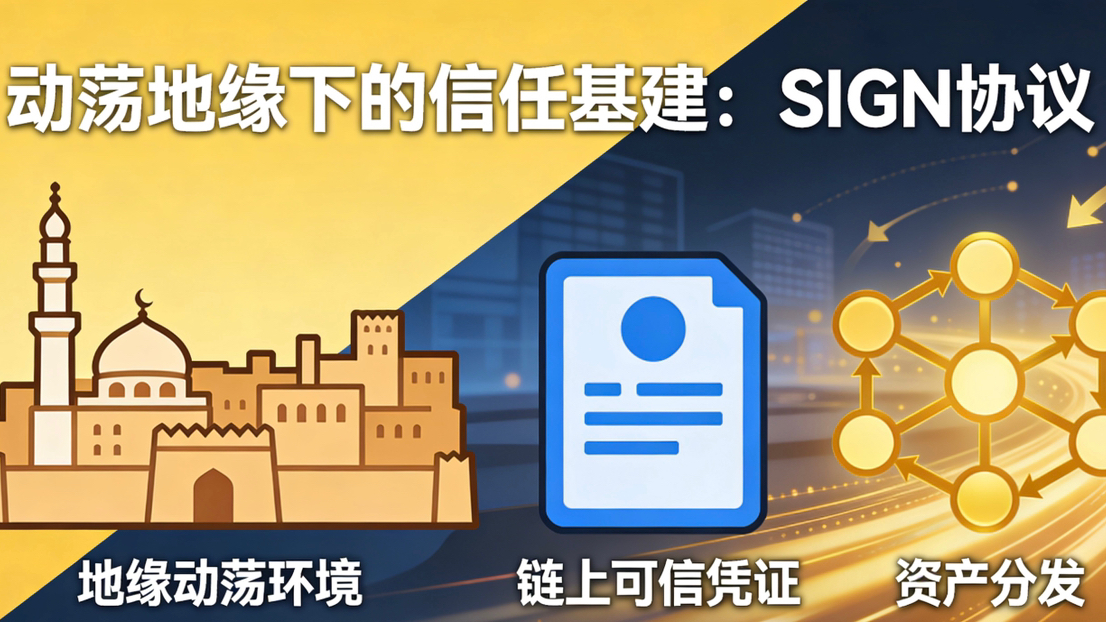
Recently, the entire crypto market has been increasingly leaning towards compliance, especially in the Middle East, which has long been in a complex geopolitical environment. The financial system is fragile, cross-border payments are obstructed, and asset security is hard to guarantee, while regulation and privacy are constantly in conflict. In such a special geopolitical landscape, I increasingly feel that what can truly last is not the hot concepts, but the underlying infrastructure that can solve real pain points, $SIGN is one such project.
Everyone in the industry should feel that the pain points of Web3 are indeed too obvious now. Various platforms repeatedly KYC, personal privacy is frequently leaked, data cannot interoperate, asset airdrop distribution is chaotic, misdelivery and missed delivery occur frequently, and institutional-level distribution lacks security standards, leaving users and project parties to passively make do. However, SIGN, from its underlying design, precisely addresses the most core issues of trust and compliance in the entire industry.
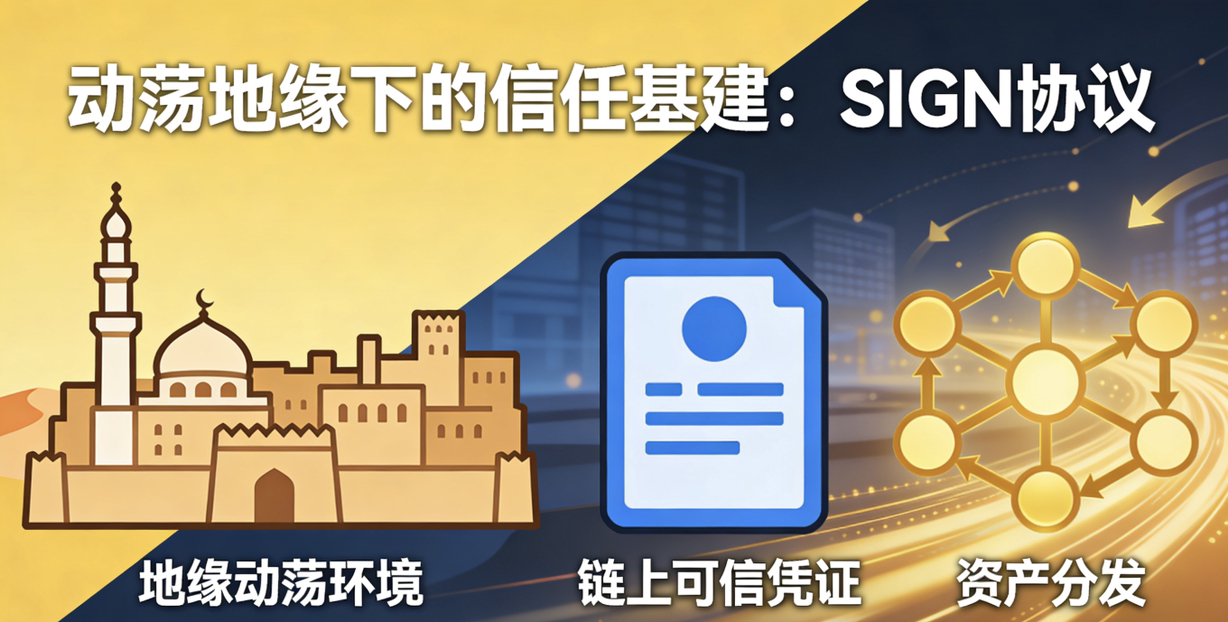
SIGN is a foundational protocol focused on globally trusted credentials and standardized asset distribution. All mechanisms are derived from the project's official white paper, with pure and pragmatic logic. The project core relies on the Sign Protocol for trusted credential operations, completing identity authentication, asset confirmation, and qualification review through a standardized on-chain verification system without exposing any raw data, perfectly balancing user privacy with regional regulatory requirements. At the same time, paired with the TokenTable smart distribution engine, it utilizes smart contracts to achieve large-scale, traceable, and error-free asset distribution, fundamentally eliminating industry issues such as opaque distribution, chaotic processes, and operational errors. The entire mechanism is simple, efficient, and implementable.#Sign地缘政治基建
Looking at it from the perspective of the geopolitical landscape in the Middle East, SIGN's value is almost irreplaceable. The situation in the Middle East is complex, with significant fluctuations in fiat currency exchange rates, strict cross-border capital controls, and limited coverage of traditional financial services, while actively promoting digital finance and sovereign digital infrastructure. Compliance, privacy, security, and cross-border circulation are all top-tier necessities. SIGN does not hype or act aggressively, focusing on building trust infrastructure, highly adaptable to local regulatory policies, and capable of providing stable and reliable on-chain services for institutions, enterprises, and ordinary users, possessing a natural advantage in the geopolitical environment, with highly imaginative development space.
However, objectively speaking, SIGN is not perfect; the project itself has very obvious shortcomings.@SignOfficial The team's focus is on technology research and institutional cooperation, with overall promotion being very low-key, lacking in marketing hype, limited market awareness, few ecological scenarios aimed at ordinary users, low C-end penetration rate, and slow ecological implementation and popularization speed, making it difficult to form explosive dissemination in the short term.
At the same time, the industry competition is fierce, and there are many players in the underlying infrastructure track. For SIGN to continue expanding its advantages, it must accelerate the ecological implementation speed. Moreover, relying on cooperation with institutions and governments also means longer promotion cycles, requiring long-term patience and cannot rely on short-term heat to support value.
I have always believed that whether a project can go far does not depend on gimmicks but on whether it meets the demands of the times. SIGN follows a route focused on heavy infrastructure, landing, and long cycles, with token value relying on ecological usage, protocol fuel, and node validation support, forming a closed-loop value logic that completely depends on real demand for development.
The rapid rise of the Middle East market has provided SIGN with excellent development soil, supported by geopolitical dividends, policy dividends, and market necessities. However, slow implementation, weak dissemination, and long cycles are all objectively existing risks.
It is not a short-term explosive market trend, but a foundational infrastructure project that steadily relies on fundamentals. If you believe in the long-term logic, patiently accompany it, accept its stability, and also accept its slowness. In the wave of compliance and digitalization in the entire Middle East, SIGN occupies the most scarce trust track. As long as it insists on promoting implementation, the future growth space is indeed highly anticipated.