
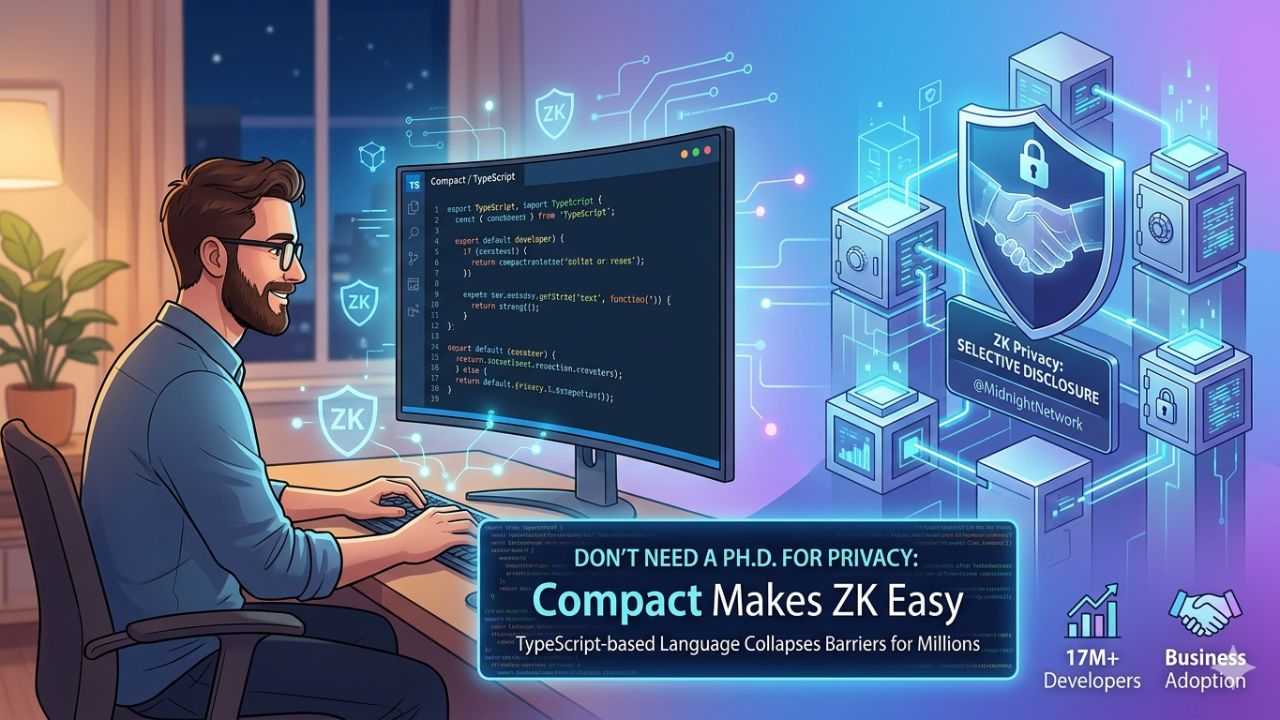
In the current global financial landscape, cross-border clearing is always in a state of high cost and low efficiency. The traditional SWIFT system appears compliant, but its reliance on the tiered processing logic of intermediary banks leads to a dual loss of time and cost for funds. When Web3 attempts to intervene in this field, the transparency of public chains becomes the biggest obstacle for institutions—exposing the flow, frequency, and pricing model of every cross-border procurement to a live broadcast on the entire network is tantamount to a commercial self-destruction for any enterprise with core competitiveness.
This is precisely the deep pain point that @MidnightNetwork attempts to address through layered privacy logic.
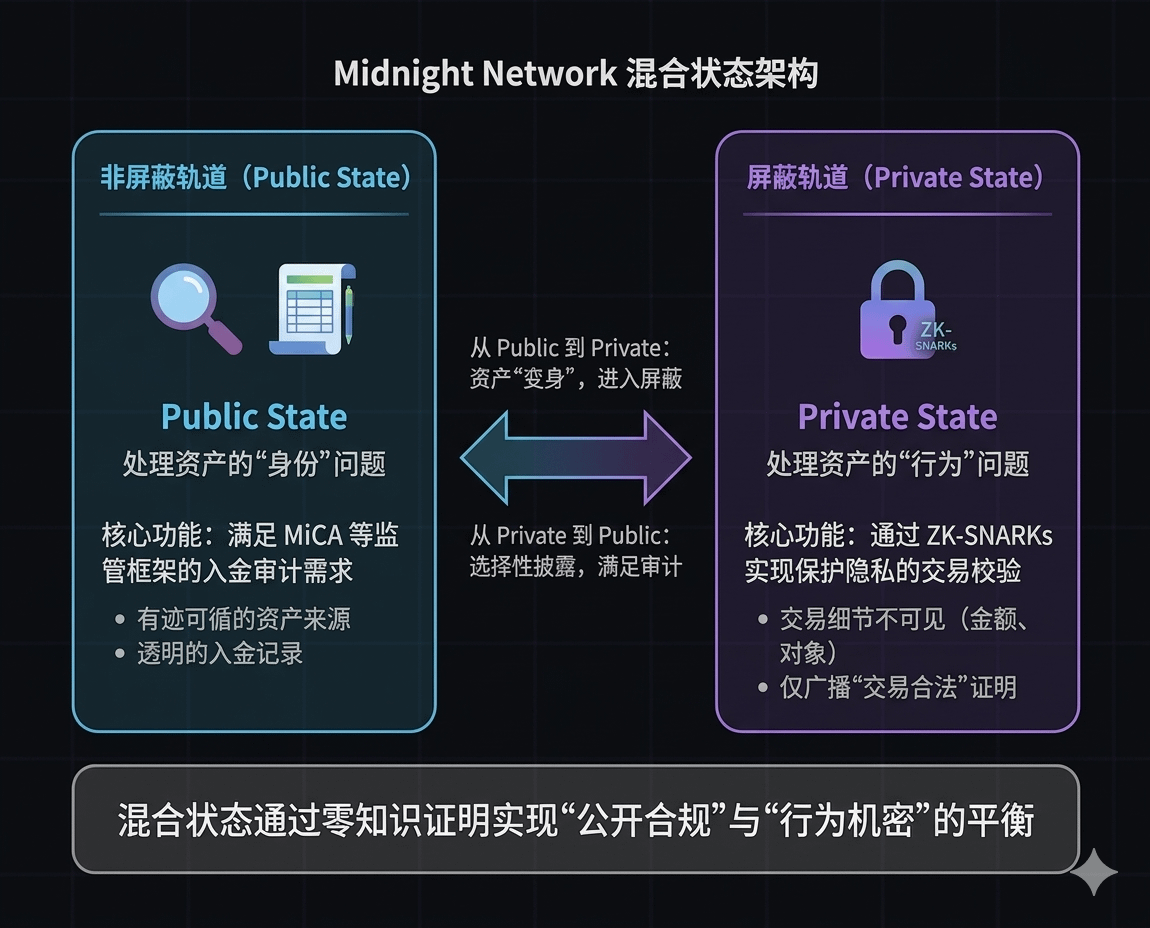
1. Regulatory hedging: Transitioning from black box concealment to controlled disclosure paradigm
The core difficulty of cross-border payments lies in balancing anti-money laundering (AML) audits and the protection of commercial secrets.
The dead end of traditional privacy coins: Extreme anonymity leads to the isolation of assets from the mainstream financial system, with liquidity drained due to compliance pressure.
$NIGHT The dual-track solution: It is not creating an invisible black box, but building a one-way glass system.
This design of 'process privacy, verifiable results' provides a set of institutional-level privacy umbrellas for cross-border payments.
[Image illustrating the Dual-Ledger system: A public compliance layer interacting with a private ZK-protected transaction layer for global trade]
2. Cost anchor point: Why is the DUST mechanism a 'dimensionality reduction strike' for CFOs?
In traditional cross-border settlements, the biggest challenge faced by finance departments is the uncertainty of costs. Exchange rate fluctuations, intermediary bank charges, and the randomness of public chain gas fees make large-scale capital forecasting extremely difficult.
Holding #night generated DUST mechanism (non-consumable resource model) actually provides enterprises with a set of 'cost insurance'.
Quota-based use: Enterprises only need to hold the corresponding proportion of $NIGHT based on business volume to obtain continuously generated DUST. This means enterprises possess 'permanent usage rights' of network capacity, rather than 'temporary leasing rights'.
Budget predictability: Regardless of how the secondary market fluctuates, the cost of each enterprise settlement is physically locked. This cost loop is the underlying driving force attracting traditional financial giants (such as MoneyGram and other node partners) to migrate real business from SWIFT to the blockchain.
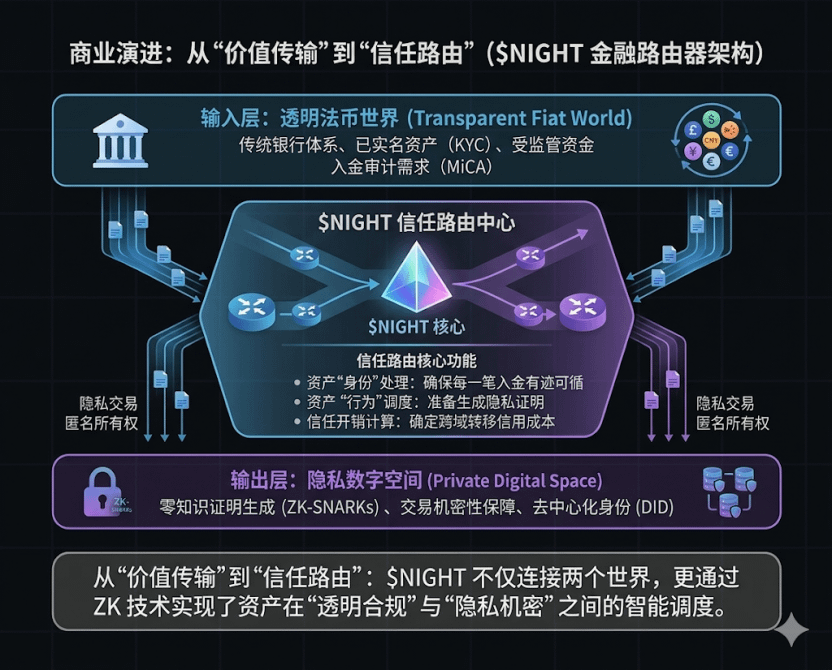
3. Business evolution: From 'value transfer' to 'trust routing'
We cannot simply see #night as a token; it is more like a 'financial router' connecting the transparent fiat world with the privacy digital space.
Imagine a scenario: A supplier from Singapore ships to a buyer in Berlin.
Asset preparation: Buyers hold $NIGHT through compliant channels.
Privacy payments: Privacy contracts written in Compact language, settled under shielded status.
Compliance proof: Each party in the transaction holds a viewing key. When necessary (such as for tax audits), details can be disclosed to specific institutions rather than exposing to the entire network.
Risk warning and objective observation
Despite the clear logic, the success of Midnight still depends on two core variables:
Extreme testing of mainnet performance: In high-concurrency cross-border scenarios, can the generation efficiency of ZK proofs support second-level settlements?
The dynamic game of regulatory attitudes: Although controlled disclosure has been designed, the regulatory acceptance of 'autonomous privacy' still needs time to adjust.
Conclusion by Caicai
Cross-border payments should not be a wealth public lesson conducted in a 'glass house'. The value of @MidnightNetwork lies in acknowledging the complexity of real business and providing answers with a pragmatic 'dual-track logic'. During the critical period of the mainnet launch in March, what we need to focus on is not the fluctuations of K-line, but when those enterprise-level settlement cases that can truly consume DUST will emerge.