Today I saw @SignOfficial log in to the plaza again!
I vaguely remember last year's plaza task hahaha, today is very different from last year, now everyone can participate! Remember to complete the basic tasks on the first day, teachers keep up and don't fall behind!
Let's review today's main character——$SIGN
I used to think that 'evidence preservation' or 'signature' was something only lawyers or wealthy individuals dealt with. But last weekend, while dealing with the leaky faucet at home and looking at that ridiculously thick manual, I suddenly thought: if the warranty card for this faucet, every repair record, and even the invoice for when I bought it could all directly become a universally accepted 'electronic proof' hanging in my wallet, then why would I need to rummage through boxes to find that crumpled paper?
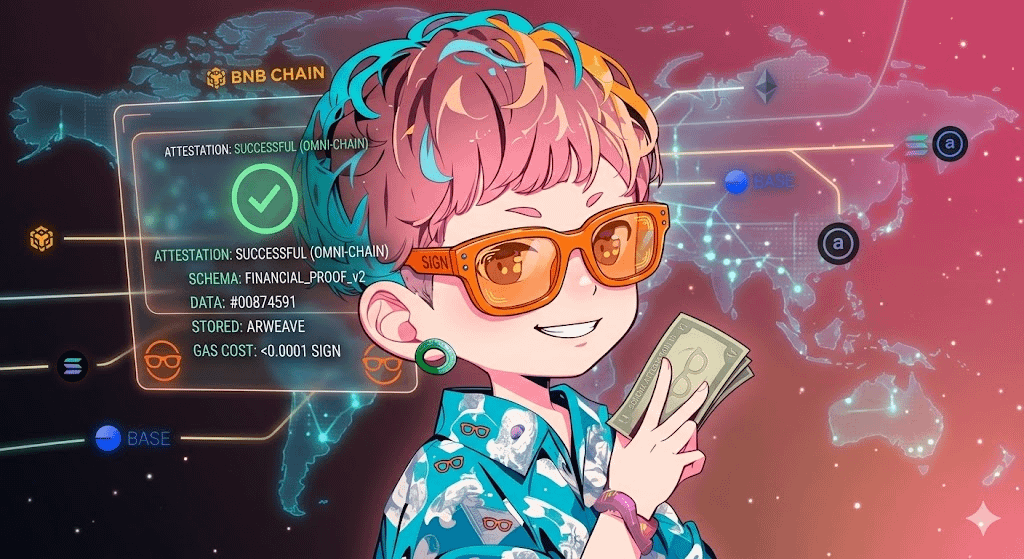
This is what Sign Protocol's 'full chain evidence storage' aims to achieve.
Many people think of it as just a contract signing EthSign, which is a narrow perspective. This time, its positioning is Omni-chain (full chain). Currently, Web3 data is actually as fragmented as it gets; your actions on Base are not recognized when you go to Solana. The logic of Sign now is to create a 'trust layer'; no matter which chain you are on, as long as you need to prove 'I am who I am', 'I actually did this', it can provide you with a universally accepted credential.
I specifically went back to review their Medium at night, and what excites a frugal player like me the most is that they integrated Arweave. What does this mean? In the past, storing a proof on-chain was prohibitively expensive, and now the cost has been reduced by 1000 times. This kind of dimension-reducing cost optimization is the prerequisite for large-scale applications to run.
When everyone is doing tasks, pay more attention to its Schema registry. This thing is like the 'Lego' of the evidence storage world; developers don't need to reinvent the wheel, they can directly call templates to run their business. This kind of efficiency is a lifesaver for teams like ours that pursue rapid business deployment.
Currently, the logic of $SIGN has transformed from a single tool into a foundational digital trust base. What I value is its practicality of 'decentralized identity', rather than just making empty promises. Taking advantage of this wave of recovery, let's complete the tasks and study the logic that can seamlessly connect RWA (real-world assets) and Web3.
Don't just focus on those points; understand the underlying technical layout. This is the long-term strategy for us to thrive in the square.