
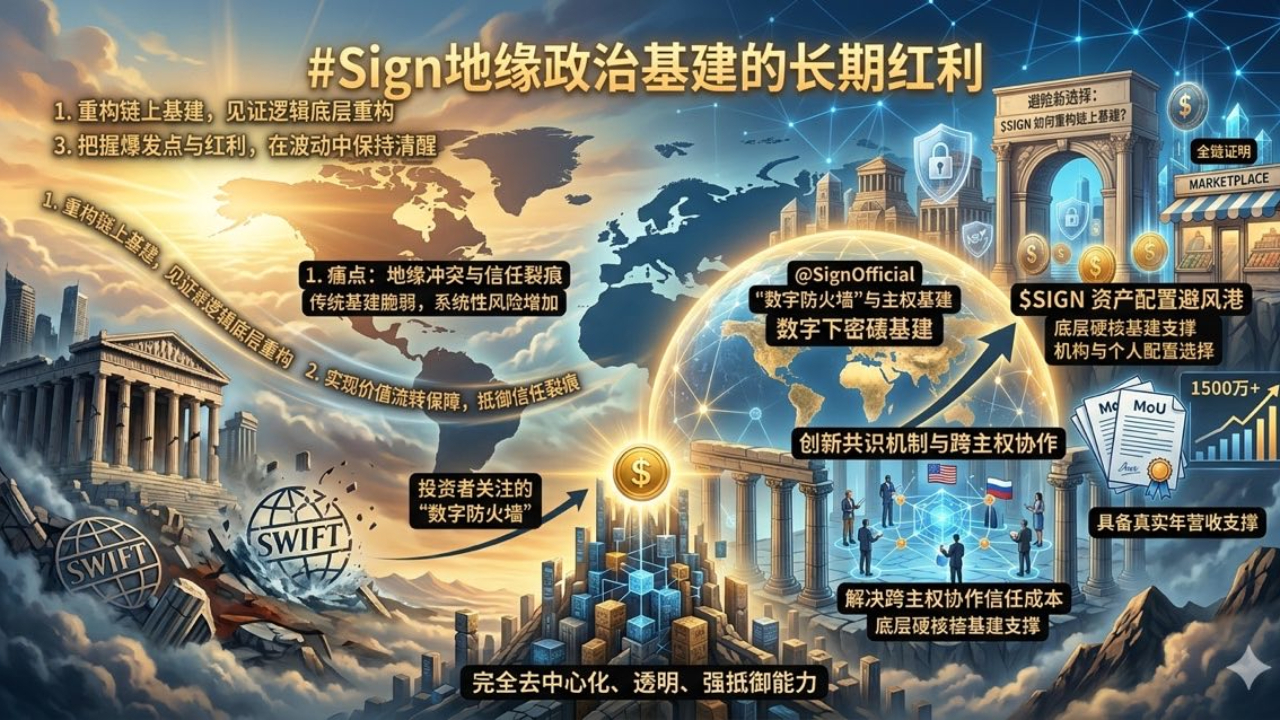

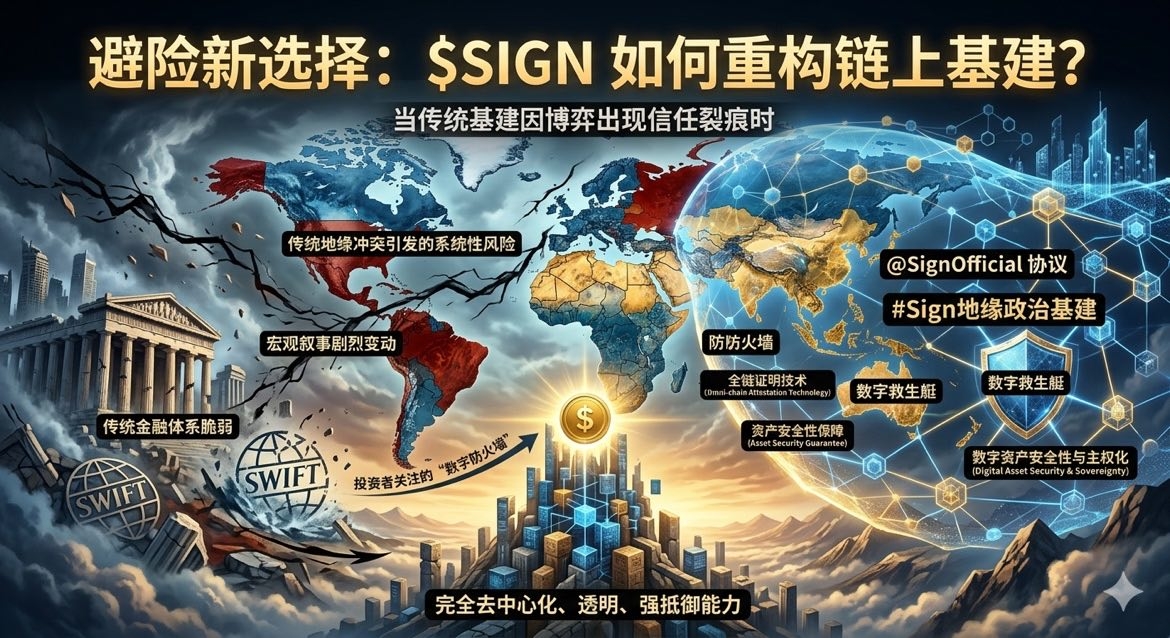
In the year 2026, a year of dramatic changes in macro narratives, we find ourselves at an extremely delicate crossroads. On one side are systemic risks triggered by traditional geopolitical conflicts such as the U.S.-Iran situation and economic uncertainties in the EU, while on the other side is the awakening of global digital sovereignty. For discerning investors, mere 'inflation hedge' is no longer sufficient to support asset safety; the real opportunities lie in projects that can provide underlying technological hedges for national-level credit. This is precisely the core logic I have been continuously tracking @SignOfficial .
1. From 'shadow agreements' to 'sovereign rebar' Many people's understanding of $SIGN remains at the level of ordinary Web3 protocols, but if you delve into its recent landing cases in countries like Thailand, the UAE, and Sierra Leone, you will find that its ambitions have long surpassed simple on-chain interactions. It's not just a gimmick; it is a tangible sovereign-level digital infrastructure. In today’s increasingly fragmented traditional financial system (like SWIFT) due to geopolitical games, countries are seeking value circulation channels that do not rely on a single hegemony. The core framework provided by @SignOfficial is essentially a 'operating system' tailored for digital sovereignty. It decouples identity verification, asset settlement, and policy control through Omni-chain Attestation technology, allowing sovereign nations to enjoy the transparency of blockchain while retaining governance autonomy. This balance of 'both open and controlled' is a pressing need under the current global political game.
2. $SIGN: The value anchor of trust premium
From a market performance perspective, the recent strong rebound of $SIGN is not an unordered speculation but a reassessment of the market's positioning as a 'digital safe haven.' When traditional infrastructure shows cracks due to a crisis of trust, protocols with strong resistance capabilities automatically generate a premium. Technical robustness: The underlying logic of $SIGN solves the trust cost of cross-sovereign collaboration through an innovative consensus mechanism. In the global regulatory tide of 2026, there are very few infrastructure projects that can comply with strict regulations like the GENIUS Act and actually serve the real economy. Revenue support: Unlike most tokens that rely on inflation, $SIGN is supported by real annual revenue (with revenue exceeding $15 million in 2024 alone). This transformation from 'narrative-driven' to 'revenue-driven' has shown remarkable resilience in a volatile market.
3. Standing on the shoulders of giants: The outbreak of long-termism
We often say, 'buy on divergence, sell on consensus.' Currently, @SignOfficial is at a critical point of transitioning from infrastructure construction to global explosion. With the popularization of Sign SuperApp and the signing of more national-level MoUs, its ecological boundaries are expanding infinitely. In the chess game of global asset allocation, SIGN is a fundamental 'logical switch.' The more chaotic the external world becomes, the more precious this decentralized proof protocol appears. If you are still entangled in short-term K-line fluctuations, you might as well look up at the larger geopolitical trends. The essence of investment is voting for the future. In this uncertain era, choosing an infrastructure target that paves the way for global digital sovereignty may be the most robust defense. I suggest everyone closely follow @SignOfficial's developments, and seize the most core certainty dividend in this cycle of 'sovereign infrastructure'. #Sign地缘政治基建