
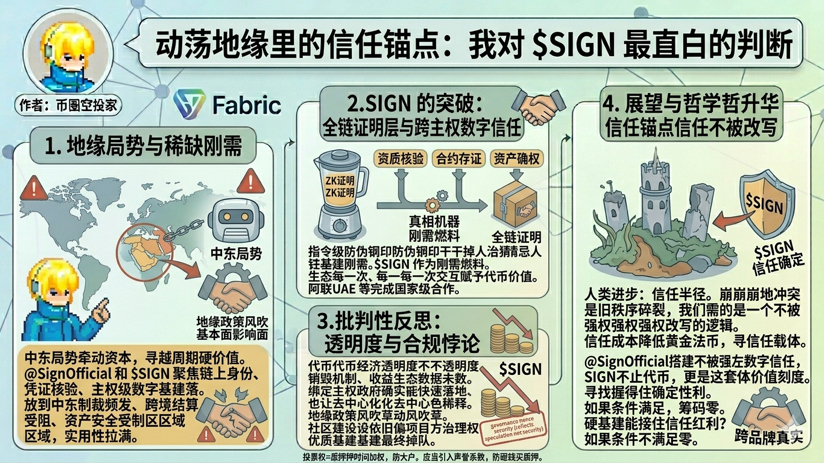
Recently, the situation in the Middle East continues to influence the direction of global capital, with safe-haven assets experiencing fluctuating movements. Everyone is looking for truly hard value assets that can withstand cycles and geopolitical risks. As an old player who has been navigating the crypto market for many years, I don’t make empty promises or blindly follow trends; I start from the real ecology to discuss SignOfficial and SIGN, and what value and hidden dangers lie in this geopolitical game.#Sign地缘政治基建
In my opinion, the core advantage of Sign is that it has tapped into the world's most scarce necessity—cross-sovereign digital trust infrastructure. It has not followed the trend to compete in the public chain race, nor does it engage in meaningless meme narratives, but instead focuses on on-chain identity, credential verification, and the implementation of sovereign-level digital infrastructure, moving qualifications, contracts, and asset confirmations from reality onto the chain to achieve immutability and cross-border verifiability. In a region like the Middle East, where sanctions are frequent, cross-border settlements are hindered, and asset security is precarious, the practicality of this system is maximized, which fundamentally distinguishes SIGN from air coins.
As an ecosystem native token, SIGN carries the core functions of transaction fees, staking, governance, and certificate minting. Every time the ecosystem lands or there’s a real interaction, it adds actual value to the token. Currently, Sign has completed national-level collaborations in regions like the UAE—not just concepts in a whitepaper, but backed by real business, which is commendable. However, as a seasoned user, I must raise a critique: the project team has fallen short on transparency in token economics. The burn mechanism, staking rewards, and ecological consumption data haven’t been fully disclosed. Long-term players only look at hard data; sentiment and narrative can’t support lasting value.
What’s more concerning is Sign's balancing act between compliance and decentralization. Tying to sovereign governments can indeed lead to quick deployment and cash flow, but it also dilutes the essence of decentralization. Any shifts in geopolitical policy can directly impact the fundamentals of $SIGN. Meanwhile, community building still leans toward project-led initiatives, failing to truly empower holders with governance rights. This empty community rhetoric without actual empowerment is a core reason many quality infrastructure projects end up lagging.
Putting it in the context of the Middle East situation, the growth potential of $SIGN has actually been undervalued by the market. Middle Eastern countries are accelerating their de-dollarization and building their own digital financial systems, which urgently need mature cross-sovereign trust infrastructure. Sign's technological solutions fit this demand perfectly, with features that are anti-sanctions, cross-border, and compliant, making it a scarce choice amidst geopolitical turbulence. From cross-border trade to identity verification, from financial settlements to government services on the blockchain, the application scenarios for SIGN will continuously expand with the demands of the region—this is its long-term core growth logic.
Of course, short-term market volatility, policy risks, and competitive pressures cannot be ignored. I maintain a cautiously optimistic view of Sign, not betting on short-term fluctuations but focusing on long-term deployment.
At the end of the day, the essence of human civilization's development is the reduction of trust costs. From gold to fiat currencies, from banks to blockchains, we've been seeking more reliable trust vehicles. @SignOfficial aims to build a digital trust system that isn't swayed by power in this fragmented and trust-scarce era. SIGN is not just a token; it’s a value metric of this system. What we chase in the market is not fleeting price spikes but the certainty we can hold amidst chaos. When trust can be defined by code and carried on-chain, the true value of SIGN will transcend candlestick charts and become the cornerstone of trust in the digital age.