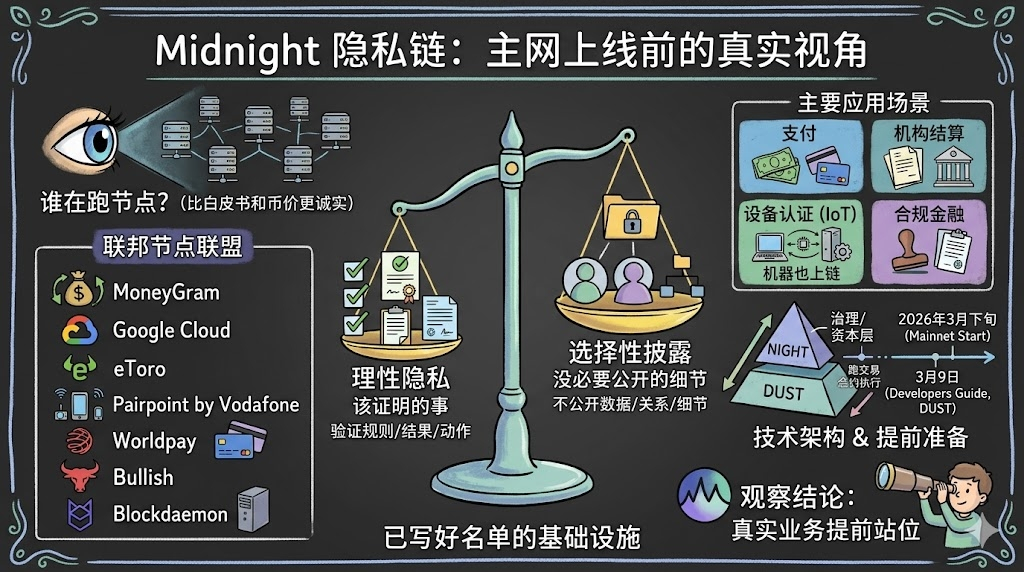
Recently, I've been looking at a chain, and what I focused on first was not the white paper or the coin price, but rather a more practical question: who is willing to run nodes before the mainnet launch.
This matter is very honest.
Everyone can say they want to serve the organization. When it comes to taking action, the ones who are willing to step up have basically clarified the project's target customers.
@MidnightNetwork This list has become increasingly extraordinary in recent times.
On March 17, the official team brought Worldpay and Bullish into the Federal Node Alliance. Going back further, there are names like MoneyGram, Pairpoint by Vodafone, eToro, Google Cloud, and Blockdaemon.
This combination, when put together, is no longer just the internal crypto circle propping each other up; it resembles real industries like payment, trading, cloud services, and the Internet of Things, starting to test the same privacy chain.
Looking back at Midnight at this point, the taste is different.
When many people mention it, privacy is the first thing that comes to mind.
But what it really wants to consume is not just the privacy narrative, but those businesses that want to go on-chain but are afraid to expose their ledgers to the whole world.
Worldpay and MoneyGram, such roles, will not run nodes for a nice story; what they care about is something else: settlement must prove compliance, and data cannot be exposed.
Pairpoint by Vodafone is more direct; the official wording includes the identity and authentication of IoT devices, making it clear that the future is not just about humans going on-chain, but machines as well. The issue is that cooperation and payment between machines also cannot have all paths broadcasted.
This is also the core of Midnight.
It keeps talking about rational privacy and selective disclosure, not hiding everything, but separating 'what needs to be proven' from 'details that don't need to be public.'
On-chain rules can be verified, results can be verified, and it can be verified that this action has indeed occurred, but that does not mean handing over all user data, business relationships, and transaction details.
Once this logic is established, scenarios that have previously feared public chains—such as payment, institutional settlement, device authentication, and compliant finance—will truly have a place to settle.
Looking at the timing, it is quite subtle.
The official confirmation in February stated that the Midnight mainnet will launch in late March 2026.
On March 9, it specially released a developer guide before the mainnet launch, allowing the team to migrate to Preprod, learn to generate DUST, and prepare the formal environment.
The most interesting layer here is that it even taught 'how to use it' before the mainnet launch.
Because Midnight is not the kind of structure that directly burns native coins for every action, $NIGHT is placed in governance and capital layers, while real transactions and contract execution rely on DUST.
This layered approach is clearly not for distributing coins, but to ensure that applications can truly run long-term.
So now when I think of Midnight, what comes to mind is no longer 'yet another chain about to go live.'
It is more like an infrastructure that first lists the target customers on the node roster. Who is willing to engage before the mainnet launch often indicates more than who shouts the loudest on social media.
Midnight now gives me the feeling that the real businesses it wants to connect with have already started to position themselves in advance.
@MidnightNetwork $NIGHT #night