
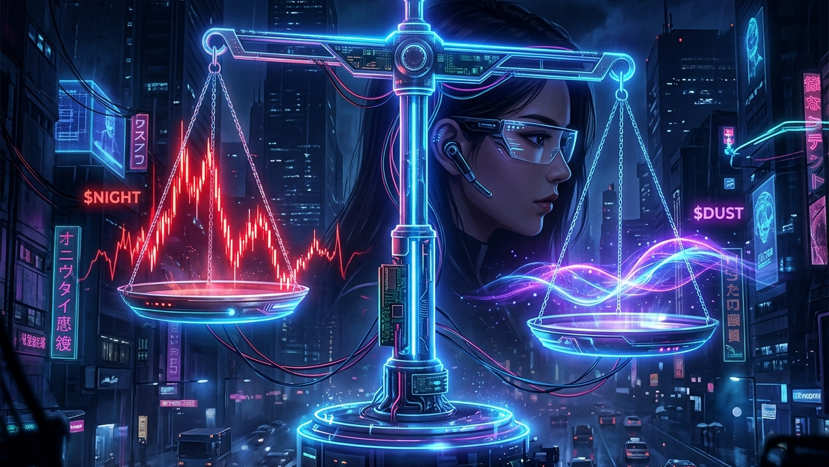
Hey, everyone! I'm Xiao Xi! 👋
Recently, I've been focusing on Midnight (@MidnightNetwork ) for several days and feel like the discussion style everyone is having is a bit 'too formal'. It's always about dual tokens, privacy, governance... These terms sound quite impressive, but it feels like they haven't hit the core issues.
From Xiao Xi's perspective, what Midnight truly wants to achieve with 'dimensionality reduction' may not actually be the dual token model, but rather to separate two things that have been forcibly tied together in public chains for over a decade: the price fluctuations of assets and the right to use the network.
💡 We used to buy 'tickets', now we buy 'bandwidth'
When we usually play with chains, what is the most exhausting part? It's not the high transaction fees, but the uncontrollability.
In the past, public chains required a coin to serve as money (payment), as well as a stock (governance), and even as a ticket (transaction fee). This led to a ridiculous phenomenon: when the coin price rises, we even have to check the date to transfer money.
You initially just wanted to buy a 'service', but ended up bearing the 'token volatility risk'.
From Xiao Xi's point of view, this actually confuses 'resource allocation' with 'asset pricing'. Midnight's cleverness lies in its desire to detach trading rights from asset prices.
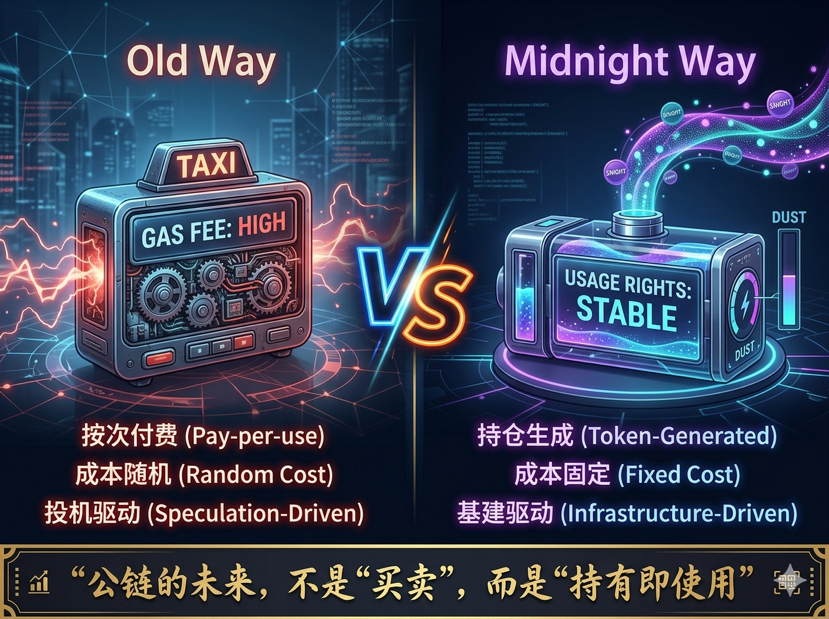
⛽ From 'Taxi Mode' to 'Cloud Service Packages'
From this perspective, the division of labor between NIGHT and DUST becomes much clearer:
• $NIGHT : Represents your long-term rights, like equity, and also akin to your 'physical stamina limit'.
• $DUST: Represents your actual execution power, the energy you consume while working.
In the past, using public chains was like taking a taxi, paying for each kilometer (pay-per-ride).
Midnight's idea is more like having a 'unlimited data card' or buying a 'cloud server quota'. If you hold $NIGHT , the system will automatically generate DUST for you. Trading is no longer about digging into your pocket each time, but a continuous supply of resource relationships.
For those applications that require high-frequency trading or complex logic (like privacy computing, enterprise-level processes), this kind of 'predictability' is simply a necessity. No one wants to go bankrupt tomorrow just because the coin price doubled after their budget was fine today, right?
⚖️ Xiao Xi's 'Awakening in the Human World': The Other Side of Coins
Of course, we can't just brag; this kind of design, while solving stability, also brings a challenge that many people overlook: the capital threshold.
Since the ability to acquire DUST is linked to $NIGHT 's holdings, the logic has changed:
1. The Ticket Logic Has Changed: It used to be 'who pays gets in', but now it may change to 'who holds shares gets in'.
2. Advantage of Large Holders: If large institutions hold massive amounts of NIGHT, can they stabilize and dominate all network bandwidth?
Although the previous Gas model was chaotic, the door was always open for small retail investors. In Midnight's ideal world, will the qualifications to use public chains gradually evolve into an extension of capital strength? That's the most worth pondering point.
💬 Xiao Xi's Words
Midnight presents a significant question to the market: In the future public chains, what will be sold to users—repeated trading opportunities or a continuous right to use the network?
If it's the latter, then Midnight's paradigm may be writing the manual for the next generation of public chains.
What do you think about this 'holding for resources' model? Do you feel it’s more stable, or are you worried that retail investors won't be able to afford it in the future? Let Xiao Xi know in the comments, and we’ll analyze it together! 👇
#night #NİGHT