
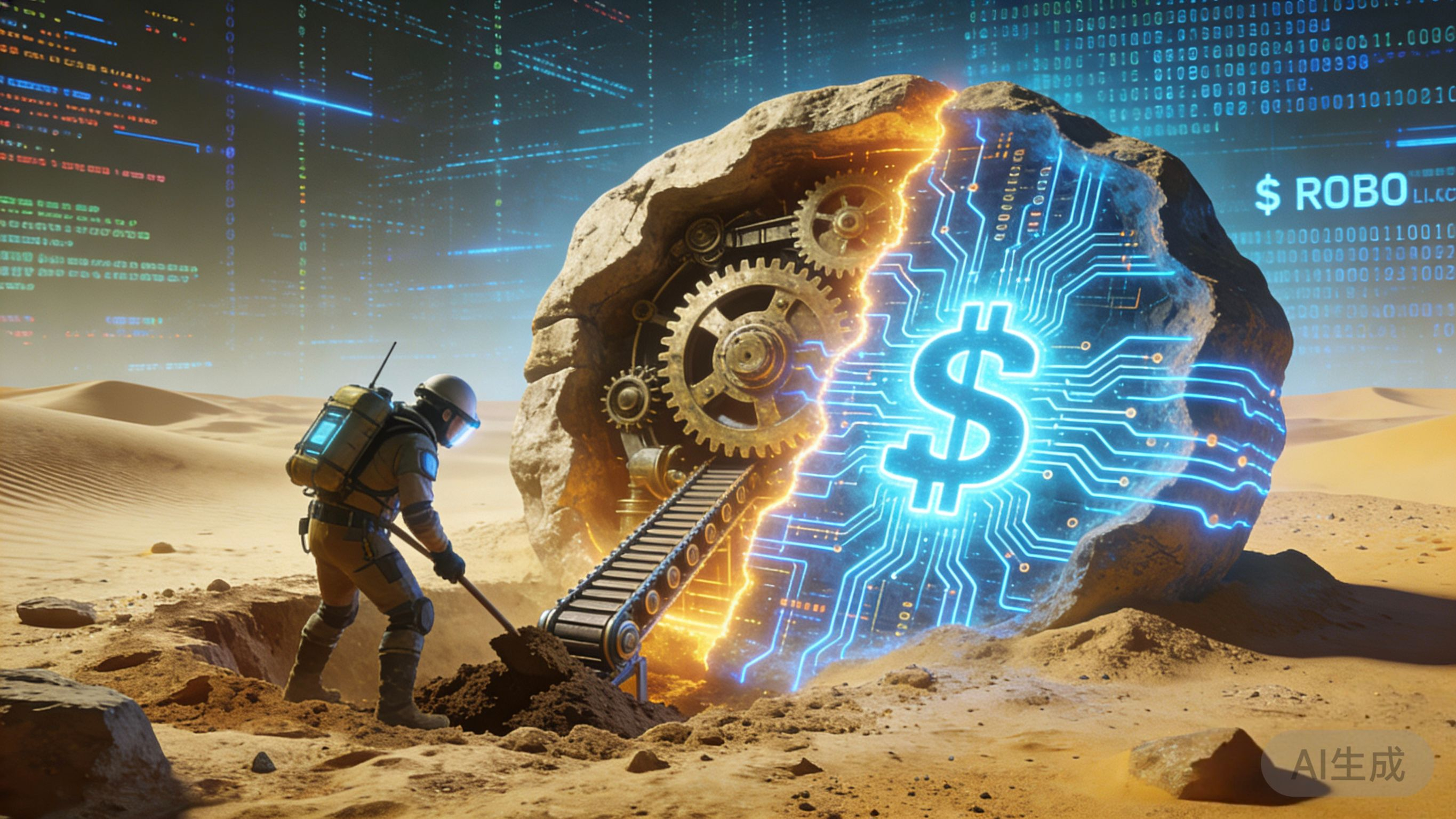
Prologue: Redefining Asset Classes
The history of human economics is defined by the evolution of asset forms: physical goods → financial notes → digital assets. We are standing at the next critical point: the era of programmable physical capital. ROBO is the first native representative of this new asset class.
Anatomy of ROBO——Triple Composite Value Structure
ROBO is not a token of a single attribute, but a composite of three identities:
Production Capital (Capital Stock)
Each circulating ROBO corresponds to a certain proportion of robot productivity usage rights in the Fabric network. Holding $ROBO is equivalent to holding a share in a globally distributed, automated 'robot production capacity'. This part of the value is anchored in the production efficiency of physical assets.
Protocol fuel (Utility)
As a network fee and settlement medium, its consumption speed is proportional to the intensity of network economic activities. This portion endows it with persistent deflationary pressure and instantaneous value flow.
Governance and growth options (Option)
Holders can decide the upgrade direction of the network (e.g., supporting new robot protocols), sharing in the value growth brought by new access capacity. This portion grants it a call option on future revenues.
Innovative insight: traditional assets rarely possess the attributes of 'producing cash flow', 'sustained consumption deflation', and 'governance properties that determine the future' simultaneously. The triple combination of ROBO makes it an unprecedented counter-cyclical asset.
New valuation framework - a discount model based on 'programmable physical capital'.
Traditional valuation models fail here. We propose a Programmable Physical Capital Valuation Model (PCCVM):
Network annual productivity value: the total potential output value of all connected robots (e.g., 100,000 robots × $50,000 average annual output per robot = $5 billion).
Protocol profit margin: the value proportion extracted from the Fabric network (assumed to be 1-3%).
Capitalization rate: reflects the risk and liquidity discount of the productivity revenue.
Governance option premium: valuation of future network expansion and standard formulation.
Key inference: under this model, the value of $ROBO does not rely on mere 'supply and demand speculation', but directly securitizes part of the future revenue streams of global machine automation productivity. This is a new species that lies between 'company stocks' and 'commodities'.
Inflection point - the revolution of combinability in 'physical Lego'.
The combinability of DeFi has created a hundredfold innovation. $ROBO brings this combinability into the physical world, giving rise to 'physical Lego':
Scenario example: a 'logistics optimization' DApp can automatically combine: idle robotic arms from Factory A (rented via ROBO) + autonomous forklifts from Warehouse B (scheduled via ROBO) + path planning algorithms from C (paid in ROBO) + delay insurance from Agreement D (claims in ROBO). The entire process is automated without human intervention, orchestrated, executed, and settled by smart contracts based on real-time data.
$ROBO's role: it is the only seamless value lubricant and trust medium between all these heterogeneous physical and digital services.
Endgame imagination - when ROBO becomes the 'currency bedrock' of the physical world.
The following scenarios may emerge in the future:
Collateral for corporate bonds: a manufacturing company can issue bonds secured by the future ROBO revenue streams of workshop robots.
National strategic reserve: manufacturing powerhouses may use $ROBO as part of their digital strategic reserves to ensure the risk resistance and global connectivity of their industrial automation networks.
The 'index fund' of the physical world: the birth of an ETF tracking the 'Global Robot Productivity Index', whose underlying assets are a basket of derivatives of $ROBO .
At that time, ROBO will no longer be seen as a 'cryptocurrency project token', but as the stock and reserve asset of economic activities in the physical world.
From speculative targets to cornerstone assets.
The narrative of investing in $ROBO is shifting from 'investing in a blockchain protocol' to 'investing in the founding moment of a new asset class'. This is not only an internal narrative of the crypto field but also a historic mapping of the value internetization of the entire real industry.
Its risk is no longer 'can this project succeed', but 'how quickly will this new paradigm be accepted by the world'. All signs indicate that, under the eternal drive for efficiency and automation, this speed may far exceed expectations.

Imagine in 2030, on a company's balance sheet, there are not only US dollar cash and Bitcoin but also ROBO. Please describe which account the accountant would classify ROBO in the company's annual report? Is it 'intangible assets', 'digital assets', 'productive biological assets', or a brand new accounting category?@Fabric Foundation