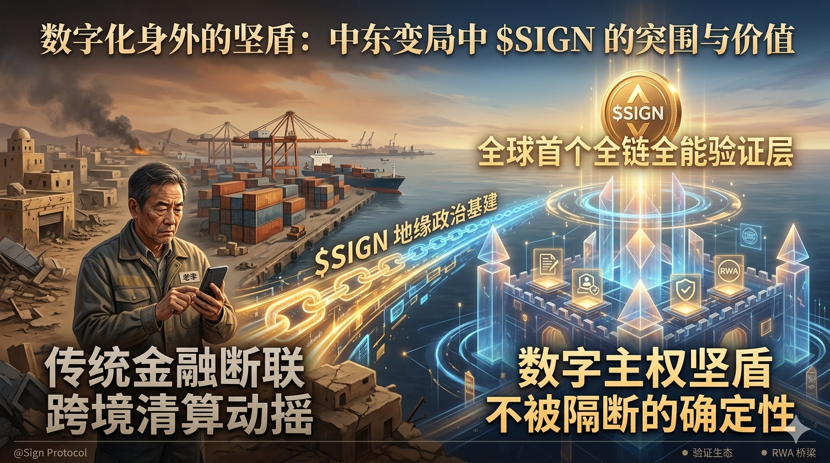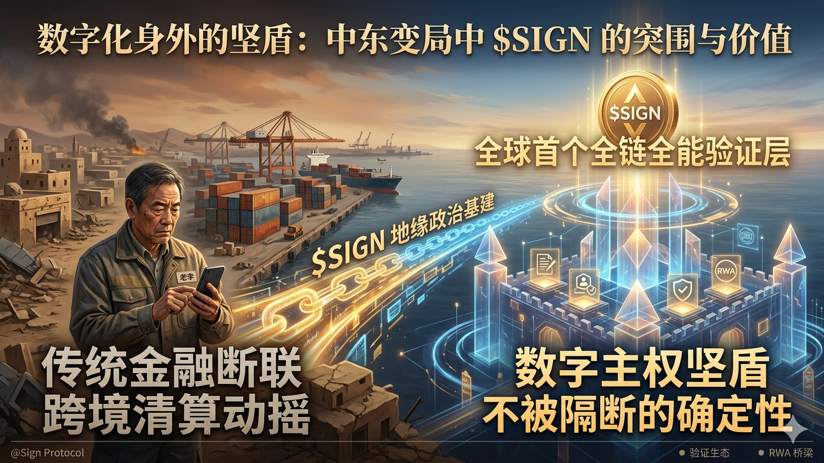
In a bustling port in the Middle East, Mr. Li stared at the logistics information on his phone, his brow furrowed. As a businessman who has long been engaged in cross-border trade, he has felt unprecedented pressure in the past six months: geopolitical conflicts have led to the possibility of traditional bank branches being disconnected at any time, and cross-border clearing agreements have become shaky under the shadow of war. What worries him most is that not only funds, but also the signatures of every order and the legal validity of every contract could be tampered with or lost in the chaotic flow of information.
Until he came across @SignOfficial . Late that night, Lao Li realized that as the rules of the physical world began to loosen, we needed a kind of "geopolitical infrastructure" based on mathematics and consensus to rebuild trust.
#Sign地缘政治基建 : The Digital Cornerstone Amidst Turmoil
The complexity of the Middle East situation is essentially due to the soaring costs of trust. When regional conflicts escalate, centralized trust institutions (such as multinational banks and traditional legal repositories) often become ineffective due to administrative injunctions or physical sabotage. In this context, the emergence of Sign is not merely a technological solution, but rather a completely new form of "decentralized infrastructure."
@SignOfficial SIGN is dedicated to building the world's first full-chain, omnipotent verification layer. By moving identity verification, contract signing, and asset ownership confirmation onto the blockchain, it ensures the immutability of information. Even in the heart of geopolitical turmoil, as long as the internet continues to exist, SIGN holders can protect their digital sovereignty through this protocol. This "censorship resistance" and "high availability" are precisely the most scarce resources in the Middle East and other volatile regions globally.
SIGN Token: Empowering a Global Validation Ecosystem
As the core of the ecosystem, the SIGN token is not just a speculative asset; it serves as the "fuel" and "vote" for the entire validator network.
1. An Economically Driven Trust Engine: Within the @Sign ecosystem, every verification action and every on-chain signature requires the support of $SIGN . As demand for decentralized offices and cross-border trade increases in the Middle East, the real-world use cases for $SIGN will experience exponential growth.
2. Governance and Security Pillars: Holders of $SIGN tokens can participate in the governance of the protocol. In a volatile geopolitical environment, this community-driven governance model can quickly respond to the legal compliance needs of different regions, making the protocol more resilient.
Why is Sign said to have huge growth potential?
From a Middle Eastern perspective, SIGN's future growth potential stems from "alternative demand." When traditional SWIFT systems or centralized data storage are affected by political maneuvering, global capital and traders will urgently seek a neutral, transparent, and automated alternative.
@Sign fills this gap perfectly. It's more than just a Web3 tool; it's a bridge connecting real-world assets (RWA) with the digital world. Imagine a future where Middle Eastern oil trade settlements and commodity transactions, with their underlying legal ownership verification and signature authentication handled by SIGN-driven protocols, would represent a trillion-dollar market.
Conclusion: Finding Certainty Amidst Uncertainty
The wheels of history roll ever onward, and the geopolitical game never ceases. But the progress of technological civilization always sprouts new hope from the cracks. $SIGN represents precisely this kind of "certainty" in the digital age, unaffected by power or conflict.
Whether you're a trader like Lao Li or an investor focused on the deeper value of blockchain, @Sign's platform...#Sign地缘政治基建 These are all things you should ponder. Holding onto $SIGN amidst change may be holding onto the ticket to the future digital order.