

The weather is really nice today, and the grass in Chengdu has grown a lot of people again.
In the afternoon, I took a stroll around Jincheng Lake, casually found a patch of grass to sit down, next to me someone was having a picnic, someone was playing cards, and there was someone wearing headphones lost in thought. The sunlight is not glaring, and the wind is just right; that feeling is— you don’t have to think about anything, time will slow down by itself.
But what's interesting is that shortly after I sat down, two people next to me started talking about coins.
Someone said: 'The on-chain is too transparent now, I dare not move my position randomly.'
Another reply: 'Then you can play with the privacy chain.'
In the end, the previous person laughed: 'Privacy chain? Are you brave enough to use it long-term?'
I was listening next to it at that time and suddenly felt that this conversation was quite real— even more real than many white papers.
Because this is actually a point where the entire industry is stuck right now:
Either too transparent or too black box.

Everyone understands the issues of transparent chains; the data on-chain is visible at a glance.
When you make a transaction, smart money can see it;
You lay out a strategy, and the opponent can also analyze it;
Even if your wallet address is marked, every step afterward feels like being watched.
But on the other side, the issue of pure privacy chains is more realistic:
You have hidden it, but you have also hidden 'trust' along with it.
Regulatory concerns, institutions don't dare to touch it, and many scenarios can't land at all.
So I have had a feeling over the past few years:
It's not that blockchain doesn't work, but many designs are too extreme.
It is precisely because of this point that I have recently started to take a serious look at @MidnightNetwork this project, which is what everyone has been talking about, $NIGHT.
I'll state the conclusion first, and then expand slowly:
This project may not explode, but its direction is one of the few that 'really solves problems.'
Let's change to a more everyday understanding.
You are now sitting on the lawn in Chengdu, with people coming and going beside you.
You can choose between two extremes:
The first type is that you broadcast all chat content through a speaker, letting the whole world hear (fully transparent).
The second type is that you hide in a completely soundproof room, and no one can hear (absolute privacy).
But in real life, most people are actually the third type:
I can chat with friends and be overheard a little by the waiter, but it won't be broadcasted to the whole venue.
This is what Midnight wants to do
Selective Disclosure
It's not about making you 'completely hidden,' but about allowing you to prove certain information when needed while protecting the underlying data from exposure.
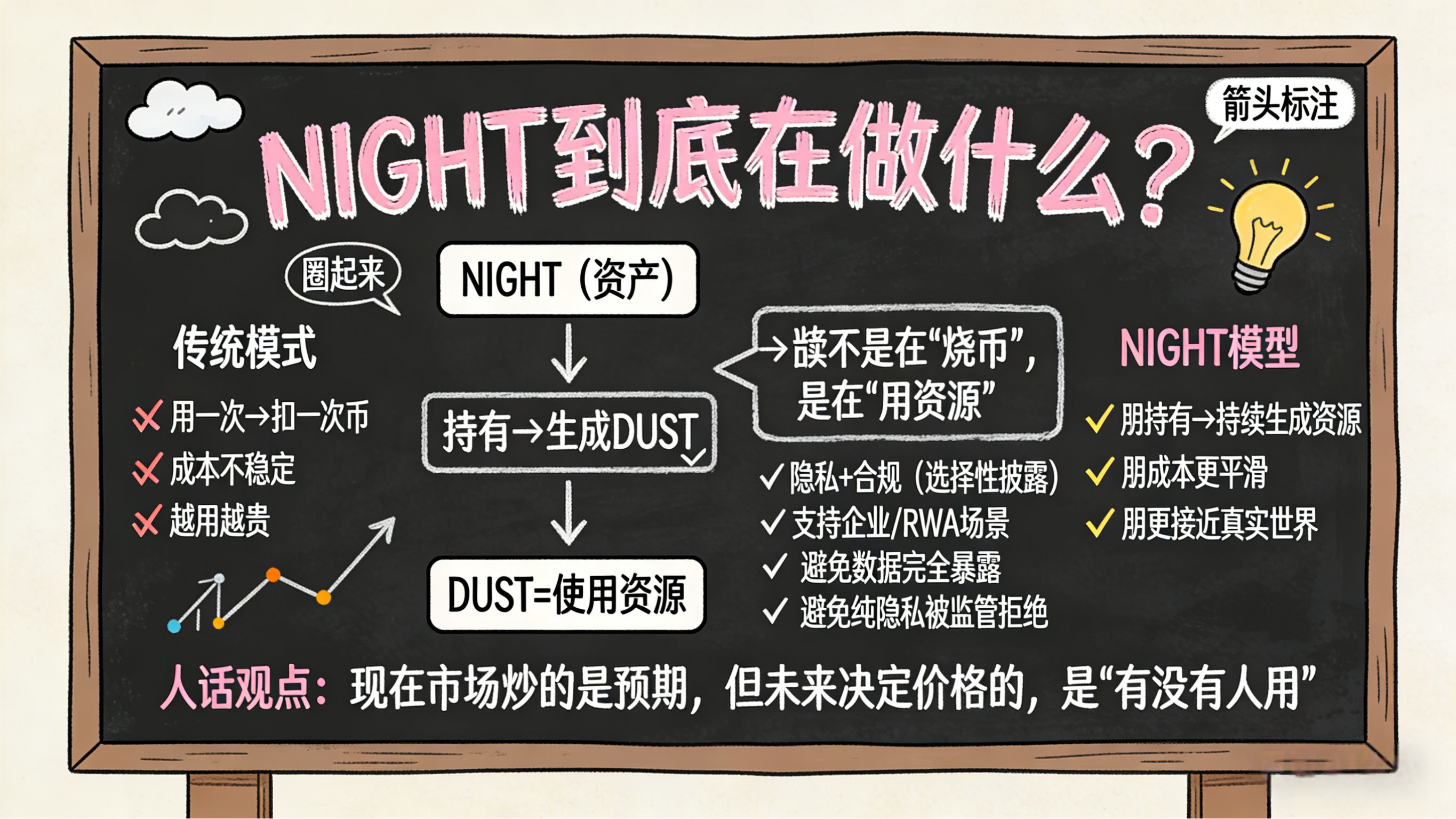
To give a more specific example:
You can prove 'I meet KYC,' but you don't need to upload your ID to everyone;
You can prove 'this transaction is legal,' but you don't need to expose all the details.
This, in my view, is the most crucial step for future on-chain.
Because the next entrants are not just retail investors.
It's institutions, it's RWA, it's real assets, it's enterprise-level applications.
What are they most afraid of?
It's not that the technology isn't enough, but the data can't be given out carelessly.
Speaking of its mechanism design, I think this is something many people have not truly understood.
Midnight has separated the two things:
$NIGHT: Public, visible assets (similar to your account balance)
DUST: Resources really used for executing privacy computing (similar to 'fuel')
The key point is here
You're not 'spending money' with every transaction, but holding NIGHT will continuously generate DUST.
This is completely different from traditional chains.
It used to be:
You use the chain once → Deduct a coin once → Costs become higher and higher
Now it has become:
You hold assets → Automatically generate usage rights → Smoother costs
Moreover, DUST will still depreciate.
What does this mean?
Simply put in human terms:
It doesn't let you hoard and not use it, nor let you swipe it casually.
I actually quite agree with this design, as it is closer to the 'resource model' of the real world, rather than just a 'transaction fee model.'
But speaking of this, I must pour some cold water.
This is also my own true opinion.
Currently, 80% of the market's attention on NIGHT is still on speculation rather than usage.
Look at the current discussion points:
Listing of exchanges, airdrops, mainnet launch, partners...
These are all very important, but they have one common point:
The value has not really formed a closed loop yet.
The real key is after the mainnet.
I personally keep an eye on this project and only look at three things:
First, is there 'human usage' on-chain.
It's not that the number of addresses has increased, but whether there are real transactions and real demands.
Second, are there any 'indispensable' applications?
It's not a demo, but rather the kind of product that makes you uncomfortable if you don't use it.
Third, whether DUST has been continuously consumed.
If resources are unused, then even the best model is just a design.
Back to this lawn in Chengdu.
As the sun sets, people gradually disperse, some pack up picnic mats, while others continue chatting.
I suddenly have a pretty simple idea:
The industry has reached today, and it's not lacking 'stories.'
What's lacking is that kind of thing— when you look at it, you know it's prepared for the real world.
Midnight is at least trying to do this.
It's not sexy enough, nor extreme enough.
But it is looking for a middle path.
This path is difficult to walk, and it can easily be overlooked by the market.
But if one day it really works out,
Then its value may not just be a coin price.
So my stance has always been clear:
I will keep an eye on it, but I won't get overly involved
I will study, but I won't blindly trust
I care more about after the mainnet, rather than before the mainnet
Some projects are for speculation.
Some projects are for verification.
NIGHT is more like the latter.
And the real opportunity is often hidden in those
A place that initially doesn't seem so lively.#night $NIGHT
