

Will Owens of Galaxy Digital stated that most crypto wallets are not exposed to quantum risks, and vulnerabilities are limited to cases where the public key is leaked.
In a report on Thursday, Owens stated that theoretically, quantum computers could derive private keys from public keys, allowing attackers to impersonate the owner, forge signatures, and steal coins.
However, he pointed out that not all wallets are equally susceptible to such risks.
"In fact, most wallets today are not vulnerable. Funds are only at risk when the public key is exposed on the chain," he said.
Owens noted that there are two main scenarios that lead to wallet exposure: one is wallets where the public key is visible, and the other is wallets where the public key is disclosed during spending.
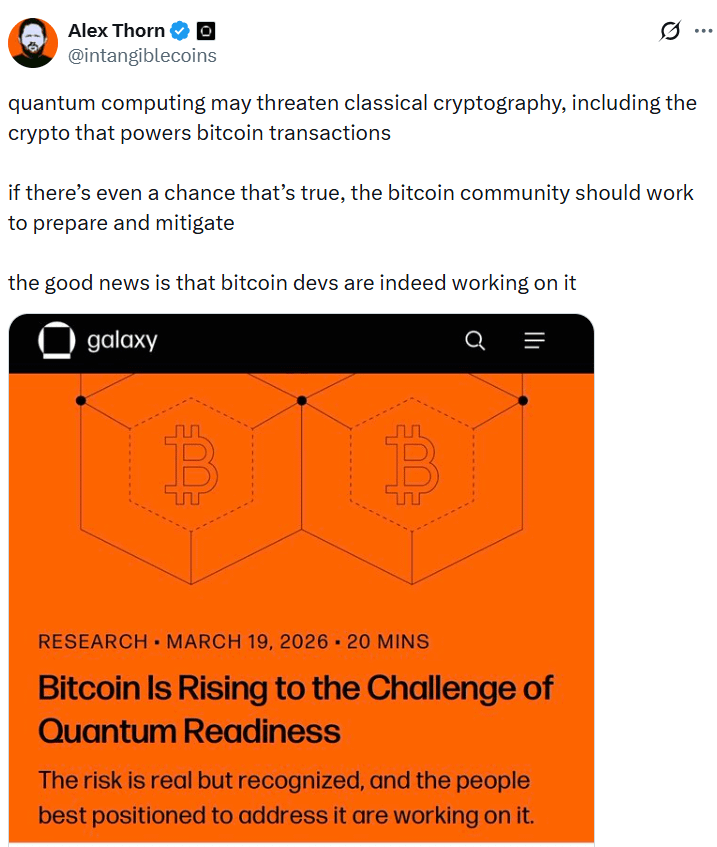 Source: Alex Thorn
The threat of quantum computing to cryptocurrencies has long been viewed within the community as an impending turning point. Advanced computers capable of breaking encryption algorithms could potentially reveal user keys, expose sensitive data, and steal user funds.
Developers are actively addressing quantum risks
Critics argue that the threat posed by quantum computing is exaggerated, as the technology is still decades away from being feasible, and traditional targets like banking giants are likely to be breached before Bitcoin.
Owens pointed out that there are discussions online suggesting that Bitcoin core developers are "ignoring and gatekeeping" proposals regarding quantum issues, such as the soft fork BIP 360, but he claims the reality is different, noting that "since the end of 2025, the submission rate of related proposals has noticeably increased."
"Our assessment contradicts some public criticisms, finding that developers have been heavily engaged in work related to quantum vulnerabilities and their mitigation measures," he said.
"The entire ecosystem now has a set of concrete and increasingly mature proposals that comprehensively address risk issues. These proposals are not theoretical but actual projects actively developed, reviewed, and discussed by the most experienced contributors within the Bitcoin ecosystem."
Other participants in the industry have also proposed solutions. Bitcoin analyst Willy Woo stated last November that storing Bitcoin (BTC) long-term in a SegWit wallet helps reduce risks associated with quantum computing.
Governance will still be a challenge
Owens stated that even if the developer community proposes post-quantum solutions, governance will still pose challenges, as "Bitcoin has no CEO, no board, and no central authority to enforce software upgrades."
"But the nature of this threat—external, technical, and widespread—has led to changes in incentives that differ from previous controversies over Bitcoin's economic direction," he said. "Every honest participant in the network, whether miner, holder, or exchange, has a direct financial interest in the ongoing security of the Bitcoin network."
"For investors, the core conclusion is very clear: the risks are real, but they are widely recognized, and the most capable individuals are actively taking action."