
I’ve been researching $NIGHT and exploring @MidnightNetwork , and the more I look into it, the more it feels like this isn’t just another blockchain design — it’s a shift in how blockchains might evolve from here.
#night
Not louder. Not faster. But smarter.
🧠 Moving Beyond the Old Trade-Offs
Most blockchain systems today force a choice:
Be transparent → gain trust, lose privacy
Be private → gain confidentiality, lose verifiability

This trade-off has shaped the entire industry.
But Midnight’s design challenges that idea. Instead of choosing one side, it tries to combine both through selective disclosure and zero-knowledge proofs.
That alone changes the conversation.
Because if users can prove something without revealing everything, then maybe blockchains don’t need to sacrifice one value to support another anymore.
🔐 Privacy That Doesn’t Break Trust
One thing that stood out to me is how Midnight treats privacy.
It’s not about hiding everything. It’s about controlling what gets revealed.

With this model:
Sensitive data stays off-chain or local
Only necessary proofs go on-chain
Verification still happens without exposure
That’s a big deal.
Because one of the biggest criticisms of privacy systems has always been:
👉 “If we can’t see it, how do we trust it?”
Midnight’s approach answers that — you don’t need to see everything to trust the outcome.
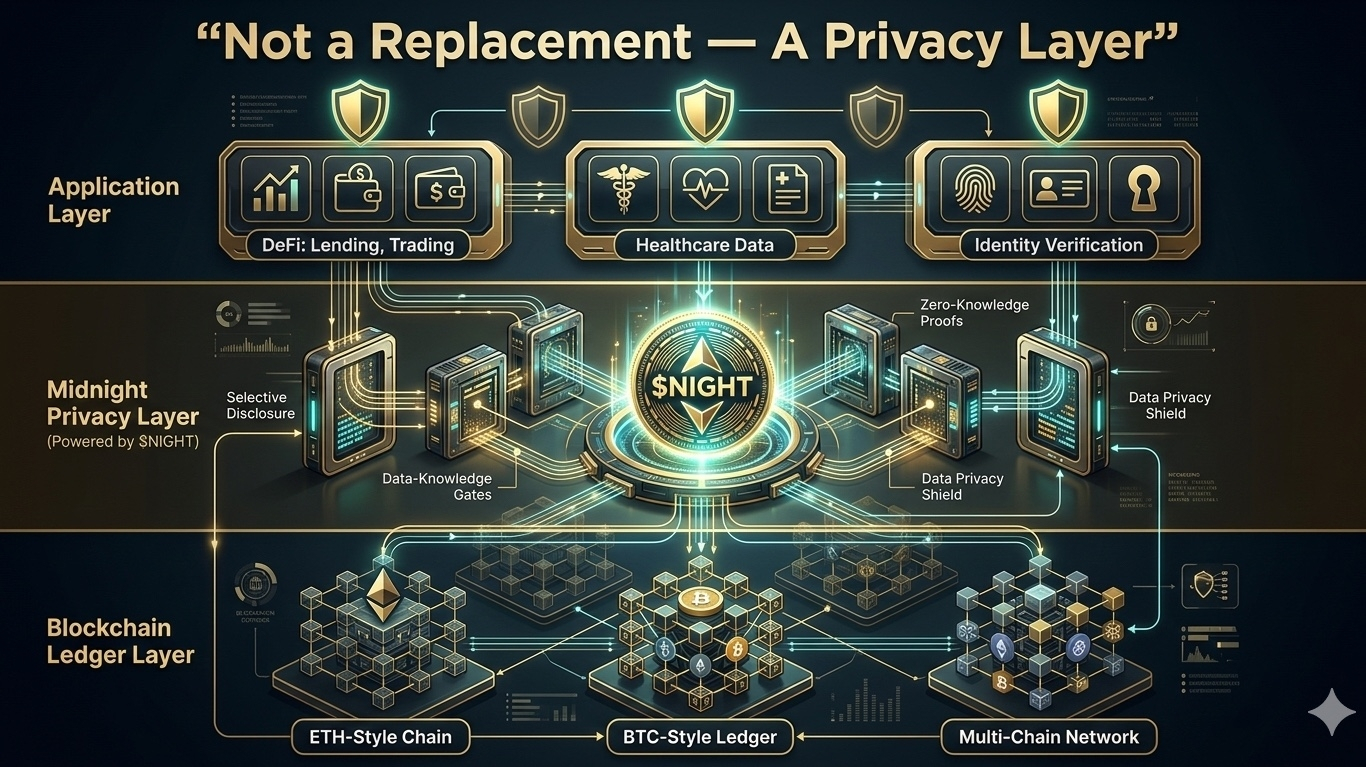
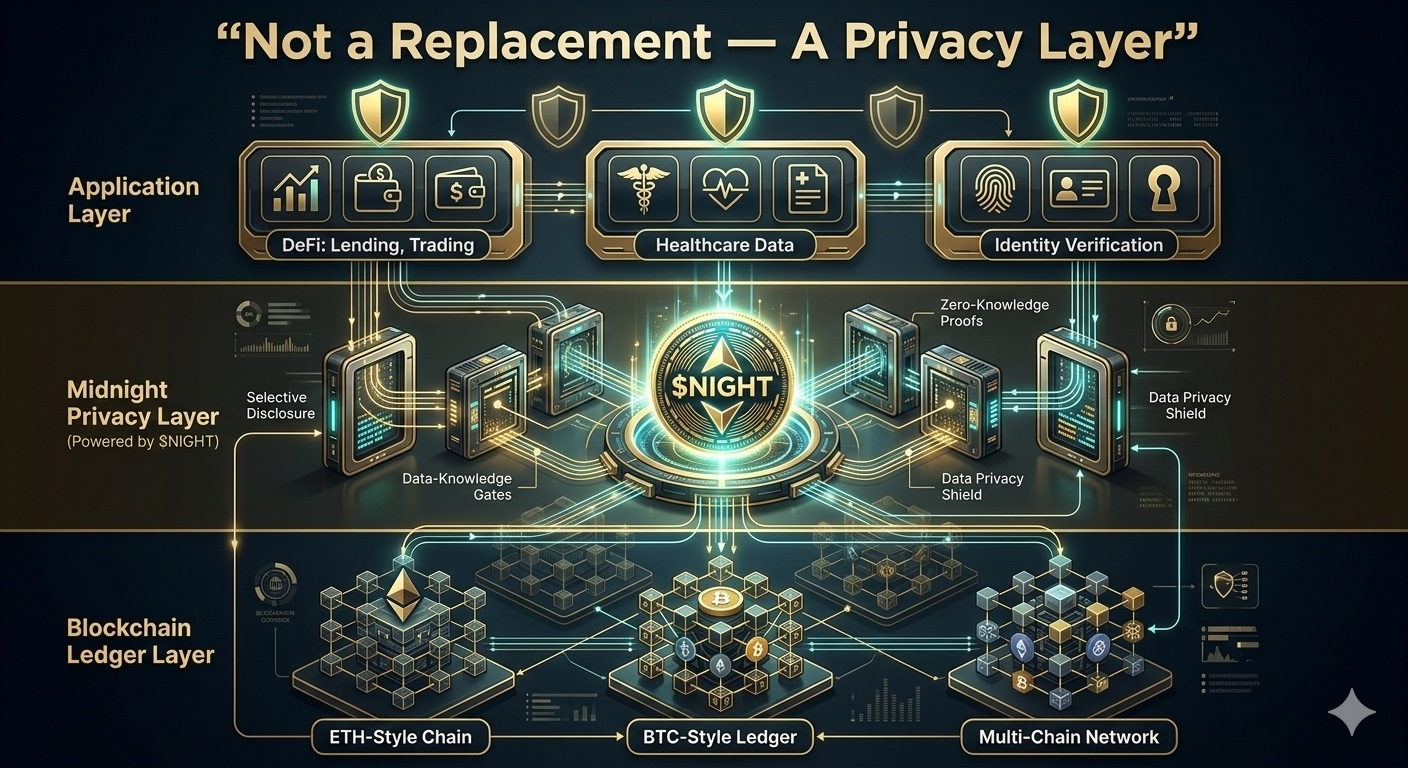
🌐 A Layer, Not a Replacement
Another interesting part of the design is that Midnight doesn’t try to replace existing blockchains.
Instead, it acts more like a privacy layer that can integrate with other ecosystems.
That means:
Existing networks don’t need to rebuild from scratch
Developers can add privacy features without breaking current systems
Adoption becomes easier and more realistic
This kind of modular thinking could be important for the future.
Because instead of competing chains, we might see specialized layers working together.
⚖️ Solving the “Real-World Problem” Gap
Let’s be honest — one reason blockchain adoption is still limited is because real-world systems don’t fit well with extreme transparency.
Businesses, institutions, and even users need:
Data protection
Compliance flexibility
Control over information
Midnight’s design directly addresses this.
By allowing selective disclosure and compliance-friendly mechanisms, it creates a system that feels closer to how real-world operations actually work.
🧩 Rethinking Blockchain Architecture
If this model proves effective, it could influence future systems in a few key ways:
Privacy becomes default, not optional
Verification replaces exposure as the core trust model
Interoperability includes data control, not just asset transfer
Developers design for both users and regulators from day one
That’s a very different direction from where blockchain started.
🚀 Final Thought
What stands out to me is this: Midnight isn’t trying to push blockchain to an extreme.
It’s trying to balance it.
And maybe that’s exactly what the next generation of blockchain systems needs — not more extremes, but better design choices.
Because the future of Web3 probably won’t be built on “maximum transparency” or “maximum privacy”…
It’ll be built on when and how to use each one.
Do you think this kind of design could shape the future of blockchain architecture? 👀
#night #Crypto #blockchain #Web3 #Privacy #defi