
Everyone is in a panic that AI and robots will take away human jobs, leading to massive unemployment. But recently, while simulating the economic model of the Fabric Foundation, I saw a completely opposite, even somewhat darkly humorous future: in the near future, many of us may inevitably become maintenance workers 'working for' robots.
This is definitely not about sci-fi jokes. In the past, we were used to humans being the employers, and machines being tools that needed to be amortized. But Fabric @Fabric Foundation has now issued on-chain wallets and independent identities to every entity hardware, completely overturning this one-way asset relationship.
Imagine this extremely down-to-earth scenario: an automated delivery tracked vehicle that runs orders around the neighborhood all day long suddenly breaks down due to a shattered shock absorber from years of heavy operation. As an autonomous economic entity, it cannot spontaneously grow robotic arms to replace its own parts. What will it do at this moment?
It will directly publish a smart contract for 'physical repair rewards' on the decentralized network of Fabric.
A nearby human repair worker (or some hardware repair team) sees this order, grabs their toolbox, runs over, and spends half an hour helping it replace the physical bearing. After the system verifies that the physical fault has been resolved, the on-chain wallet of this delivery vehicle will automatically transfer an amount of $ROBO into this human repair worker's account.
Have you noticed the blind spot? In this closed loop, the 'boss' who issues tasks and pays wages has become a machine, while the 'gig workers' selling their physical labor have become humans.
In my view, many people think that Web3 can only endlessly nest within financial protocols; they do not understand how projects like Fabric restructure production relationships. It establishes not just a base for M2M (machine-to-machine) payments but also an extremely large M2H (machine-to-human) offline order dispatch system.
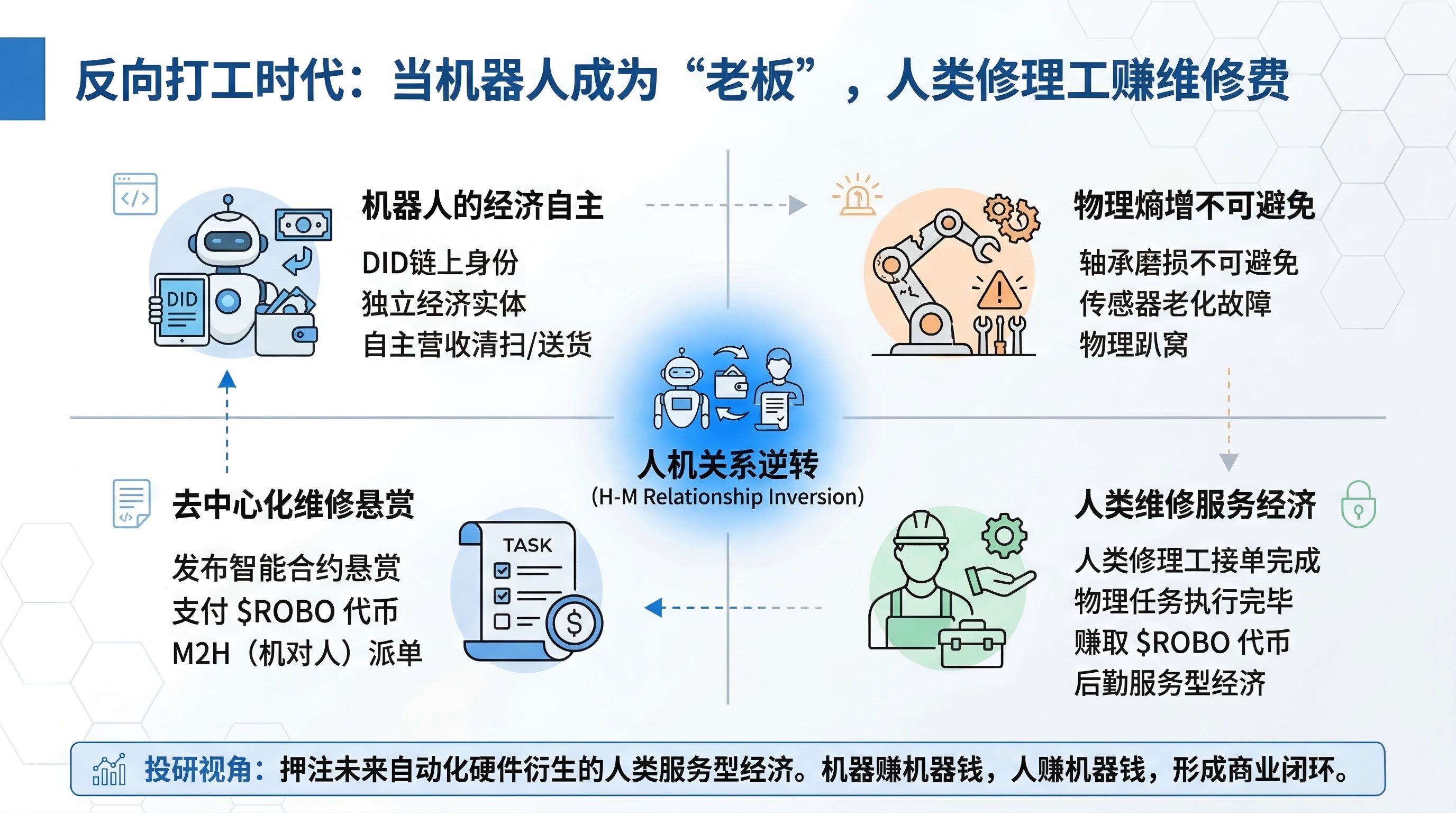
When millions of smart devices flood the streets and factories of the real world in the future, they will inevitably encounter physical wear and tear, sensor aging, and even unforeseen damage caused by passersby. The physical world is subject to entropy; these iron clumps cannot operate perfectly forever. They require a massive human logistics team to maintain, to clean lenses, and to replace gears.
Robots work hard in the front, leveraging efficient computing power to earn tokens, but must then use a portion of those tokens as 'medical fees' and 'maintenance fees' to pay human repair workers.
Therefore, instead of worrying every day about whether AI will replace your job, it is better to change your investment and research mindset. Grasping the underlying logic of $ROBO is not just about investing in those cold, hard smart hardware components; it is also about betting on the immeasurable 'human maintenance service economy' that will arise around automated hardware in the future.
Machines earn money from machines, and humans earn money from machines. This is the most complete and ruthless commercial closed loop of the physical intelligent network. Once you see through the benefits of this 'reverse working,' your mindset will be much steadier in the face of market fluctuations.
