
Recently, this market has probably left many people confused again? Chasing after rises, cutting losses during falls, and staring at the screen until our eyes are blurry, only to find that the transaction fees have eaten away our profits. I've been thinking, after surfing for so long, what exactly are we riding on? Is it just for those tiny fluctuations? No, I believe the real big opportunity lies in looking towards 'infrastructure', towards places that can support the future trillion-dollar capital flows.
Today, I want to chat with everyone about a project I've been deeply researching lately — SIGN. Don't feel strange just because of the name; in my opinion, this thing might be the 'key puzzle' connecting Web2 and Web3, even connecting the real world with the crypto world.
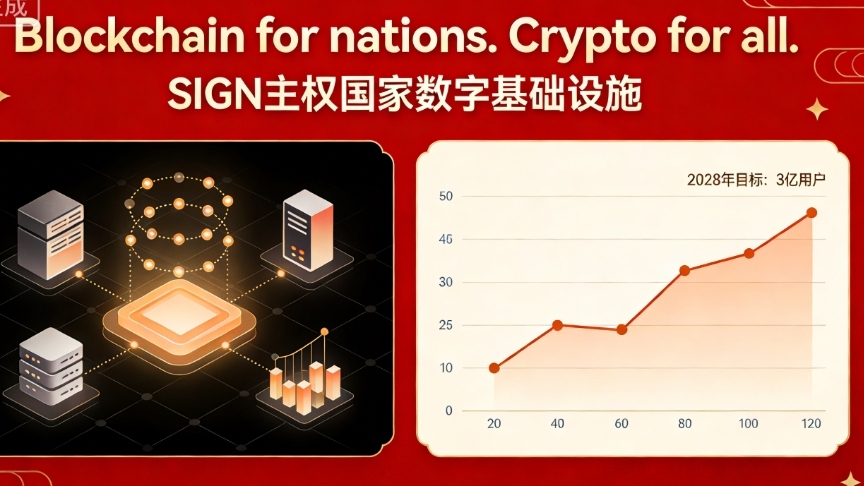
SIGN stands for 'Sovereign Infrastructure for Global Nations,' which translates to 'sovereign-level global infrastructure.' Just hearing this name, doesn’t it widen your perspective? It is not a simple token issuance project, nor is it an ordinary DeFi protocol. Its positioning is as the infrastructure for global credential verification and token distribution. What does that mean? You can think of it as a super complex of the 'government service hall' + 'bank counter' in the Web3 world.
We all know that one of the biggest pain points in Web3 right now is compliance, privacy, and trust. On one hand, we hate the monopolistic data collection of traditional KYC that requires giving out ID cards and addresses, fearing information leaks; on the other hand, project parties and regulators need to know whether the money is clean and if the person is real. This is a deadlock, right?
SIGN is here to solve this deadlock. Its core is a full-chain proof protocol called Sign Protocol. This thing is impressive; it follows the W3C's standards for verifiable credentials and utilizes zero-knowledge proof technology. In plain English, it means: you can prove to others 'I am who I am,' 'I have passed KYC,' 'I have a certain qualification,' without having to throw sensitive information like your original ID card or home address in their face. If you want to prove that you are over 18, you only need to present an encrypted, verifiable credential stating 'This person is an adult,' without exposing your specific birthday. This is the charm of selective disclosure, perfectly balancing privacy and verification needs.
This is just the tip of the iceberg. SIGN has an engine called TokenTable, specifically for automated token distribution. The current chaos of airdrops is evident to everyone, right? Witch attacks, insider trading, and project parties changing the rules at will. TokenTable is here to solve this problem. It can achieve large-scale, compliant airdrops, specifying when to unlock, who is eligible to receive, and how to prevent illegal distribution, all clearly arranged for you. Project parties can use it to accurately connect to identity credentials, genuinely ensuring that 'those who should receive get every bit, and those who shouldn't find it hard to exploit loopholes.'
What excites me the most is that SIGN is not just theoretical; it already has practical cases. For example, in the Middle East, it has participated in the CBDC (Central Bank Digital Currency) bridging project and has also done cross-border asset migration. What does this indicate? It indicates that its technical architecture and compliance capabilities have been recognized by sovereign states. While other projects are still struggling with whether 'compliance' is a constraint or a future, SIGN has already opened that door with the key.
So, brothers, when we are chasing the next hundred times meme, why not also look up and see the far side? Projects like SIGN, which are genuinely solving core industry pain points and connecting the real world, might be the 'ballast' we can hold onto, traversing bull and bear markets. Its native token $SIGN will be used in protocol calls, payment of fees, and ecological governance in the future. As it carries trillions of verifiable credentials and distribution demands, its value is self-evident. This time, I won’t talk to you about K-lines; I’ll just talk about this narrative that might change the game.