Arab countries are gradually leaning towards the United States and Israel on security issues, which essentially reflects that the original regional trust system is accelerating its loosening. Especially after energy facilities have frequently suffered attacks, the balance previously maintained by 'tacit cooperation' is becoming increasingly difficult to sustain.
In this context, looking at $SIGN makes the logic easier to see.
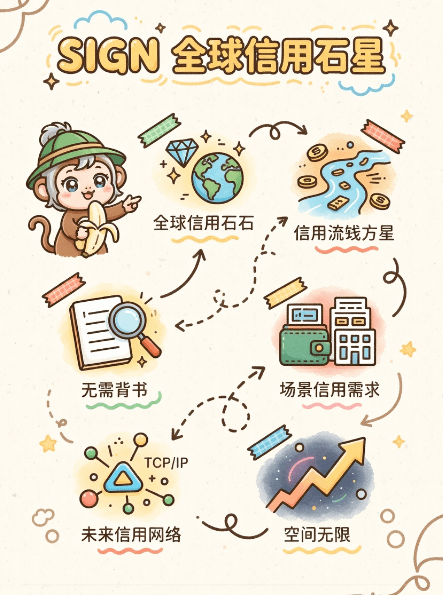
Many still regard it as a narrative project, but if the situation remains tense, what is truly scarce may not be resources, but the ability for 'trustworthy cooperation.' As the competition among parties intensifies, with information being opaque and the cost of cross-regional cooperation high, many problems essentially get stuck at the level of 'trust.'
Once some key processes begin to migrate to the chain—whether it is identity verification, data rights confirmation, or protocol execution—the mechanism that does not rely on a single endorsement is actually more likely to be accepted in complex environments.
So instead of treating SIGN as a short-term market target, it is better to regard it as an observation window: when geopolitical conflicts intensify, does blockchain have the opportunity to take on part of the role of 'infrastructure'.
If this direction is valid, its value will no longer be driven solely by market sentiment.
Of course, we are still in the early stage at this point. Ultimately, what determines the upper limit is still the capability of implementation: whether there are real scenarios for access, whether there is sustained usage, and whether it can form positive feedback.
But one point is worth noting—in high uncertainty environments like the Middle East, if a neutral, verifiable system is truly needed, then solutions like $SIGN have the potential to be adopted.
Short-term may not shine, but once it enters the practical usage phase, the rhythm may undergo a qualitative change.
Another signal worth noting: countries like the UAE are still advancing long-term, large-scale investment frameworks with the US, indicating that even in tense situations, strategic binding has not weakened, but rather has strengthened. This combination of 'security alignment + capital binding' is also reshaping regional order.
I will continue to track this direction, not rushing to conclusions, but I will not ignore the changes it may bring.