
After flipping through Midnight's cross-chain bridge code for the third day, I have to admit defeat. But to be fair, while I have my complaints, #night some designs really did surprise me, so I need to say a couple of objective words.
What impresses me the most is their dual-token model. The separation of NIGHT and DUST seemed flashy at first, but then I realized—this design really has something to it. Traditional public chains use the same token as both an investment asset and gas, and when the price rises, on-chain activities can come to a halt. Midnight's approach is: NIGHT is responsible for governance and staking, holding NIGHT automatically generates DUST, which is specifically used to pay for gas, and DUST will decay and is non-transferable, making it impossible to speculate. This means that the metadata of privacy transactions will not be tracked on-chain, and MEV can't find a path to front run. This 'rational privacy' design logic is indeed a step above Zcash's 'either completely private or completely transparent.'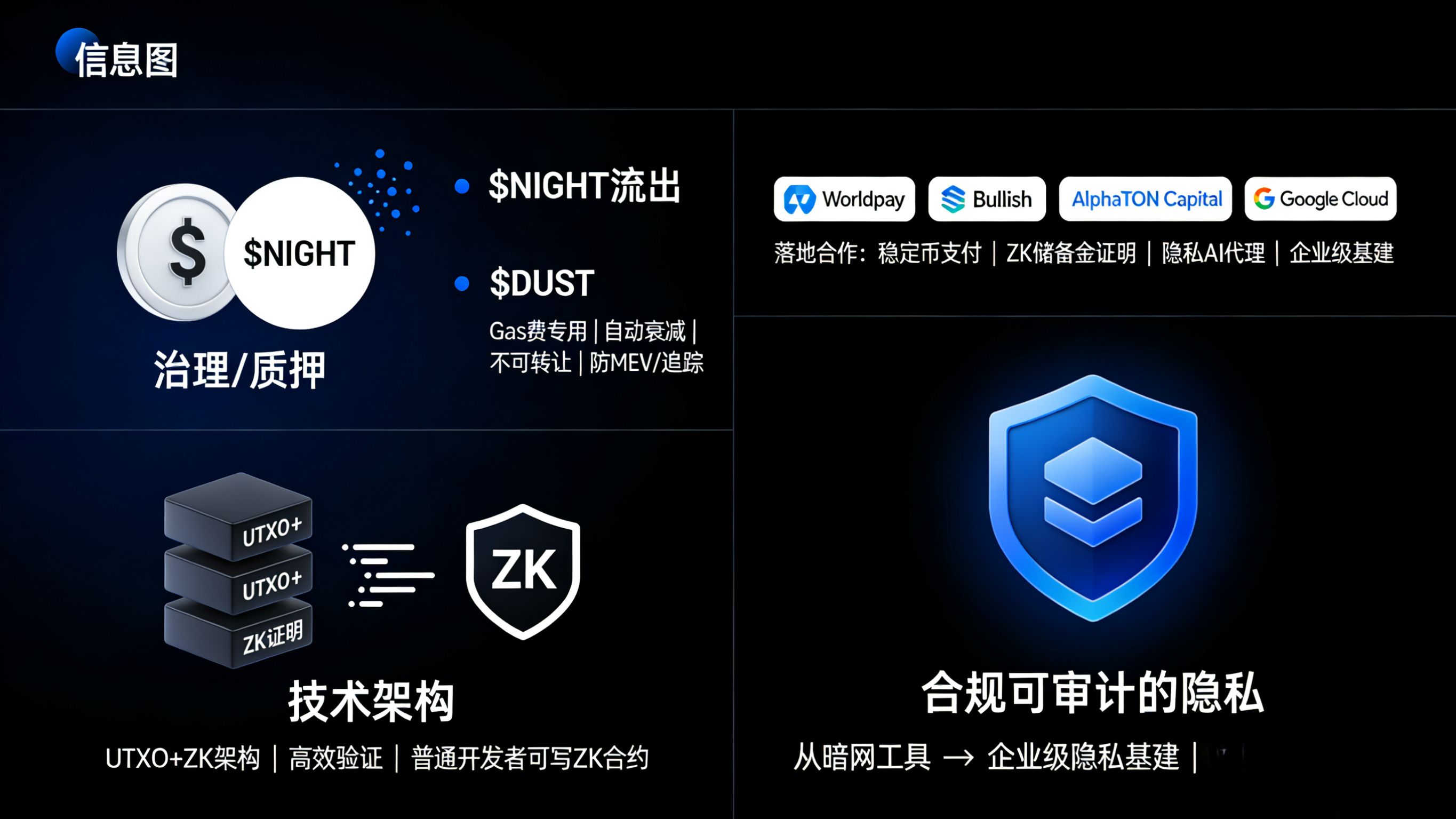
And the institutions they brought in, I initially thought it was just a white-label partnership, but after looking around, I found it was genuinely being implemented. Worldpay—a payment giant with 6 million merchants globally, processing $3.7 trillion in payments annually—is set to build stablecoin payment infrastructure on Midnight. Bullish is doing reserve proof on Midnight's ZK layer, which can verify solvency without exposing wallet and transaction records. There’s also AlphaTON Capital from Telegram, which signed a node agreement to create a privacy AI agent, covering nearly 1 billion users. Google Cloud is also providing them with enterprise-level infrastructure support. These things are not just empty promises; they are solid contracts signed.

Technically, Midnight's UTXO + ZK architecture is indeed better suited for privacy than account models. Each UTXO can independently add proof; although the commitment tree expands quickly, the verification efficiency is high. While Compact language has its error pitfalls, at least it allows regular developers to write ZK contracts without having to learn cryptography from scratch like Circom.
In my personal opinion: Midnight's direction is correct—turning privacy from being 'dark web exclusive' into a 'compliant and auditable' enterprise-level tool. The cross-chain bridge is indeed rough at the moment, but the dual-token model and institutional ecosystem foundation may be the largest moat for $NIGHT . However, the technological foundation of $NIGHT deserves a bit more time to be evaluated.