
After witnessing several ups and downs in the industry, we inevitably fall into a reflection: does the decentralized vision we currently pursue, under the existing public chain architecture, create a terrible variant? When we excitedly move assets and interaction records onto mainstream networks like Ethereum, we are actually actively stepping into a 24/7, all-encompassing surveillance panorama. In this absolutely transparent system, every on-chain interaction, asset balance, and fund flow is permanently recorded by block explorers, and anyone can freely retrieve, analyze, or even trace them. Although this mechanism perfectly solves the trustless machine consensus problem, it inadvertently deprives us of the most core right - data sovereignty.
The industry always loudly proclaims that blockchain has brought true ownership of assets, but if the flow of wealth and the trading cards are observed by the entire network, such ownership is extremely fragile. It’s like having an incredibly sturdy transparent glass safe; although no one can steal the money inside, everyone can see exactly how much wealth there is. For ordinary users, this means continuous exposure to the risks of big data analysis and address tracking; for physical businesses and financial institutions, this is even more a deadly risk. No company would be willing to write the core supply chain flow, client lists, or quantitative trading strategies on a publicly accessible global ledger. Extreme transparency has become the hardest wall obstructing decentralized networks from achieving large-scale commercial applications.
Early tech geeks tried to break this wall with pure privacy coins, but they went to the other extreme. Traditional privacy technologies built absolute black boxes, which protected the anonymity of transactions but completely severed the interface with real-world compliance checks. In today's increasingly strict anti-money laundering and financial regulatory environment, a network that cannot provide any audit trail is destined to wander in the gray area and cannot carry massive mainstream financial liquidity. This has created a seemingly unsolvable knot: transparency means losing trade secrets, while closure means being abandoned by the mainstream system.
It was not until the emergence of Midnight Network @MidnightNetwork that the industry truly saw a practical path that balances both. It did not make a simple compromise between transparency and closure but rather, starting from the underlying protocol, achieved a mechanistic leap using zero-knowledge proof (ZK) technology. In its architecture, data storage and state verification are intricately physically isolated. Sensitive business data and personal information are by default kept on local devices or in private environments, and the public chain network receives only a string of mathematical proofs generated after extremely complex cryptographic computations.
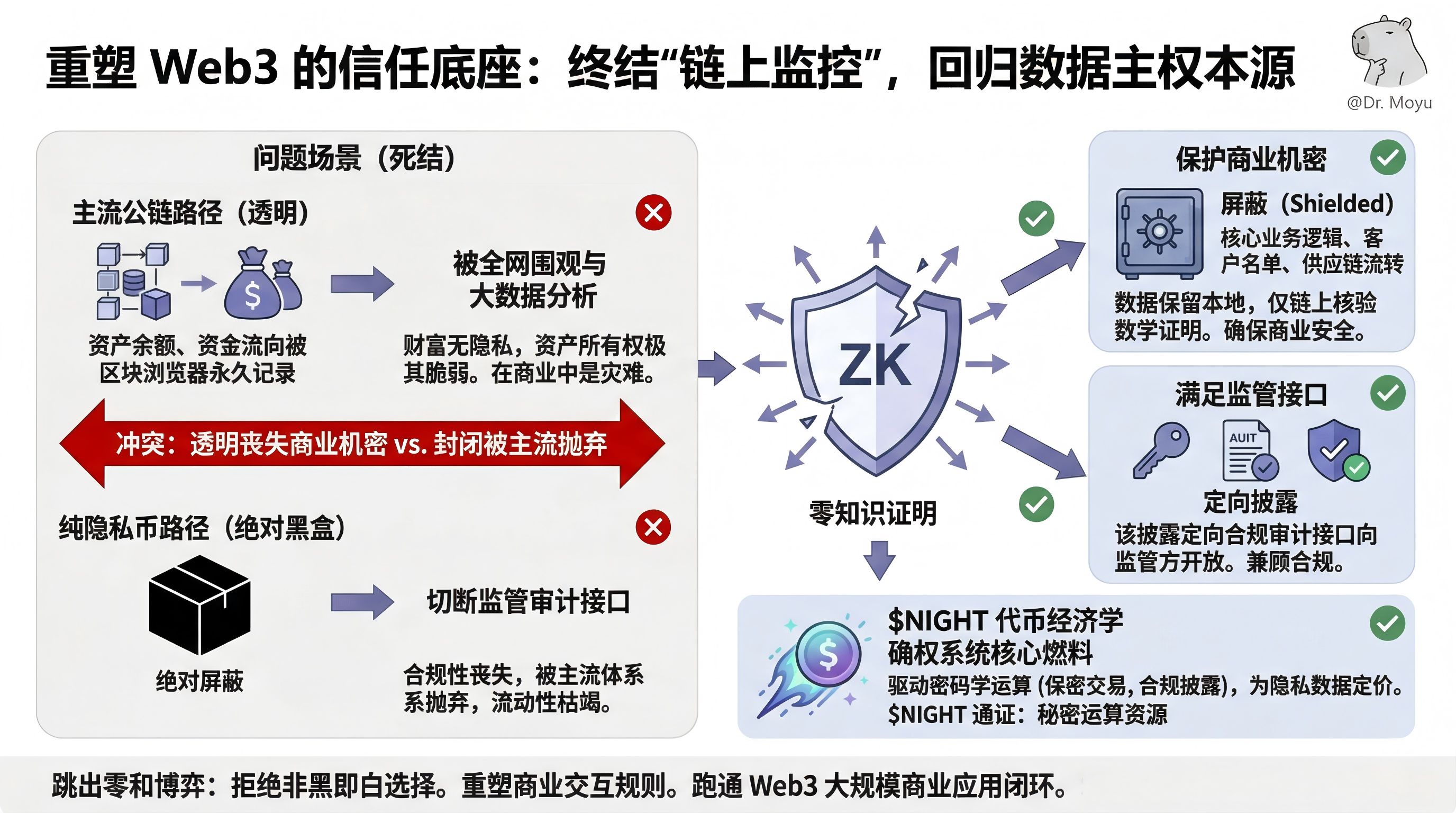
This mathematical proof broadcasts a definitive fact to the entire network: this transaction is legitimate, or this interaction meets the requirements of the smart contract, but it never reveals any underlying raw details. This mechanism of programmable disclosure fundamentally changes the way the system establishes trust. We no longer need to confirm security by 'viewing all details' but rather achieve consensus by 'verifying mathematical laws.' Users can prove to lending protocols that they have sufficient funds while hiding the specific scale of assets; enterprises can complete on-chain compliance settlements without exposing supplier quotes. The hidden business secrets are strictly safeguarded, and the compliant audit interface can be selectively opened to regulators.
Supporting this vast and intricate trust foundation is the core resource of the network $NIGHT token. In this ecosystem, the processes that protect data sovereignty and generate zero-knowledge proofs do not happen in a vacuum; they require substantial underlying computing power. This secret computation is precisely the value anchor of the token. It is no longer a speculative vehicle maintained by emotional games but has become the essential fuel driving real commercial activities, certifying and pricing privacy data. As more traditional enterprises, quantitative institutions, and even future automated programs begin to build anti-snooping business loops on this network, the demand for such underlying computational resources will be immense and genuine.
Stepping out of short-term market fluctuations to examine those truly vital infrastructures, the core of the latter half is no longer about who’s throughput is faster by a fraction of a second, but who can safely and compliantly transfer the complex business logic of the real world onto the chain. Midnight fills the long-missing privacy firewall in decentralized networks, allowing data sovereignty to truly return to its source. This is not only an elevation of the existing public chain architecture but also lays a sustainable evolutionary foundation for large-scale commercial applications in the next decade.
