
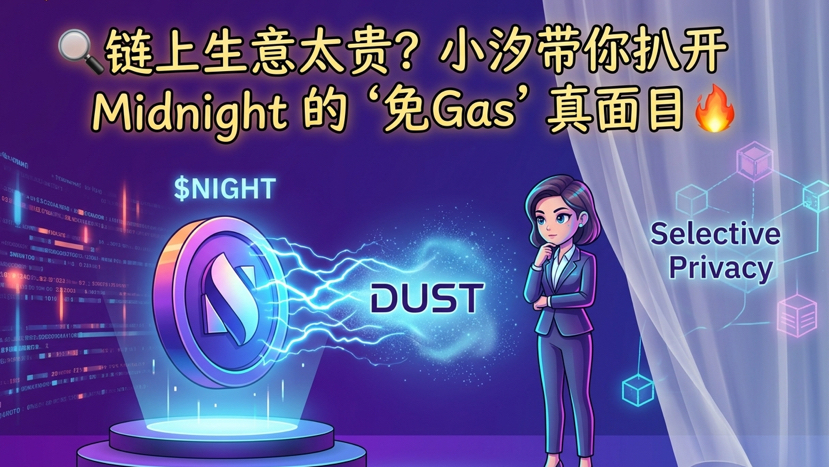
Family, have you noticed? After shouting for so long about 'Web3 changing business', most legitimate businesses in reality are still lingering off-chain.
Why? From Xiao Xi's perspective, technological imagination often falls short against the stark reality. Think about it, a traditional enterprise holds client privacy, business secrets, and supply chain prices in their hands; who would easily expose all of this on a public chain? Once it’s on-chain, it’s permanently public. Plus, with the rollercoaster-like Gas fees, when the market is good, the cost of transactions skyrockets. How can a budgeting director survive that? For developers, this is called 'unpredictable product disaster'; for the boss, it’s called 'putting the business on fire'.
The on-chain world is becoming increasingly mature, and everyone has finally realized a truth: 'verifiable' is quite impressive, but if it’s 'not practical', it can only be a castle in the air.
🤫 $NIGHT is responsible for value, and DUST is responsible for work: this is not just 'free'
That's why @MidnightNetwork is worth our careful consideration today. It's not just speculating on the old theme of 'privacy'; it's solving a more complex equation: how to ensure a chain can simultaneously address privacy, security, predictable costs, and truly be implemented.
In Midnight's design, they've played with a 'dual-token structure':
1. NIGHT: Carries the core value of the network (you can understand it as production).
2. DUST: Specifically designed to bear the consumption of network resources (used for work).
This kind of splitting directly changes the way we pay costs. When users initiate a transaction, they no longer have to directly pull out $NIGHT each time (eliminating the painful feeling of traditional gas fees), but instead cover more through DUST.
On the surface, this can easily be marketed as 'free transactions', which indeed sounds eye-catching. 👀 But Xiaoxi needs to remind everyone that when it comes to economic analysis, you'll find this is actually a clever 'cost reorganization'.
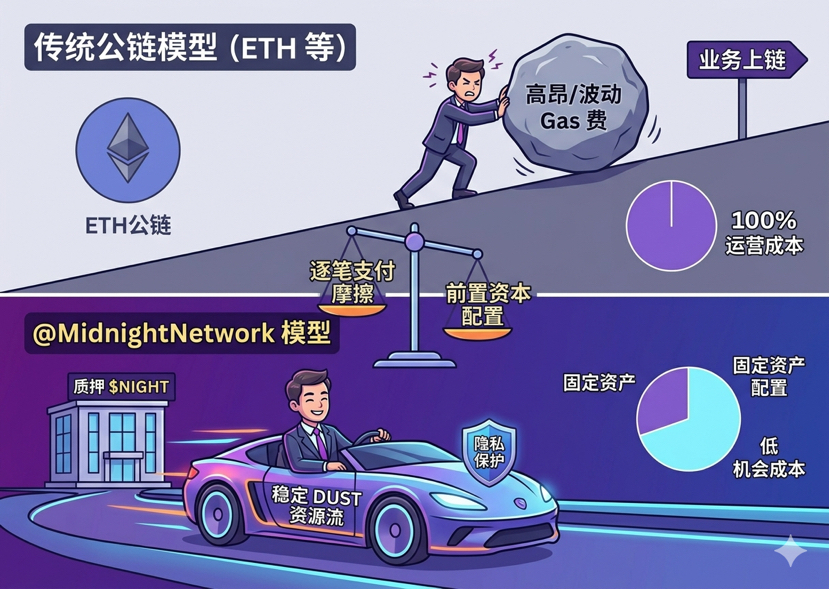
🔥 The truth about 'free gas': from 'pay-per-use' to 'asset allocation'
More accurately, Midnight has transformed the marginal cost that was originally settled per transaction (you have to pay for each action) into a requirement for the scale of asset holding (you need to have goods in hand), as well as the opportunity cost that arises from it (the money is tied up there).
Do you want to continuously obtain DUST to do work? Alright, then you need to hold enough NIGHT. The larger your NIGHT holdings, the higher the rate of DUST generation, and the higher the usage frequency it can support.
You see, the experience has changed: transactions are no longer an additional gas fee every time you perform an operation, but rather it feels like you have configured a 'perpetual motion machine' (production capacity) in advance, and are continuously extracting resources.
It feels like you've purchased a device with a built-in generator in advance. Later, when using electricity, it feels effortless, but the cost of the device is not a small amount; the capital occupation is substantial. The so-called free experience is closer to eliminating the painful friction of 'paying per transaction'; the cost itself hasn't disappeared, it's just changed its position and form.
 🤝 Who benefits the most? Who has to wait?
This change means completely different things to different people.
• Most benefited: High-frequency users, DApp operators, long-term institutions in the ecosystem. They need stable, continuous, and predictable resources. By frontloading costs, it makes budget management easier, and the product experience can be more aligned with Web2 (after all, users don't like having to pay every time they click).
• Average: Occasional users, small trial users. If I only want to transfer money occasionally, it’s clearly not cost-effective to configure a large amount of $NIGHT just to exchange for a little DUST, like buying a dairy farm just to drink a cup of milk tea. 🐮
Therefore, the capabilities mentioned in the white paper, such as payment on behalf, capacity markets, and multi-chain payments, are crucial. Only when these are implemented can the 'preloaded holding pressure' be released from ordinary users, allowing them to truly enjoy low friction.
🛡️ Business considerations of privacy and security
Besides resource design, Midnight’s approach to privacy is very commercially minded. It’s not just emphasizing anonymous narratives (often just a concept), but focusing on protecting sensitive information during commercial processes.
The premise of bringing the business world on-chain is: settlement is trustworthy, processes are controllable, and key information (behavior paths, transaction conditions, identity associations) is not naked running. This privacy capability based on business value is far more attractive to developers and institutions than a mere 'privacy' concept.
Interestingly, the positioning of DUST: it does not bear transaction attributes and is not a storage tool. The market speculation space has shrunk, and the understanding cost of regulation usually decreases as well. At the same time, the dynamic fee mechanism can suppress spam (junk transactions) at the network level. Any open network must face the problem of abuse, and DUST allows the network to maintain a friendly experience while enabling detailed regulation.
💡 Don't just look at the labels
So, when looking at Midnight, don’t just focus on the imaginative space brought by the two words 'privacy', and don’t just look at the easily spreadable label of 'free transactions'.
More importantly, it attempts to integrate privacy protection, resource allocation, security defense, compliance pressure, and user experience into the same design framework with a complete network structure. If it's only understood as a privacy chain, it underestimates the changes in its economic model; if it's only understood as a new packaging of free gas, it will overlook the main line of capital occupation.
Putting these layers together brings us closer to its true commercial value. Do you think this model of 'assetized gas' can succeed?
#night #NİGHT